

Empty multifamily properties, more specifically, empty apartment buildings, can be costly for property managers and owners. The ultimate goal is to increase occupancy and improve cash flow–but to achieve this, you’ll need a steady stream of high-quality leads.
Fair warning: Not all leads will convert into tenants. Some warm leads may never return your call and will continually ignore your requests to schedule a time to visit the property. That means your success isn’t directly proportional to the number of times you follow up via email or phone. (If only it were that simple.)
That’s why having a diversified lead generation strategy—one that captures leads from various sources—is essential. In this guide, we’ll explore some of the best rental lead generation strategies and, most importantly, how to convert those leads into long-term tenants.
Lead Generation Methods Comparison
Going into this process, understand that while one strategy for rental lead generation may help you generate a large volume of leads, others will fall flat, attracting very few high-quality leads. This is simply the nature of the game, so don’t lose hope.
Ultimately, the strategies that produce lackluster results aren’t a waste of time; they bring you one step closer to what does work.
Here are some methods to test when fleshing out your lead generation strategy.
| Method | Impact | Cost | Description | Pros | Cons |
| Chatbots | High | Low | Automated communication for questions and tours. | Saves time, available 24/7. | Cannot fully replace human touch. |
| Self-Guided or Virtual Tours | High | Medium | Prospects explore the property independently. | Increases accessibility and saves time. | Lacks personal interaction. |
| Social Media Marketing | Medium | Low | Promote units on platforms like Facebook, and Instagram. | Free, reaches a large audience. | Requires consistent content. |
| SEO and Website Optimization | High | Medium | Improve rankings with keywords and quality content. | Increases visibility. | Takes time to see results. |
| Paid Search Ads (PPC) | High | High | Use targeted ads on Google and social media. | Quick, highly targeted. | Can be expensive, needs management. |
| Partnering with Local Businesses | Medium | Low | Collaborate with local businesses for cross-promotion. | Builds relationships, attracts relevant leads. | Takes time and effort to establish partnerships. |
| Community Events and Open Houses | Medium | Medium | Host events to connect with potential tenants. | Builds personal connections. | Time-consuming, slow results. |
Rental Lead Generation Strategies
When building your rental lead funnel, you want to use a combination of online and in-person sources. Not all prospective tenants are on social media, and an even lower number attend your local community events.
So, where to start? Here are some best practices for generating rental leads and developing a plan that works for your rental property.
#1: Social Media Marketing
- Leverage User-Generated Content (UGC), including videos from current renters positively speaking about their experience as tenants.
- Post Facebook and Instagram stories and live features for prospective tenants who may miss your posts
- Use geo-targeting to run ads for those in your local area
- Collaborate with local influencers
Social media marketing is an ever-changing game, but it’s one that all property managers must play when it comes to apartment lead generation. It’s estimated that 80% of prospective tenants use social media in their decision-making process.
As a property manager, it’s important that your social media team leverages user-generated content from current residents as often as possible (i.e., renter reviews, testimonials, photos renters took at community events, etc.), whether that social media team is comprised of one solid specialist or an entire third-party agency.
Potential tenants resonate with UGC content. Current renters who have had a positive experience may be willing to do a video testimony or interview that can be shared on social media. The authenticity of this content helps to sell your rental properties in a different light (in a way that a traditional unit tour or brochure just can’t).
Another strategy is to use live features and stories. Stay current and up to date with current events around the apartment community. But fair warning: one post a month won’t help improve your presence on social media platforms. You’ll only see results if you’re consistently posting (once per day, preferably, but a few times a week at the very least) across all popular social media platforms.
Pro tip: To generate the most qualified leads from social media, use geo-targeting and collaborate with local influencers, friendly faces that your audience will recognize.
#2: SEO and Website Optimization
- Ensure your website is fully responsive on mobile and aesthetically pleasing, too
- More than 50% of web traffic comes from mobile.
- Create specific and relevant localized content to attract an audience with the highest potential of becoming tenants.
- Keep the website stocked with fresh content, calendars, and announcements regarding incentives.
- Update and edit the website often to help increase your site’s authority.
As you might expect, competing from an SEO perspective with all apartment buildings in a 10-mile radius is much harder than competing in a 5-mile radius. The more narrow your focus (and the smaller your audience), the easier it will be to get your message across to the right people. When done right, adding hyperlocal content to your website will also improve your SEO ranking.
For example, for an apartment building in Savannah, Georgia, you’ll want to add content related to specific neighborhoods like Ardsley Park or Midtown.
#3: Paid Search Ads (PPC)
- Set up conversion tracking using programs like PERQ or Remarkably to measure the effectiveness of your ads
- A/B test ad copy to see which has the highest conversions
- Pay close attention to negative keywords, and don’t pay to show ads to the wrong target audience. (For example, if you don’t accept Section 8, set Section 8 as a negative keyword)
Paid search ads can be a good solution for more apartment leads. These ads will be shown to prospective tenants as they use search engines or scroll through content.
Hiring a PPC expert is a great way for time-constrained property management teams to enhance online visibility without spending too much additional time or resources per month. On average, PPC experts set rates between $100 and $150/hour.
Whether you outsource to a contractor or keep PPC in-house, test your ad copy and track it, so you know what works and what doesn’t. Look at key metrics such as click-through rate (CTR), cost per lead (CPL), and conversion rate.
#4: Self-Guided or Virtual Tours
- Incorporate virtual tours on your website.
- All virtual tours should have 360-degree views of each room AND all common areas; professionals typically charge around $300-$500 to film a virtual tour for a 2000 sq ft unit.
- In-person tours should accommodate a wide range of schedules, with night and weekend availability (not just M-F from 9 to 5)
The majority of potential renters will look at your property’s website before they schedule an in-person tour. Make sure your online tours are easy to use, have quick load times, and provide 360-degree views of all common areas. If you have the budget, interactive floor plans are a great addition to virtual tours.
Generally speaking, if someone books an on-property tour, they are likely highly interested in the building. But don’t count your eggs before they hatch.
If what this prospective tenant sees in person doesn’t match up with what they saw on the virtual tour, this lead can slip through your fingers. There’s no point in spending hundreds (even thousands) on a professional videographer if you don’t plan to keep your amenities and common areas in the same pristine condition as seen in your online video footage.
#5: Chatbots
- Implement AI-powered chatbots (free or paid) that can handle inquiries and provide personalized responses.
- Offer 24/7 availability
- Integrate the chatbot with the CRM system to track leads
As a property manager looking to find more qualified leads, you can use a chatbot to help when you are not in the office. You can train the bot to answer questions in the same way that you would. You can even train it to organize and store all contact information, as well as lead origin information about a potential renter, in your CRM system.
To maximize time savings, allow the chatbot to schedule tours or appointments and ensure it is linked to your scheduling tool.
#6: Community Engagements and Local Partnerships
- Collaborate with local businesses to offer discounts to your tenants
- Create a community newsletter featuring local news, events, news about changes to amenities and property availability
Getting involved with the local community can benefit existing tenants and help fill vacant apartments. One of the best ways to start is by hosting events.
For example, partner with a local restaurant or food truck and host a pizza or taco night in the community; most vendors will offer your tenants around 10% off the product. Not only will your tenants get to-go dinners and snacks at discounted rates, but you’ll also demonstrate your commitment to your tenants’ quality of life.
To extend your reach and increase attendance, advertise these events in your community newsletters.
#7: Rent On-Site Parking and Storage to Non-Residents
While an unconventional approach, renting on-site amenities to non-residents is a surprisingly effective lead-generation strategy (one that’s used by two of the top five multifamily REITs).
Beyond generating additional revenue, these non-residents represent free leads that can be converted to future tenants. While on-site, a non-resident may be interested in taking a property tour and eventually signing a lease. But this begs one very important question: will someone needing car storage/parking actually choose a multifamily parking lot over a traditional one?
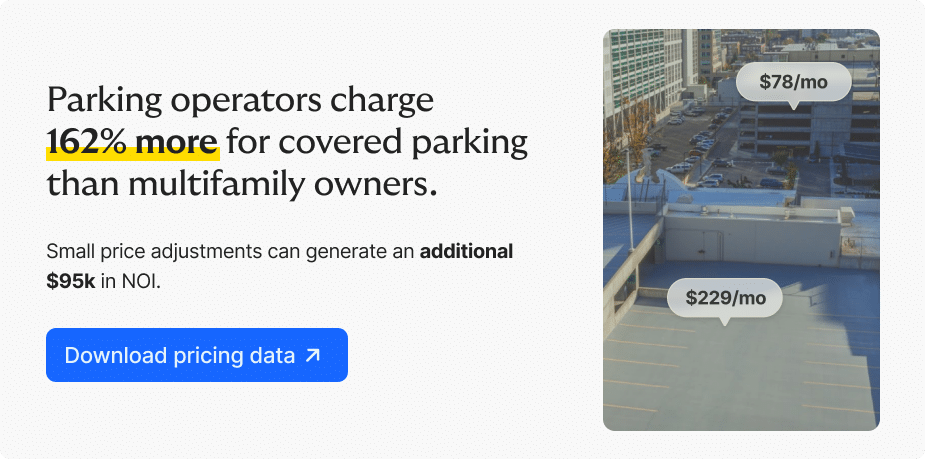
Ultimately, responses will vary from parker to parker. However, there will definitely be cases where a multifamily parking lot is a more attractive option than a typical commercial parking garage—not only because of the amenities offered but also because of the lower price points. What residents (prospective and existing) will see as luxuries, non-residents will see as an affordable alternative, especially when resident parking rates are ~30% cheaper than those of neighboring commercial parking garages.
Assessing Lead Quality for Apartment Rentals
The first part of this process is to generate leads.
The next step is to determine lead quality. As property owners and managers, you’ll need to be able to distinguish between a high-quality lead and a low-quality lead.
We recommend implementing a lead scoring system as part of your CRM. The lead quality of interested prospects will determine the next steps to take with that lead. For instance, a high-quality lead ready to lease should be a priority regarding your follow-up protocol.
Here’s a general look at a basic lead quality ranking system that you should use to manage your leads effectively.
| Score | Type | Description | Actionable Next Steps |
| 9-10 | High-quality lead | Ready to lease. | Schedule a tour, prioritize follow-up, and send lease application. |
| 6-8 | Medium-quality lead | Still considering options – close to making a decision | Follow up with additional information, offer incentives, and schedule tours. |
| 3-5 | Low-quality lead | Still unsure – early in the decision-making process | Add to the email list for future follow-ups, and consider less aggressive follow-ups. |
| 1-2 | Not ready to rent | Hasnn’t expressed any clear interest. | Do not prioritize, keep it in the database for later outreach if they engage again. |
Final Thoughts
If you are working on enhancing online visibility, building a referral program, and improving social media marketing, it can take some time to fill vacancies. During that time, you can recover lost income by renting vacant units as storage space on Neighbor.com. Neighbor.com can also help you fill vacant parking spaces with non-resident renters. Whether you are in the middle of a lease-up period before your building stabilizes or have just gone through fluctuations in the market, Neighbor can help.