


Can you earn rental income without an entire property (or, at the very least, a spare room)? The short answer? Yes! The best part? You don’t have to welcome a stranger into your home to generate additional rental income.
There are plenty of other ways to turn your own home into a passive rental income generator without renting out a room or owning rental property and renting out living space.
Here are some creative and practical ideas to help you rent part of your home (and rack in some extra monthly income.
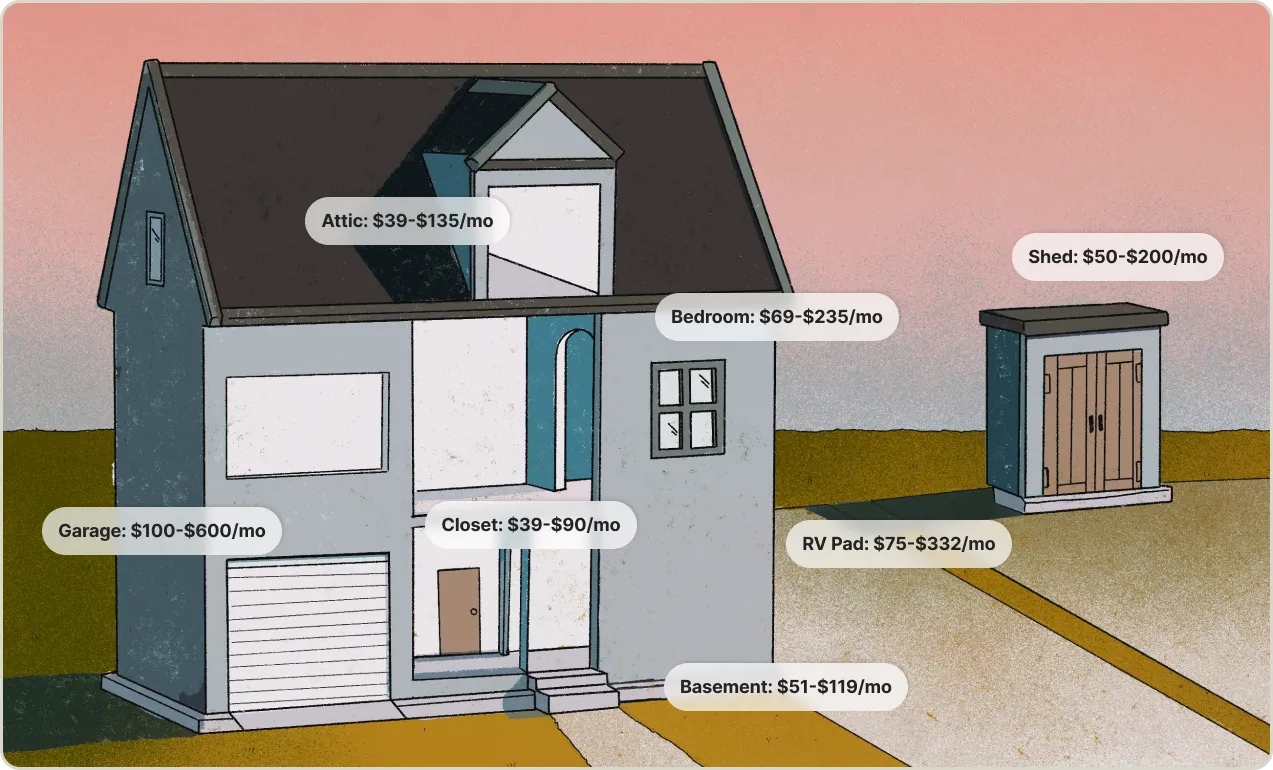
Here are some common spaces homeowners rent out (along with the average earnings per month)
| Space Type | Average Monthly Earnings |
| Attic | $39-$135/month |
| Bedroom | $69-$235/month |
| Closet | $39-$90/month |
| Basement | $51-$119/month |
| Garage | $100-$600/month |
| Driveway | $50-$150/month |
| RV pad | $75-$332/month |
| Shed | $50-$200/month |
Ready to list your space? Become a Neighbor host.
Why Should You Rent Out Part of Your Home?
For most homeowners, home ownership is a liability. It only costs money but rarely (if ever) generates it.
Sure, your property appreciates over time. Sure, you’re earning equity, but month over month, it’s costing you.
Leveraging the space in your home to earn extra money is one way to turn your liability into a revenue-generating asset.
But what’s the key to unlocking this untapped income stream? Consider offering up some of your unused space.
Here’s why I think just about every owner should rent out part of their home:
Reason #1: It Generates Passive Income
Turning unused spaces into rental opportunities can provide a steady stream of passive income to the property owner. This extra money can help cover mortgage payments or home improvements. (It will even help you save money for future investments).
Reason #2: Maximize Your Property’s Potential
Many homes have untapped potential, like an empty garage, unused basement, or extra driveway space. Renting these areas allows you to make the most of your property without significant renovations or lifestyle changes.
Reason #3: Avoid the Hassle of Traditional Roommates
Unlike renting a spare room, leasing spaces like your garage or driveway allows you to maintain your privacy while still earning rental income.
You can enjoy the benefits without sharing your living quarters or being subject to a landlord-tenant law.
Reason #4: Low-Cost Entry into the Real Estate Sector
You don’t need to purchase a separate investment property or rent out an entire house to earn rental income. Renting parts of your home is a cost-effective way to dip your toes into the real estate market and learn the ropes of being a landlord.
Reason #5: You Support Local Communities and Small Businesses
Renting out your kitchen to food entrepreneurs, your shed as a workspace, or your yard for gardening can help others pursue their goals while you benefit financially.
Reason #6: You Have Ultimate Flexibility and Control
You decide the rental terms, including the price, duration, and usage. This control lets you tailor agreements to fit your lifestyle and comfort level.
10 Common Methods for Renting Parts of Your Home
Method # 1 Rent Out Your Yard
Effort: High
Expense: Medium
Profitability: High
A sizable yard can be leased as an event space or, more unconventionally, an RV parking facility. If you own an acre of land, you can store up to 50-70 RVs, translating to hundreds of thousands of dollars in annual earnings (depending on your location). For tips on starting an RV storage business, check out this guide.
Revenue varies widely but can reach $20,000 to $100,000+ per year for RV storage or $200 to $2,000 per event for yard rentals.
Homeowners in urban areas might also consider turning their yard into a rental space for urban gardening. Just be warned that maintaining your yard may incur certain expenses.
Method # 2 Rent Out a Section of Your Home for Filming or Events
Effort: High
Expense: Medium
Profitability: High
If your home has unique architecture or a spacious layout, it could serve as a backdrop for photoshoots, commercials, or even micro-events.
This is pretty niche, and earnings can vary widely but can range from $500 to $5,000+ per day, depending on your property and market demand.
Listing your property on platforms like Peerspace or Giggster can attract prospective tenants in creative industries. Note that earnings vary greatly depending on your square footage, amenities, and floor space.
Method #3: Turn Your Garage into a Rental Space
Effort: Low
Expense: Low
Profitability: Medium
For some people, additional garage space is hard to come by.
But if you’ve got the room, you can rent out your garage to people needing car storage or monthly parking. Some vehicle owners prefer private residential parking options–and they’re willing to pay a premium price for them.
Here’s what the average garage space goes for in ten major U.S. cities:
Denver: $111/month.
Los Angeles: $225/month.
Miami: $196/month
New York: $467/month
Phoenix: $162/month
Salt Lake City: $175/month
San Diego: $303/month
San Francisco: $412/month
Seattle: $175/month
Washington, D.C.: $285/month
Platforms like Neighbor make it easy to list your space for rental use. Neighbor will match you with qualified tenants (that you approve), collect rent, and help you oversee background checks, tenant screening, and payment processing.
Method # 4 Lease Your Basement for Storage
Effort: Medium
Expense: Low
Profitability: Medium
Your basement doesn’t need to be finished to generate rental income. People often need storage for seasonal items, furniture, or equipment.
If it’s clean and secure, you can rent it out as a storage unit (even if your basement is unfinished).
Most basement spaces are listed for anywhere between $51-$119/month, depending on where your home is located.
Pro tip: Remember to clearly distinguish rental areas from personal use areas inside your home. If part of the basement is still in use by you, consult a tax professional to determine which portion qualifies as rental use and whether certain rental expenses, like repairs, can be fully deducted during tax season.
Method #5 Turn Your Shed into a Workspace
Effort: Medium
Expense: Medium
Profitability: Medium
A well-maintained shed can become a goldmine. Rent it out as a workshop for hobbyists or storage for tools and equipment.
Expect to earn $100 to $500 per month, depending on size, utilities, and local demand.
For example, someone starting a small business might need a place to store and organize inventory. This type of rental business can bring in steady extra income, especially if you provide secure locks and utilities.
Method #6 Use Your Kitchen as a Rental Space
Effort: High
Expense: High
Profitability: Medium
Food entrepreneurs, like bakers and caterers, often need certified kitchens to prepare meals for sale. If your kitchen meets health code standards, it could become a lucrative rental space for culinary professionals.
Certified kitchens can generate $20 to $50 per hour, translating to $1,000 to $4,000+ per month if rented regularly
Establish clear terms in your rental agreement, such as usage hours and cleaning responsibilities. Track expenses like utilities, cleaning supplies, and repairs to get a larger deduction.
Method #7 Rent Out Your Driveway
Effort: Low
Expense: Low
Profitability: Low
If you don’t have free space in your garage, you can always rent out your driveway.
On average, you can rent out a driveway space for $50-$150/month.
If you live near a busy downtown area, sports venue, or college, your extra space can become prime parking real estate. If your driveway is big enough, you may even be able to store someone’s RV.
Because many people are willing to pay a premium for secure and convenient parking, you can also charge more during special events.
Method #8 Renting Out Floor Space for Indoor Storage
Effort: Low
Expense: Low
Profitability: Low
Not all renters need entire rooms. Sometimes, they just need floor space–or a closet space–to store boxes or equipment. If you have unused corners or closets, these areas can provide a cost-effective storage solution.
Renting out small spaces can bring in $20 to $200 per month, depending on the size and location.
Platforms like Neighbor allow you to rent sections of your home as self-storage space, making it easy to generate extra income without much hassle.
Method # 9 Rent Your Laundry Room to College Students
Effort: Medium
Expense: Medium
Profitability: Low
If you live near a campus, consider renting your laundry room to college students without convenient access to washers and dryers. This is a niche opportunity that could provide consistent rental income while helping students save time.
This niche opportunity can bring in $50 to $150 per month per tenant.
Remember that your rental and personal use areas should be separated, and reasonable methods should be used to calculate income during tax season. In most cases, it’s worth it to purchase separate laundry machines.
Method # 10 Rent Out Your Roof for Solar Panels or Antennas
Effort: Low
Expense: Low
Profitability: Low
Energy companies and telecom providers may pay you to install solar panels or antennas on your roof. This type of lease provides steady rental income with little effort on your part.
Average revenue can range from $250 to $1,500 per year, depending on location and the lease agreement.
But wait! Before entering into a contract, review it carefully to ensure the terms align with state laws. Otherwise, you may face disputes down the line.
Tax and Legal Considerations
Earning taxable rental income from your home comes with tax and legal considerations. Here are a few things to keep in mind.
#1: Reporting Rental Income
All income earned from renting out parts of your home is taxable income and must be reported to the IRS. This includes payments from storage rentals, driveway leases, or temporary event spaces. Maintain detailed records of all rental agreements, payment receipts, and any other related documents.
#2: Understanding Tax Deductions
One of the perks of generating rental income is that you may qualify for deductions.
Expenses directly related to the rental portion of your property, such as repairs, maintenance, and utilities, can often be deducted. If you’re renting out a portion of your home, you’ll need to calculate the percentage of your home used for rental purposes to claim deductions accurately.
For example, if you rent 25% of your basement, that percentage may be deductible for specific expenses.
#3: Zoning & Regulations
Check local zoning laws and HOA rules to verify that renting is allowed. Some areas prohibit commercial use and control rent prices.
#4: Permits & Licenses
Sometimes, a business license or permit may be required, especially for workspace rentals. Any modifications may need building permits.
#5: Insurance & Liability
Home insurance may not cover tenants; consider landlord or commercial liability insurance. Use waivers for stored items.
#6: Lease Agreements
Have a written contract outlining rent, usage rules, responsibilities, and liability disclaimers. Self-storage requires specific terms.
#7: Tenant Rights & Eviction
Renters may have tenant rights; eviction laws may apply. Ensure legal removal procedures for stored items.
#8: Safety & Building Codes
Comply with fire codes, ventilation, and structural safety, especially for workspace rentals.
Final Thoughts
If you’re ready to turn your own home into a passive rental business, you can start small and grow your rental opportunities over time. Take the first step today. Your home might just become your biggest source of extra income.
One of the things I appreciate about Neighbor is that they cover a lot of the paperwork for you AND help you monetize a variety of spaces in your home (garages, driveways, basements, unpaved lots–to name a few).