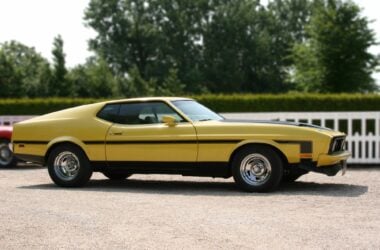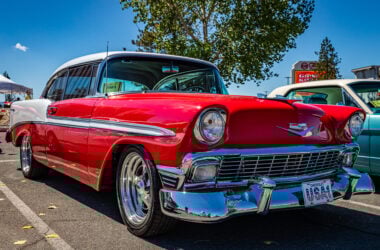


If you’re considering expanding your classic car collection, adding high-speed muscle models should be among your top priorities.
If looking for the fastest muscle car options to buy and restore, always review the performance capabilities and stand-out features. This tried-and-true method will help you spot the muscle cars with the best investment potential.
Note: The muscle cars spotlighted on our best-of list appear in order of fast to fastest.
Brief History of Muscle Cars and Their Evolution
The roots of muscle cars trace back to the post-World War II era when American car enthusiasts sought speed and excitement. However, the introduction of the Pontiac GTO in 1964 ignited the true muscle car movement.
The mid to late 1960s marked the golden era, with iconic models like the Ford Mustang, Chevrolet Camaro, Dodge Charger, and Plymouth Road Runner dominating the scene. This period witnessed fierce competition, known as the “muscle car wars,” as manufacturers engaged in a horsepower race.
By the early 1970s, the muscle car era faced challenges from stricter emission standards, safety regulations, and fuel shortages, leading to a decline in production. In the late 20th century and beyond, American automakers revived classic nameplates. They introduced modern iterations, blending contemporary technology with the timeless appeal of their predecessors.
Muscle cars remain a symbol of American automotive innovation, with modern classics like the Chevrolet Camaro, Ford Mustang, and Dodge Challenger carrying the legacy forward into the 21st century.
Top 7 Fastest Muscle Cars
#7: Pontiac Firebird Trans Am
- Top Speed: Approximately 128 mph
- Year Released: 1969
- Average Market Value: $75,000 – $90,000
The 1969 Pontiac Firebird Trans Am emerged as Pontiac’s response to the high-performance demands of the late 1960s. The Trans Am aimed to dominate the streets and bore the name of the SCCA Trans American Championship, solidifying its racing pedigree.
Under the hood, the 1969 Trans Am boasted a robust 400 cubic-inch Ram Air III V8 engine, delivering approximately 335 horsepower and 430 lb-ft of torque. Its aggressive styling featured a distinctive hood scoop, rear spoiler, and iconic Trans Am graphics.
The Trans Am achieves a 0 to 60 mph acceleration in around 6.5 seconds and covers the quarter-mile in approximately 14.9 seconds.

#6: Chevrolet Nova SS
- Top Speed: Approximately 130 mph
- Year Released: 1969
- Average Market Value: $35,000 – $50,000
The 1969 Chevrolet Nova SS embodies the spirit of the compact muscle car era, offering a blend of performance and agility. The Nova SS received a stylish facelift for the 1969 model year, featuring a distinctive front grille and prominent SS badging.
The Nova SS was available with various engine options, with the 396 cubic-inch V8 standing out as a powerhouse. This robust engine contributed to the Nova SS’s reputation for delivering exhilarating performance on the streets, appealing to drivers seeking a thrilling and agile driving experience.
Accelerating from 0 to 60 mph in approximately 6.5 seconds and covering the quarter-mile in around 14.5 seconds, the 1969 Nova SS showcased impressive performance metrics that added to its allure.

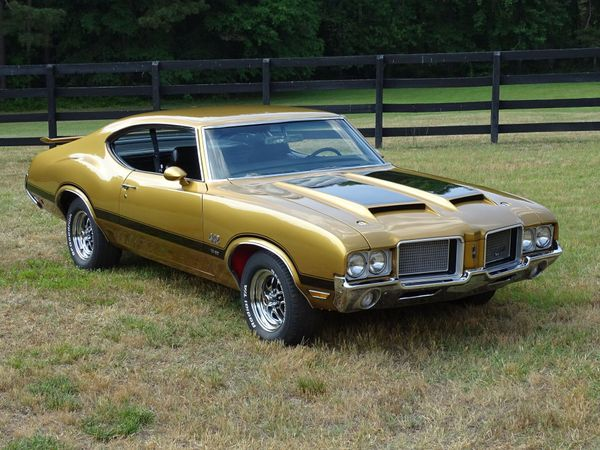
#5: 1970 Oldsmobile 442 W-30
- Top Speed: Approximately 135 mph
- Year Released: 1970
- Average Market Value: $70,000 – $90,000
The 1970 Oldsmobile 442 W-30 represents Oldsmobile’s commitment to high-performance vehicles. In 1970, Oldsmobile infused the 442 W-30 with distinctive elements, including a functional fiberglass hood with air scoops, W-30 decals, and specialized suspension components.
The heart of the 442 W-30 lay in its 455 cubic-inch V8 engine, enhanced by the W-30 package components. These included a special camshaft, an aluminum intake manifold, and a forced-air induction system. Also, it achieves an acceleration from 0 to 60 mph in approximately 5.5 seconds and a quarter-mile time of around 13.8 seconds.
#4: 1968 Dodge Charger R/T
- Top Speed: Approximately 140 mph
- Year Released: 1968
- Average Market Value: $90,000 – $120,000
The 1968 Dodge Charger R/T stands out among American muscle cars, capturing the essence of power and style from the late 1960s. The 1968 Charger R/T showcased a distinctive fastback design, recessed front grille, and concealed headlamps.
Under the hood, the Charger R/T housed a powerful engine with a displacement of 425.6 cui. It boasted an impressive 425 hp and a torque of 490 lb-ft, making it a powerful vintage vehicle. This car accelerates 0 to 60 mph in around 6.5 seconds and covers the quarter-mile in approximately 14.5 seconds.
The available transmission options include the A833 4-speed Manual Transmission and TorqueFlite 3-speed Automatic Transmission.

#3: 1969 Plymouth Road Runner Hemi
- Max Speed: Approximately 140 mph
- Year Released: 1969
- Average Market Value: $200,000 – $250,000
The 1969 Plymouth Road Runner Hemi represents a pinnacle in the era of American muscle cars, celebrated for its unbridled power. It emerged in response to the demand for a stripped-down, high-performance muscle car.
Its famous 426 Hemi V8 engine and four-speed manual transmission are the heart of its performance, making it one of the most powerful street-legal vehicles of the time. Also, the engine produces about 425 horsepower. The Road Runner Hemi’s acceleration from 0 to 60 mph in approximately 5.3 seconds and a quarter-mile time of around 13.6 seconds attest to its drag-strip dominance.

#2: 1969 Chevrolet Camaro ZL1
- Max Speed: Approximately 140 mph
- Year Released: 1969
- Average Market Value: $1 million – $1.5 million
Designed by drag racer Dick Harrell, the Camaro ZL1 was a rare and powerful muscle car that stood out on the drag strip. It’s one of the most sought-after and iconic muscle cars of its time. Conceived with a primary focus on drag racing, the ZL1 was developed to meet homologation requirements.
Its exclusive feature, the all-aluminum 427 cubic-inch V8 engine, set it apart and laid the foundation for its legendary status. Factory-rated at around 430 horsepower and 450 lb-ft of torque, the ZL1 was not merely a street machine but a track dominator.
The ZL1 achieves 0 to 60 mph acceleration in around 5.2 seconds and covers the quarter-mile in approximately 13.2 seconds. It features a variety of transmission options, including a close-ratio four-speed manual transmission.

#1: 1969 Shelby Cobra
- Top Speed: Approximately 153 mph
- Year Released: 1963
- Average Market Value: $1.5 million – $2.5 million
The 1963 Shelby Cobra by Carroll Shelby merges American power with British craftsmanship to create an unparalleled sports car. Born out of a collaboration between Shelby American and AC Cars, this roadster boasts a legendary racing pedigree and an enduring legacy as an automotive icon.
Powered by various engine options, the 1963 Cobra often featured the formidable 289 cubic-inch Ford V8. Its lightweight body and well-tuned suspension created an exceptional power-to-weight ratio. This lightweight powerhouse was equipped with a Ford V8 427 FE engine, allowing it to accelerate from 0-60 mph in a mere 4.0 seconds.
Designed for speed, the Cobra sported a hood scoop for better airflow, a side exhaust for efficient gas expulsion, and a four-speed manual gearbox. These features and its design made it a force to be reckoned with during the classic muscle car era.

Summary
Whether you are planning on purchasing the fastest classic muscle car to restore it or collect it in its original condition, you should always store classics in a secure and enclosed storage space. Proper storage reduces the risk of temperature and moisture-related damage, preserving the overall value of the muscle car.
If you don’t plan to use your classic muscle car as your daily driver and lack space in your garage, consider renting a 10’x20’ or 10’x30’ storage unit or a climate-controlled storage unit. One of these options will keep your vehicle away from rain and humidity, which can easily cause rust in the heater channel or floor pan.
Be sure to check out Neighbor, the world’s largest classic car storage marketplace, to find safe, nearby, and budget-friendly indoor and climate-controlled storage spaces for your classic car.