

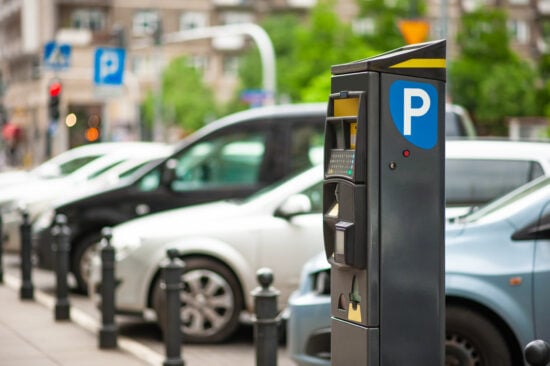
The U.S. parking market generates over $120 billion annually. The more space you have, the easier it is to increase revenue.
To secure a piece of this $120-billion-dollar pie, your next step is to purchase land or prepare your existing property (or properties) for your thriving parking business. (FYI: This part of the process may or may not involve the installation of gravel or asphalt).
Once you have a lot to work with–be it a paved or unpaved lot—it’s time to determine how many parking spaces per acre you can accommodate.
This calculation will depend on the following factors: the size of the vehicles you plan to store (sedans, SUVs, box trucks, trailers, boats, RVs, etc.) and the amount of land you have to work with.
Thankfully, with the help of our parking rule dimensions/guide and our free parking Blueprint tool, you can explore different layouts and maximize the profitability of the land you have to work with.
The Basics of Parking Space Dimensions
Before calculating how many cars, RVs, or trucks can fit in a one-acre lot, you need to know the dimensions of different parking spots. In North America, a standard space is between 8.5 to 9 feet in width and 18 feet in length.
These dimensions accommodate most passenger vehicles comfortably, allowing enough room for car doors to open and passengers to enter and exit safely.
Here is a general guideline of the traditional parking space dimensions:
- Standard Parking Space: 8.5–9 ft wide by 18 ft long
- Parallel Parking Space: 8.5–9 ft wide by 22 ft long
- Pull-Through RV Space: 12 ft wide by 40 ft long
- Angled RV Space: 10 ft wide by 30 ft long
- Box Truck Space: 12 ft wide by 30 ft long
- Tractor-Trailer Space: 12 ft wide by 70 ft long
- Flatbed Truck Space: 12 ft wide by 55 ft long

Neighbor’s Free Parking Blueprint Tool
There’s no reason to settle for a rough estimate of the # of parking spaces that can fit on your acre(s) of land when there are tools that can offer a precise calculation.
For insight into the exact # of parking spaces that can fit on your specific piece of land, check out Neighbor.com’s Blueprint tool. After entering your address, the Blueprint tool will pull aerial Google Maps footage of your property. From there, you can drag and drop to-scale vehicle icons (cars, boats, RVs, etc.) onto a visualization of your property and test out different parking configurations.
Note: As the Neighbor Blueprint tool will show, the vehicle type, vehicle length, and parking angle will all influence how many parking spaces can fit on an acre of your land.
How Many Parking Spaces Per Acre
Once you know how large the average parking space is, you can estimate how many cars (or other vehicles) will fit within a one-acre lot. Because the answer to how many parking spaces can fit in an acre will vary depending on the type of vehicle being parked, we’ve provided three different answers to your questions: one calculation for traditional parking spaces, one for RV storage spaces, and another for semi-truck parking.
Traditional Parking Spaces Per Acre
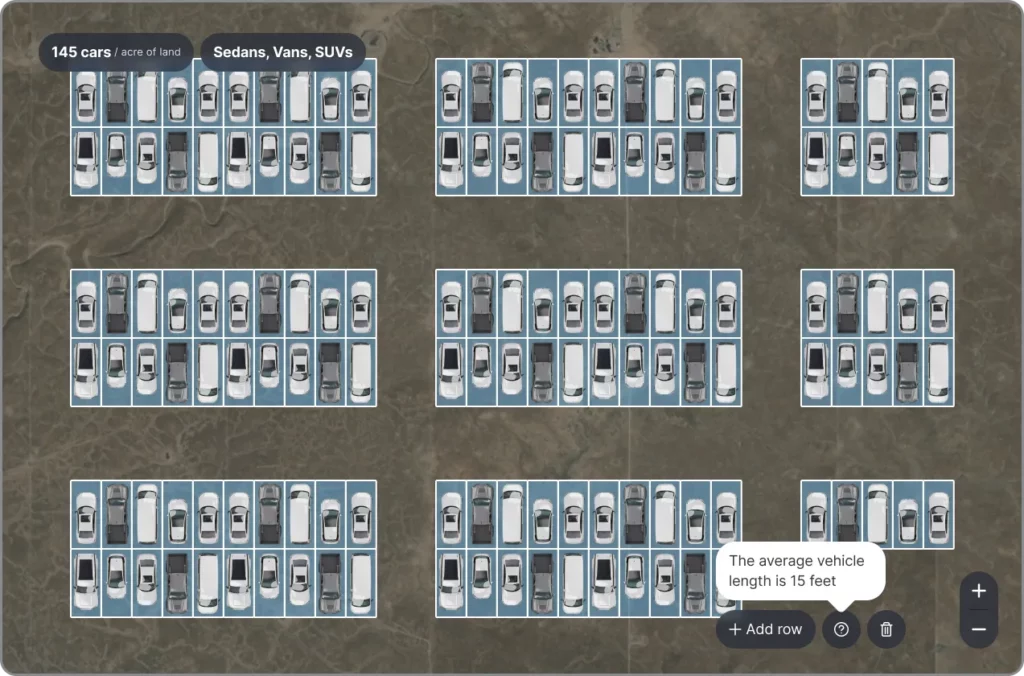
A standard acre (43,560 square feet) can accommodate 144 traditional parking spaces per acre (roughly). However, that’s in a best-case scenario and may not always be practical. As you plan out your parking lot, always account for the space required for aisles, driveways, and any landscaping. And remember: you don’t want to sacrifice maneuverability just for the sake of squeezing an extra couple of parking spaces. Do this, and you may jeopardize your renters’ overall satisfaction.
If you want your renters to be able to access and exit the space with ease, you’ll need to map out the necessary aisleways. Generally, aisle width is typically 24 feet.
Here’s how the configuration of your parking lot will impact the # of usable parking spaces:
- Optimized Layout (No Aisles or Landscaping): Up to 144 spaces per acre.
- Practical Layout (Including Aisles and Landscaping): Typically 100–115 spaces per acre.
- Accessibility-Compliant Layout: Adjustments for ADA-compliant spaces and wider spaces typically reduce capacity to 90–105 spaces per acre.
RV Storage Spaces Per Acre
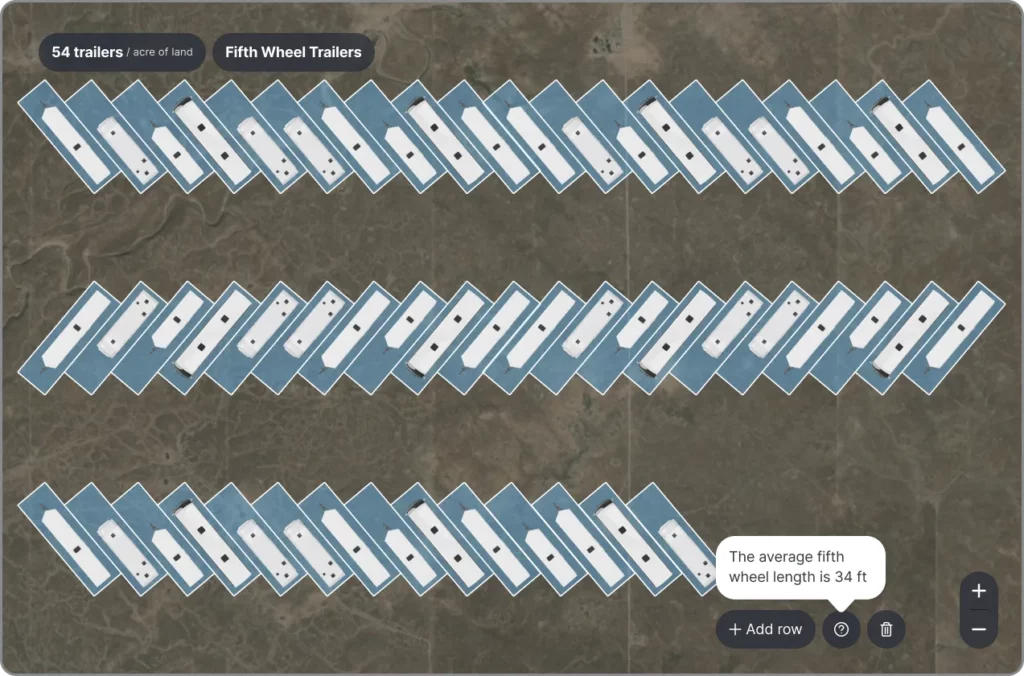
RV storage requires more space for both parking and maneuvering. Pull-through RV parking reduces the number of parking spaces available to rent.
| RV Type | Space Dimensions | Spaces Per Acre |
| Pull-Through RV Spot | 12×40 feet | ~36 |
| Angled RV Spot | 10×30 feet | ~48 |
| Compact RV Spot | 10×20 feet | ~60 |
Boat Parking Spaces Per Acre
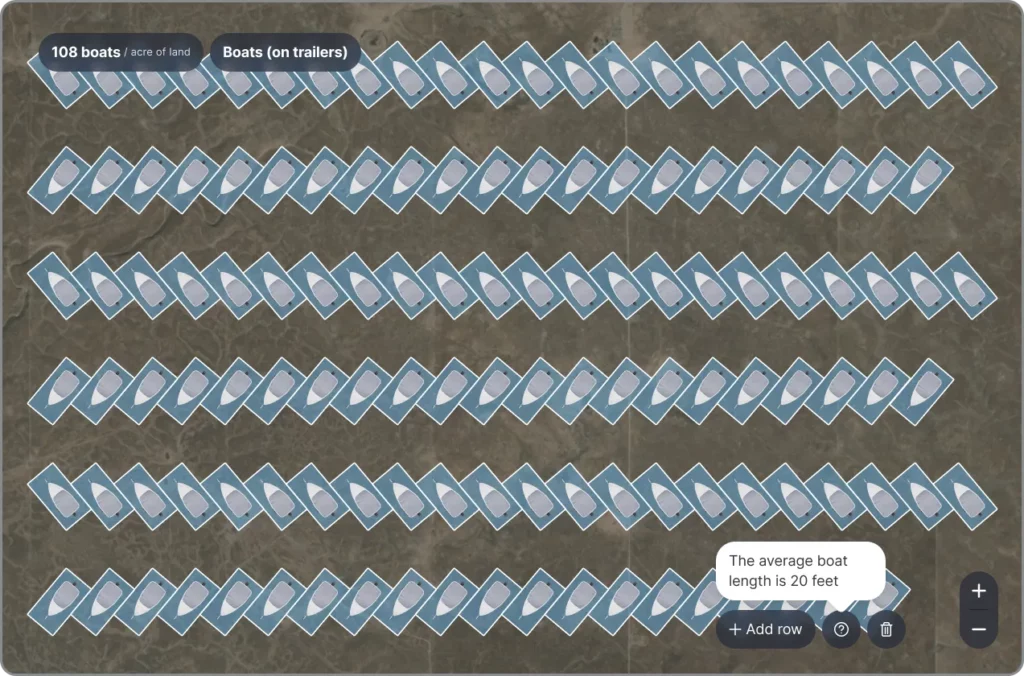
Assuming that the average boat is 20 feet long, you’ll be able to fit an average of 108 boats per acre of land.
Note that most types of facilities will require that boats be stored on trailers (unless it’s dry-stack storage). Therefore, you’ll need to account for more than just the length/width/height of the boat itself, but the length/width/height of the trailer, as well.
But how tall is a boat on a trailer, generally speaking?
Check out the chart below, as these heights will vary according to boat type:
| Boat Type | Average Height on Trailer |
| Bass Boat | 6 to 7 feet |
| Pontoon Boat | 8 to 10 feet |
| Ski/Wakeboard Boat | 6 to 8 feet |
| Center Console | 7 to 9 feet |
| Jon Boat | 3 to 5 feet |
| Sailboat (small) | 6 to 8 feet |
| Cabin Cruiser | 9 to 12 feet |
| Bowrider | 5 to 8 feet |
| Yacht | 10 to 15 feet |
| Inflatable Boat | 4 to 6 feet |
Semi-Truck Parking Spaces Per Acre
Parking for commercial vehicles requires significantly more space because of the maneuvering room required. The most important things to consider here are the type of truck and the designated use of the lot.
Will you grant your renters daily access, or would you prefer to market to an audience that requires long-term truck storage? If the former, maneuverability and strategically plotted aisleways are of much greater importance.
Here’s a breakdown of the spaces per acre you’ll be able to fit, depending on the type of truck. The most common types of trucks include box trucks, tractor-trailers, and flatbeds.
| Vehicle Type | Space Dimensions | Spaces Per Acre |
| Box Truck | 12×30 feet | ~48 |
| Tractor-Trailer | 12×70 feet | ~15–18 |
| Flatbed Truck | 12×55 feet | ~22–24 |
Factors Influencing Parking Capacity
Using our free blueprint tool will help you quickly determine how many parked cars or trucks you can fit on your one-acre lot. There are a few things to remember as you build your parking area and manage parking requirements set by local cities and governments.

Landscaping and Driveways
Landscaping and driveways are important, but they will reduce parking capacity and can lead to increased parking lot maintenance. Note that some zoning laws may dictate that parking lot owners allocate a portion of every lot to landscaping, which, in turn, will limit usable space.
Here’s a good rule for determining the amount of space a driveway will take up. If the driveway can accommodate two-way traffic, allocate approximately 24 feet for two-way traffic. For one-way traffic, 12 feet should suffice.
While these driveways can limit usable space, they play a key role in stormwater management. Utilizing permeable materials, such as porous asphalt, pervious concrete, or permeable interlocking concrete pavement (PICP), allows stormwater to infiltrate the surface, reducing runoff and helping to prevent flooding.
Accessibility Requirements
Compliance with accessibility laws, such as the Americans with Disabilities Act (ADA), is non-negotiable.
Accessible spaces require a minimum width of 8 feet plus a 5-foot access aisle, often reducing capacity compared to standard parking spaces. These spaces must also be located close to building entrances and must be planned into the layouts.
If you take one thing away from this article, let it be this: always consult local building codes, regulations, and zoning requirements when configuring a parking lot.
Parking Ratio Formula
If you’re determining the number of parking spaces you can fit in an acre, it’s also important to ensure parking lots comply with local zoning requirements and adequately serve the size and use of your building.
To measure whether the number of available parking spaces will serve your target demographic, calculate the parking ratio, aka the number of spaces per 1,000 square feet of property. To do so, divide the total parking spaces by the building’s square footage, then multiply the result by 1,000.
Local zoning codes typically dictate required ratios according to the type of property. For retail, four spaces per 1,000 sq ft is recommended. For office buildings, two to three spaces per 1,000 sq ft will suffice.
To remain in compliance, always check your area’s specific regulations.
Choosing a Parking Layout
The layout of your parking facility will be one of the key determinants of the # of cars per acre you can comfortably fit. Ultimately, your goal as the lot planner should be to balance functionality and compliance with local real estate and zoning laws.
Angle parking is often favored for its ease of use and efficient flow.
To help you decide on the optimal parking layout for your property, here’s a breakdown of the pros and cons of the most common parking layouts: angle, perpendicular, and parallel.
| Layout Type | Pros | Cons |
| Angle Parking | Maximizes spaces in smaller areas | Requires one-way traffic flow |
| Easier entry and exit for drivers | Less space-efficient than perpendicular parking | |
| Reduces sharp turns and collision risk | ||
| Perpendicular Parking | Highest space efficiency in most areas | Requires precise maneuvering skills |
| Ideal for accommodating many vehicles | Can be difficult in high-traffic or tight areas | |
| Parallel Parking | Uses space efficiently in narrow or urban settings | Difficult for less experienced drivers |
| Allows better traffic flow in limited spaces | Parking can be more time-consuming and there (generally) fewer spaces per acre |
Summary
Running a successful parking business requires you to do more than meet the required number of parking spots according to local regulations. You must also think strategically and optimize your parking lot to serve the largest # of customers without compromising maneuverability and functionality.
The first step of the optimization process is to take a look at revenue potential and maximize it for your parking area.
Once your parking lot is mapped out, it’s time to fill these spaces with renters needing parking. To expand your marketing reach, list your spaces on Neighbor, a leading parking and storage platform. Become a host here.

