
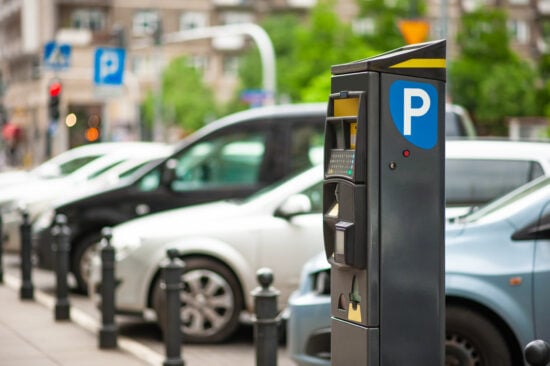
Neighbor.com sampled 20 multifamily properties across the greater Phoenix area (Central Phoenix, Deer Valley, Avondale, Goodyear, West Glendale, Peoria, Sun City, and Surprise.) to gather data on what apartment buildings charge for resident parking.
To set competitive parking rates, it’s advised that Phoenix property owners study the rates set by other apartment complexes in their neighborhood. Unfortunately, this data is not easily accessible.
That was until the 2025 Multifamily Parking Report was published by a team of multifamily parking pricing experts, including Ralph Johnson, the National Parking Association’s ‘40 under 40.’
Fair warning: The results of this research may surprise you.
Findings of Neighbor.com’s Phoenix Parking Research
Between these 20 Phoenix apartment complexes, pricing discrepancies can range up to 300%. Imagine you’re a property owner that’s currently charging $45/month for parking, while a multifamily property a couple of blocks away is charging $180/month. You’re located in the same neighborhood. You both have installed parking lot access control systems and EV charging stations.
So why the vast price difference?
In some cases, these parking spots are priced according to the type of parking structure (indoor, covered, outdoor), the type of space (standard, tandem, compact, EV), and the parking ratio (# of spaces allocated per tenant/unit/bedroom).
Indoor and covered parking may be set at higher rates than outdoor, surface lot parking. Similarly, tandem spaces will be priced higher than standard spaces, given that they can accommodate two sedans/small SUVs rather than a single vehicle.
Beyond these three factors, parking prices may also be adjusted according to the market parking rate, ratio to rent, and whether the spaces are assigned vs. unassigned.
But the most surprising finding of all is that oftentimes, resident parking prices are set arbitrarily rather than strategically. Spread thin and deprived of the data they need to make research-backed pricing decisions, teams of property managers may set parking rates subjectively, basing these rates on personal assessment.
When choosing how much to charge for parking space, it’s recommended that property managers and property owners consider all six factors below:
#1: Type of parking structure
- Surface lot, parking garage, carport, private residential garage, etc.
#2: Parking ratio
- As this wil influence whether there is an active waiting list
#3: Type of parking space
- Standard, tandem, compact, stacked, etc.
#4: Market rate
- The rate set by local parking operators
#5: Ratio to rent
- The cost of resident parking compared to total monthly rent costs
#6: Whether the space is assigned or unassigned
How Much Should I Charge for a Space in an Uncovered Parking Lot?
Types of uncovered parking options: Uncovered surface lots, rooftop spaces in multi-level parking garages, etc.
Of the 20 Phoenix properties contacted, 75% currently offer uncovered parking to residents–but only 13% of that 75% charge residents additional fees to park in those uncovered lots; the remaining 87% offer free, on-site parking as an amenity.
Of the 10 markets included in this research (Phoenix, Denver, Los Angeles, Miami, New York, Salt Lake City, San Diego, San Francisco, and Seattle), Phoenix properties were the most likely to offer free parking to tenants.
Of those properties that charge for uncovered parking, the average parking rate for LA is around $32/month (Note: This ~$32/month is a separate, unbundled fee charged on top of monthly rent fees, utilities, storage, etc.)
| Market Name | Raw Average | Charged Average | % of Properties That Offer Uncovered Parking | % of Properties That Charge for Uncovered Parking |
| Phoenix | $4.33/mo | $32.50/mo | 75% | 13% |
*Definition of “Raw Average”: This average includes properties that offer residents free parking (whether uncovered or covered), as well as those properties that charge residents additional fees for a given type of parking space.
**Definition of “Charged Average”: This average excludes those properties that offer free parking. It only represents those properties that charge residents additional fees to park in their on-site parking facilities.
How Much Should I Charge for a Space in a Covered Parking Lot?
Types of covered parking options: Private carports, enclosed/open-air parking garage spaces, private residential garage spaces, etc.
Of the 20 multifamily properties sampled, 100% currently offer covered parking as a resident amenity. However, only 74% of properties charge residents additional fees to park in those covered spaces; the remaining 26% offer covered parking as a free amenity.
Of those properties that charge for covered parking, the average parking rate for Miami, FL is around $20/month (Note: This ~$20 is a separate, unbundled fee charged on top of monthly rent fees, utilities, storage, etc.)
| Market Name | Raw Average | Charged Average | % of Properties That Offer Covered Parking | % of Properties That Charge for Covered Parking |
| Phoenix | $22.95/mo | $30.93/mo | 100% | 74% |
*Definition of “Raw Average”: This average includes properties that offer residents free parking (whether uncovered or covered), as well as those properties that charge residents additional fees for a given type of parking space.
**Definition of “Charged Average”: This average excludes those properties that offer free parking. It only represents those properties that charge residents additional fees to park in their on-site parking facilities.
Factors to Consider When Setting Parking Prices in Phoenix, AZ
90% of these Phoenix apartment complexes offer multiple parking options to tenants. As discussed earlier, parking spots should always be priced according to coverage level (indoor, covered, outdoor) and parking space type (standard, compact, tandem), among other factors.
However, it’s understood that in some situations, free resident parking is the most advantageous strategy, as it can win favor with cost-conscious prospective renters and maintain the trust of existing residents.
Our data shows that 65% of these Phoenix properties offer at least one form of free parking (most often, these free options are uncovered surface lots).
For those multifamily property owners who want to maximize their monthly parking revenue, however, optimizing resident parking prices is a great first step (one that will have a dramatic impact on NOI).
When adjusting these prices, it’s advised that the following factors be considered: (Otherwise, you may fail to meet the parking needs of your tenants and lose your renters to local parking operators).
Factor #1: Parking Structure Type
Unlike other markets in the 2025 Multifamily Parking Report, Phoenix showed the greatest # of properties that charge more for uncovered parking than covered parking. This is considered unexpected behavior, given the greater weather protection and security of a covered parking spot.
Factor #2: Parking Space Type
Parking space types in Phoenix, AZ, can vary by either size or amenities offered.
Most parking spots in Phoenix fall into one of three categories:
- Compact Spaces: These smaller spaces are typically priced lower due to their reduced square footage.
- Tandem Spaces: Tandem parking spots cost more than a standard parking space but are often cheaper than renting two individual spaces. (For example, one Phoenix multifamily property charges $250/month for a single space and $450/month for a tandem parking spot.)
- EV Charging Spaces: Prices vary based on access. Communal charging stations may be included as an amenity, while assigned EV charging spots are generally priced at a premium.

Prices of EV Charging Spaces
Of the 240 multifamily properties contacted, 42% of properties provide EV charging options for residents, whether free or paid. 30% reported they do not offer any type of on-site EV charging. The remaining properties did not offer any insight into their EV charging facilities (if any existed).
When EV charging is offered as an amenity, the pricing of these EV spaces will vary according to the following factors:
- Whether the stations are communal or private
- Who their contracted EV charging provider was
- Whether or not the apartment complex charges residents for non-EV parking
The data showed that only 38% of the properties that offer EV charging charge residents an additional fee to use the facilities (as seen in the visual below):

Factor #3: Whether the Space is Assigned vs. Unassigned
Assigned parking is a valued amenity amongst Phoenix renters. In high-demand and high-traffic areas, like Downtown Phoenix or Scottsdale, offering assigned, guaranteed parking can help your property stand out.
But how much more should you charge for this premium feature?
After surveying 240 multifamily properties across 10 U.S. markets, the data revealed that the price gap between assigned and unassigned spaces is most significant for uncovered parking.
For uncovered spaces, assigned parking is priced 64% higher on average. However, for covered spaces, the difference in pricing between assigned and unassigned options is much smaller. In fact, in this sample of apartment complexes, the average property charged less for assigned, covered parking than for unassigned parking that is covered. (This trend was observable across all 10 markets).


The parking pricing experts behind the 2025 Multifamily Parking Report see this as further proof that ancillary revenue streams, like resident parking, require optimization. This optimization is not limited to resident parking price optimization.
One low-hanging opportunity is to introduce assigned parking into a parking lot or parking garage. You either transition the entire lot to assigned parking OR offer a variety of both assigned and unassigned parking.
Here’s a quick run-through of the benefits of assigned parking (that will be marketable to residents):
- Less parking-related stress: When your residents arrive home from a long work day, there will be a designated parking space waiting for them.
- Assigned parking makes it easier to monitor for unauthorized parkers: With unassigned parking, your staff will need to monitor for unauthorized parking more closely.
- It’s a selling point that differentiates your parking from other lots/garages: In larger cities, assigned parking is hard to come by. If your multifamily property is near an office complex or downtown area, your multifamily lot/garage with assigned spaces will stand out from other parking options.
Factor #4: Market Rate (Location)
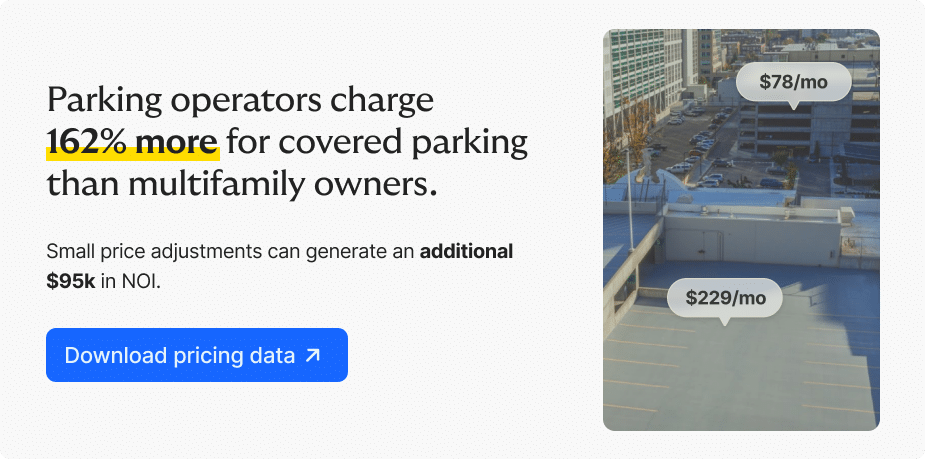
The 2025 Multifamily Parking Intelligence Report shows that local parking operators in cities like Phoenix, AZ, charge ~162% more (on average) for covered parking than multifamily property owners for covered parking. These garages/lots may be identical. They may even be located across the street from one another. Yet these prices are dramatically different. But why?
According to parking experts like Ralph Johnson, the National Parking Association’s “40 under 40, there are very few reasons why multifamily property owners should be charging 70% less for parking than a parking operator in the same neighborhood.
So, how does the market parking rate in Phoenix, AZ, compare to the average multifamily parking rate?
Multifamily Parking Rates vs. Market Rates (Uncovered Parking)
In Phoenix, commercial parking facilities charge (on average) around 33% more for uncovered parking than multifamily properties in the area.
| Market Name | Avg. Multifamily Parking Price | Avg. Market Parking Price | Price Difference ($) | Price Difference (%) |
| Phoenix | $32.50/mo | $86.93/mo | +$54.43/mo | +33% |
Multifamily Rate vs. Market Rate (Covered Parking)
In Phoenix, commercial parking facilities charge (on average) around 196% more for covered parking than multifamily properties in the area.
By setting resident parking prices at 50-70% of the market rate, Phoenix-based multifamily properties can earn up to an additional $178,296/mo in NOI (per year per property).
| Market Name | Avg. Multifamily Parking Price | Avg. Market Parking Price | Price Difference ($) | Price Difference (%) |
| Phoenix | $30.93/mo | $165.39/mo | +$134.46/mo | +435% |
.
Factor #5: Parking Ratio
In Los Angeles, the average parking ratio is 1.9. Meanwhile, the average # of vehicles per household is 1.8. Because the average # of vehicles per household is higher than the average parking ratio in the area, Phoenix multifamily properties have more parking options for residents than other markets and, therefore, are less likely to experience parking shortages.
In such cases, property managers should consider offering discounted parking rates (free parking for the first three months of a lease, 50% off the first month, etc.) Otherwise, they may end up with a surplus of parking vacancies.
When property owners experience high parking vacancies, they can rent out these spaces to non-residents.
Factor #6: Ratio to Rent
One of the biggest parking price missteps that property owners can make is overlooking their residents’ purchasing power.
A single market (like Phoenix, AZ) can represent a bounty of household incomes. While some properties in certain Phoenix neighborhoods will be able to get away with raising their rates to 70% of the market rate. In other neighborhoods, owners will need to err on the more conservative side, keeping parking rates at 30-50% of the market rate.
Overall, it’s recommended that monthly parking rates stay within 8-10% of your resident’s monthly rent costs.


When Are Free Parking Spots the Best Pricing Strategy?
What is branded as “free parking” may not actually be free. Some property owners choose to bundle parking fees into monthly rent costs. However, some properties will offer 100% free parking for the following reasons:
- Free (or included) resident parking can help an apartment complex stand out from others in the area.
- Free (or included) resident parking is often a more valued amenity than on-site pools, rooftop spaces, coworking spaces, etc.
- Free (or included) resident parking
Making Adjustments to Your Resident Parking Prices
When executed thoughtfully and strategically, resident parking price optimizations can have a seismic impact on ancillary revenue. Parking price adjustments are also a great alternative to raising rents.
When implemented recklessly, however, this can result in higher resident turnover and lost leads. Therefore, it’s important to act with caution.
- Test this assigned parking program with new/prospective residents before implementing them property-wide.
- Avoid off-cycle increases. Instead, implement modest price hikes at the time of lease renewal.
- Consider the earning potential of assigned parking: Begin advertising the benefits of reserved parking to existing residents. The goal is to avoid turnover and/or an uptick in resident complaints.
Note: Optimizing parking prices requires hyperlocal data.
For pricing data in the top 10 US markets (including L.A.), as well as cutting-edge parking optimization strategies, download the 2025 Multifamily Parking Intelligence report here.