

Neighbor.com contacted 40 multifamily properties in Washington, D.C.’s top submarkets: Navy Yard/Capitol South, Northeast D.C., Central D.C., Bethesda/Chevy Chase, and Northeast D.C.
The goal? To provide Washington D.C. multifamily investors with the data they need to optimize their resident parking pricing strategies.
Our data shows that 25% of multifamily properties in the Washington area offer more than one type of parking. As a result, these property owners will need to price their parking spots proportionately to their value. For instance, if an apartment complex in Bethesda offers both uncovered surface lot parking and garage parking options, how should these rates vary?
This begs a bigger question: how do your competitors price these parking spaces according to their value?
Warning: these findings may surprise you.
Findings of Neighbor.com’s Washington D.C. Parking Research
Looking at two Washington D.C. apartment complexes located in the same neighborhood, resident parking rates can vary by as much as 300%, even if those properties are sitting on the same block.
When deciding how much to charge for parking space, many property owners look to their competitors for guidance.
But what should you charge for your parking spots if the competitor down the street is charging $50/month while the property next door is charging close to $200/month? Do you take a risk and price on the higher end of the spectrum? Or do you shoot low and set your monthly parking rates below the average to stay competitive?
The answer is nuanced. Parking prices should always be set according to a) market rate, b) parking type, c) parking ratio, and d) whether the space is assigned vs. unassigned–among other factors.
Note that only 5% of Washington D.C. properties in our sample offer at least one form of free parking, which may indicate that free parking isn’t a viable parking strategy in the D.C. area.
Here’s how to optimize your resident parking prices if you own a property in any of the following Washington D.C. submarkets: Navy Yard/Capitol South, Northeast D.C., Central D.C., Bethesda/Chevy Chase, and Northeast D.C..
How Much Should I Charge for a Space in an Uncovered Parking Lot?
Types of uncovered parking options: Uncovered surface lots, rooftop spaces in multi-level parking garages, etc.
According to our sample, multifamily properties in Washington, D.C., are unlikely to offer uncovered parking options to residents. Only 10% of those properties sampled offer uncovered parking. Of those properties that do, only 50% charge for it. The rest offer uncovered parking as a free amenity.
Of those properties that charge for uncovered parking, the average parking rate for Washington D.C. is around $140/month (Note: This ~$140/month is a separate, unbundled fee charged on top of monthly rent fees, utilities, storage, etc.)
| Market Name | Raw Average | Charged Average | % of Properties That Offer Uncovered Parking | % of Properties That Charge for Uncovered Parking |
| Washington D.C. | $70/mo | $140/mo | 10% | 50% |
*Definition of “Raw Average”: This average includes properties that offer residents free parking (whether uncovered or covered), as well as those properties that charge residents additional fees for a given type of parking space.
**Definition of “Charged Average”: This average excludes those properties that offer free parking. It only represents those properties that charge residents additional fees to park in their on-site parking facilities.
How Much Should I Charge for a Space in a Covered Parking Structure?
Types of covered parking options: Private carports, enclosed/open-air parking garage spaces, private residential garage spaces, etc.
Of the 20 properties sampled, 100% offered one or more forms of uncovered parking (surface lot parking, parking on the rooftop of a parking garage, etc.). 100% of those properties charged residents for covered parking (private carports, parking garage spaces, private garage spaces, etc.), reaffirming that free resident parking isn’t a popular strategy amongst multifamily properties in the D.C. area.
The average rate for covered parking in Washington D.C. is around $220/month (Note: This ~$78 /month is a separate, unbundled fee charged on top of monthly rent fees, utilities, storage, etc.)
| Market Name | Raw Average | Charged Average | % of Properties That Offer Covered Parking | % of Properties That Charge for Covered Parking |
| Washington D.C. | $220.52/mo | $220.52/mo | 100% | 100% |
*Definition of “Raw Average”: This average includes properties that offer residents free parking (whether uncovered or covered), as well as those properties that charge residents additional fees for a given type of parking space.
**Definition of “Charged Average”: This average excludes those properties that offer free parking. It only represents those properties that charge residents additional fees to park in their on-site parking facilities.
Factors to Consider When Setting Parking Prices
Factor #1: Parking Structure Type
Although most consider covered parking to be an amenity of value, given that it offers protection from direct sunlight, hail, rain, snowfall, debris, etc., in close to 50% of sampled markets (4 of 10), uncovered parking is charged at a higher rate than covered parking (New York, Phoenix, San Diego, and San Francisco).
Washington D.C., however, is one of the six markets where covered parking is more expensive. Our data shows that covered parking in Washington D.C. is (on average) around 58% more expensive than uncovered parking. In other words, a parking garage space will be about 58% more expensive than a surface lot space.
Factor #2: Parking Space Type
Multifamily parking spaces will fall into one (or multiple) of the following categories: standard/single, tandem, compact, stacked, and/or EV charging spaces.
Compact Spaces
With less square footage and maneuverability, compact spaces are typically less expensive. This space type is common in larger, population-dense cities like Washington, D.C., as more tenants can fit in the same parking facilities, shortening parking waitlists (if one is in effect).
Tandem Spaces
Tandem spaces are often charged at bundled rates. For instance, a Washington D.C. multifamily property may charge $400/mo for a single on-site parking space, while a tandem space (that can fit two vehicles) may be priced at $700/mo.
EV Spaces
While communal EV charging stations are often free for residents to use, assigned EV charging spaces are almost always charged at a rate that’s higher than the rate of a standard parking space. Our data shows that 38% of properties that offer some form of EV charging charge residents an additional monthly fee to rent these spaces.
In Neighbor’s sample of 240 multifamily properties nationwide, 42% said they offer EV charging options for residents. Of that 42%, 13% cited that EV charging was completely free for residents. 36% mentioned that residents are charged third-party fees through the charging provider. 38% charge residents a monthly fee to rent a private EV parking space. The remaining 17% of the sample did not specify price.

Factor #3: Whether the Space is Assigned vs. Unassigned
Assigned parking has its unique perks, including the following benefits:
- It’s predictable: Tenants are guaranteed parking, eliminating the need to look for street parking.
- It’s more secure: Unauthorized parking is easier to detect when each resident is assigned a space.
- This sets your lot/garage apart from other commercial parking options: Historically, parking in Washington D.C. has been on the scarcer side; as a result, assigned parking is particularly difficult to come by. By offering assigned parking, you provide tenants with a unique amenity that residents are unlikely to find in neighboring parking garages.


When you provide extra value, you can justify extra costs.
If you already offer assigned parking at your property, ensure these parking spots are priced according to their value.
If you don’t offer assigned parking, consider introducing it into your resident parking strategy: When you frame assigned parking as an upgrade, tenants will be willing to pay an additional fee for this premium amenity.
Factor #4: Market Rate (Location)
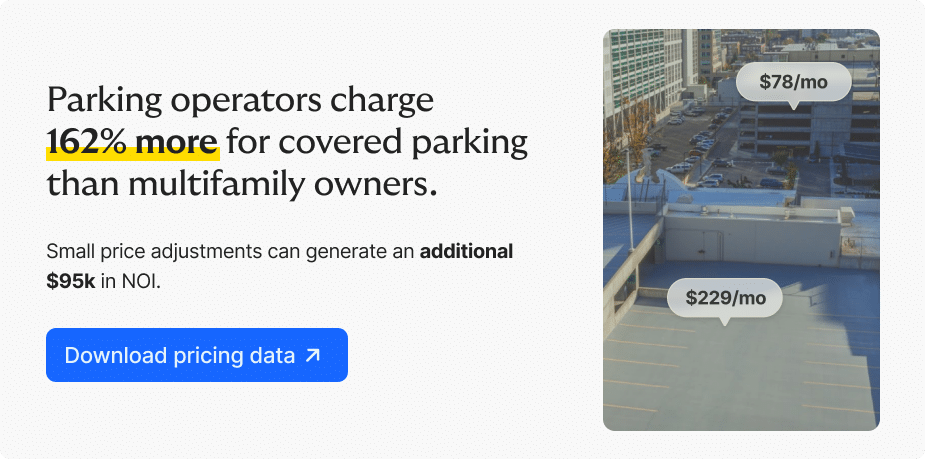
Neighbor.com’s research showed that professional parking operators in larger cities charge ~162% more (on average) for covered parking spaces than multifamily property owners, even when those parking spots offer similar levels of coverage and are located in the same prime locations.

*Note: The table only represents covered parking spaces–not uncovered.
When comparing a multifamily parking garage to a standard downtown parking garage, these facilities will often be located in the same desirable locations and offer many of the same amenities (EV charging, installed security cameras, etc.)
So, what’s the explanation behind these dramatic price differences?
As our team of parking experts sees it, there are very few reasons why multifamily property owners should be charging up to 435% less for parking than a parking operator located in the same neighborhood.
Note: These pricing discrepancies will vary depending on whether the space is uncovered vs. covered. Continue reading for more insight.
However, we see a different trend unfolding in Washington, D.C.. With both uncovered and covered parking spaces, the pricing discrepancy between the multifamily rate and the market rate is virtually non-existent. Even more unusually, multifamily properties in Washington D.C. charge more than local parking operators (on average).
Multifamily Parking Rates vs. Market Rates (Uncovered Parking)
In Washington, D.C., commercial parking facilities charge (on average) 5% less for uncovered parking than multifamily properties in the area.
| Market Name | Avg. Multifamily Parking Price | Avg. Market Parking Price | Price Difference ($) | Price Difference (%) |
| Washington D.C. | $140/mo | $132.45/mo | -$7.55/mo | -5% |
Multifamily Rate vs. Market Rate (Covered Parking)
In Los Angeles, commercial parking facilities charge (on average) around 3% less for covered parking than multifamily properties in the area.
| Market Name | Avg. Multifamily Parking Price | Avg. Market Parking Price | Price Difference ($) | Price Difference (%) |
| Washington D.C. | $220.52/mo | $213.85/mo | -$6.67/mo | -3% |
Factor #5: Parking Ratio
In Washington, D.C., the average parking ratio is .8 (one of the lowest parking ratios of all 10 markets sampled). Meanwhile, the average # of vehicles per household is also 1.7 vehicles per household (over double the average parking ratio).
In markets where the average number of vehicles per household exceeds the average parking ratio, demand will outweigh supply. In that case, property managers will face parking shortages, long waiting lists, and potentially dissatisfied residents.
But how can these Washington D.C., property owners maintain resident satisfaction and meet these unmet parking needs? One option is to expand existing parking facilities or introduce more parking structures. Another option is to recommend platforms like Neighbor to tenants looking for a parking spot nearby.
Factor #6: Ratio to Rent
Property managers and owners should always consider a resident’s purchasing power when setting on-site parking prices.
Looking at 240 multifamily properties across 10 top US markets (Los Angeles, New York, Salt Lake City, Seattle, San Francisco, Miami, Washington D.C., Phoenix, Denver, and San Diego), charged residents 3-4% of total monthly rent costs to rent these on-site parking spaces.
These % averages varied between covered and uncovered parking (as seen in the charts below):


Generally speaking, Neighbor’s parking experts recommend that resident parking rates equate to 8-10% of your residents’ average monthly rent costs. This strategic change can potentially boost NOI, increasing overall property valuation.
Factor #7: Recommendations from Parking Pricing Tools and Other Experts
Note that pricing should not be set according to the city-level averages included in this report. Instead, pricing should be set at the property level, accounting for the hyperlocal market and resident dynamics.
For local parking pricing data and customized pricing recommendations, property owners can contact Neighbor’s team for a free demo and a personalized portfolio analysis.
When Are Free Parking Spots the Best Pricing Strategy?
Free parking is a viable strategy for some property owners.
- Free (or included) resident parking sets an apartment complex apart from competition in the area.
- Free (or included) resident parking can be leveraged in marketing materials. On-site laundry facilities may not be eye-catching enough for a brochure, flyer, or social media post–but free parking may be a different story.
- Free (or included) resident parking will prevent residents from seeking third-party parking options in the area. You won’t want to lose thousands in monthly parking revenue just because your parking rates are higher than those set by local operators in the area.
Making Adjustments to Your Resident Parking Prices
When optimizing resident parking prices, it’s always better to be cautious. If owners were to optimize for revenue alone (and overlook resident purchasing power), the outcome could be higher vacancy rates.
To avoid resident dissatisfaction, multifamily property owners should take the following precautions:
- Test this assigned parking program with new/prospective residents before rolling out the program to existing tenants.
- See if new/prospective residents are willing to pay these higher parking rates. If they are, begin raising the monthly parking rates of existing residents.
- Avoid off-cycle increases. Instead, implement modest price hikes at the time of lease renewal.
When executed thoughtfully and strategically, resident parking price optimizations can have a seismic impact on ancillary revenue.
Parking price increases can be a great alternative to raising rents.
For pricing data in the top 10 US markets (including L.A.), as well as cutting-edge parking optimization strategies, download the 2025 Multifamily Parking Intelligence report here.