

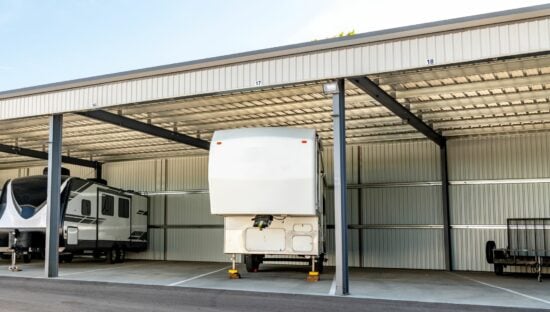
Starting an RV storage business?
If so, you’ll need to calculate how many RV storage spots per acre will fit to maximize your return. These spots can take the form of private RV lots or enclosed storage units, large enough to accommodate a 5th wheel, travel trailer, or even an Airstream.
Estimating the number of RV storage spots per acre before you actually invest in the land itself can be tricky.
(If you’re still considering whether RV lot ownership is right for you, read this guide.)
But even if you’ve already made the big purchase, accurately calculating how much space you’ll need to devote to each storage space (without an expert opinion) is that much more challenging.
There are factors you may not have considered that can and will impact the necessary size of your individual lots. Not considering these factors could negatively affect your construction plans, delaying your opening or adding new and unexpected construction costs.
So, whether you’re calculating how many storage units you can have per acre or how much individual space you need per RV, we’ll set you up for success.
Read on to learn more.
How Many RV Storage Spots Can You Have Per Acre? (A Rough Answer)
First, let’s get to the most pressing questions: how many RV storage spots can you have per acre?
You can typically fit about 50-70 RV storage spots in an acre of land.
For a more exact answer that’s specific to your unique piece of land, check out Neighbor’s Blueprint tool.
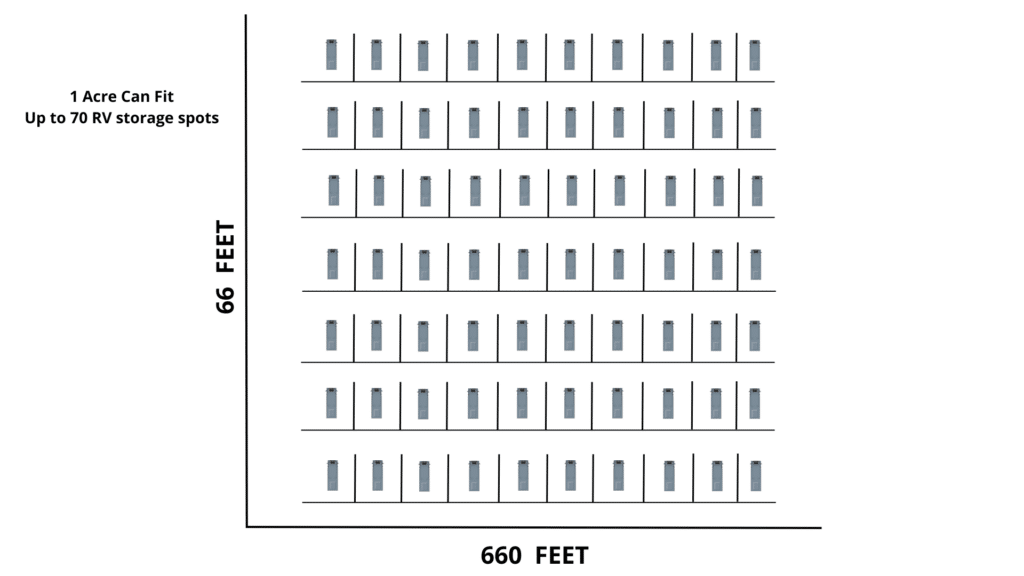
However, knowing that is only helpful if you understand how to do the math yourself.
After all, you might not have precisely an acre, meaning you’ll need to know what extra considerations go into that calculation.
So, let’s take it step-by-step and break down how to figure out how many RV storage spots you can fit in your lot.
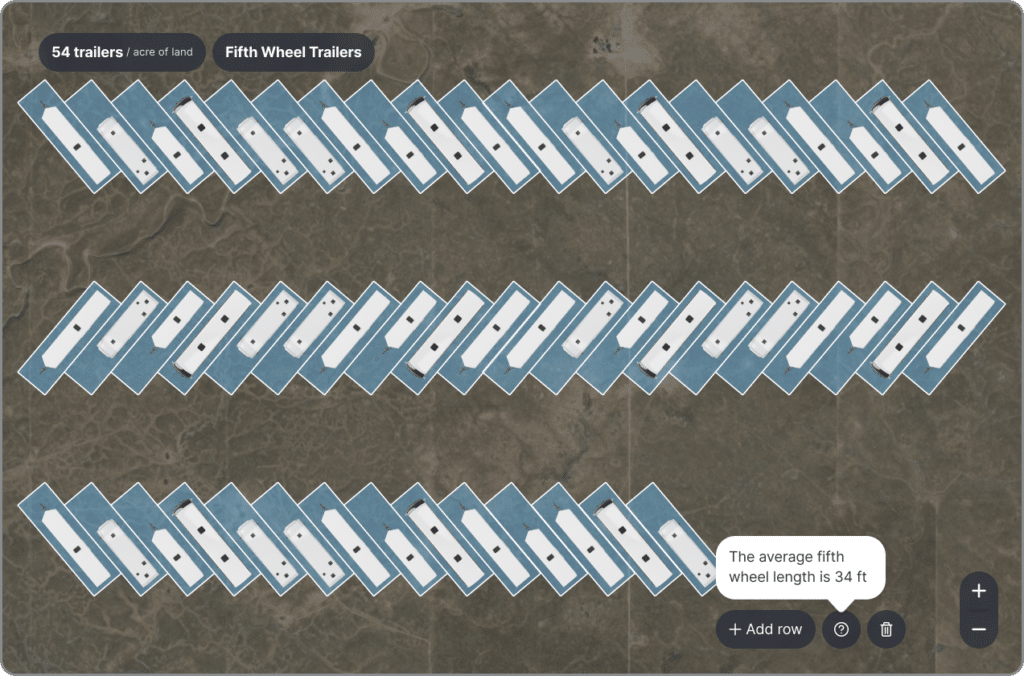
Note: The number of RVs you can comfortably fit on an acre of land will depend on two factors: 1) the type of RV, and 2) your preferred configuration (90-degree parking vs. angled parking).
If you’re storing fifth-wheel trailers at an angle, you’ll be able to fit roughly 54 trailers on a single acre of land (see diagram below).
Calculating the # of RV Storage Spots Per Acre (A Detailed Walkthrough)
Sure, you can use rough averages to estimate the # of RV storage spots that can fit on your acre(s) of land, but why settle for rough estimates when there are tools that can offer a precise calculation?
For detailed insight into the exact # of RV storage spaces that can fit on your specific piece of land, check out Neighbor.com’s Blueprint tool. After entering your address, the Blueprint tool will pull aerial Google Maps footage of your property. From there, you can drag and drop to-scale RV icons onto your property and test out different parking configurations.
However, if you want to do things the old-fashioned way, you can follow the steps below:
Step #1: Understand What “Coverage Rates” Are
The ‘coverage rate’ is the percentage of your land that is– or can be– covered by storage units.
You can’t fill every inch of your land with RV storage units. You need to consider the overall layout of your facility including:
- Fencing
- Water runoff
- Driveway + parking spaces
- Office space
- Additional security measures
For the average RV storage facility, you’ll have a coverage rate of about 40-50%.
If you’re new to storage facility design and that sounds low, keep in mind that the coverage rate of the average storage facility isn’t usually above 50%.
When designing a layout for your RV storage business, you’ll need to check your local building department for city codes and zoning regulations related to wastewater runoff, stormwater retention regulations, and coverage rates to make sure you’re following any and all provincial laws.
While following local laws is imperative, it’s equally imperative that you maximize coverage, which will, in turn, enable you to maximize revenue.
Step #2: Determining What Size Storage Space Do I Need for Each RV? (Common Size Examples)
Now, let’s get into the details.
It’s time to talk about what unit sizes you should consider offering in your facility.
According to RV Storage Depot, owner of the largest RV storage lot in the United States, some of the most common lot sizes offered are in the 10’ x 20’ to 12’ x 20’ foot range.
Here’s a breakdown of the most common sizes (by foot):
- 10’ x 15’
- 10’ x 18’
- 10’ x 20’
- 10’ x 22’
- 10’ x 26’
- 10’ x 40’
- 10’ x 45’
- 11’ x 12’
- 11’ x 28’
- 11’ x 40’
- 12’ x 12’
- 12’ x 14’
- 12’ x 25’
In some cases, RV self-storage units can even go as large as 13’ x 10-20’ (not every RV is created equal!).
With that said, the most common RV storage unit sizes are within the 10’ x 20’ to 10’ x 40’ range.
Step #3: Calculate the Amount of Usable Square Footage You Have for the RV Storage Facility Units Themselves
One acre totals 43,560 square feet of space.
As we just discussed, that square footage doesn’t equate to pure storage unit space.
If we assume– for the sake of example– that you have one acre of land for your facility, and we take our coverage rate of about 50% and subtract that from an acre, we end up with enough room for a little less than 22,000 square feet of RV storage unit space.
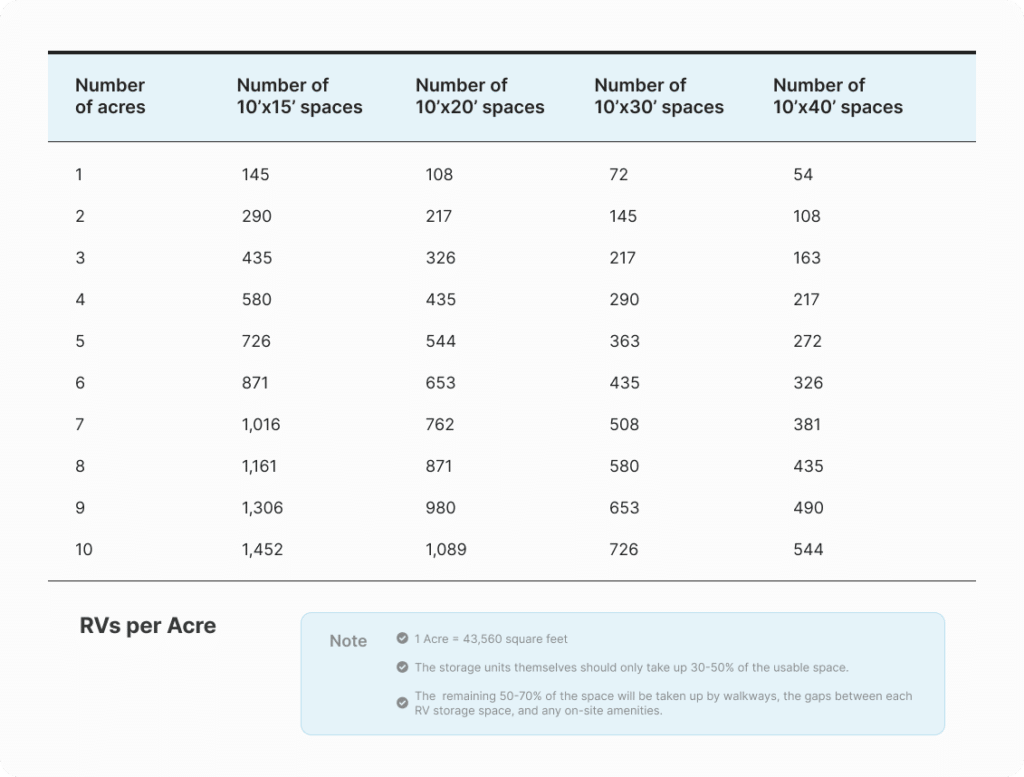
However, the # of RVs you can fit will ultimately depend on the size of the RV spaces you choose to offer.
Step #4: Calculate How Many Individual RV Self-Storage Units You Can Fit Within That Space
Lastly, you’ll divide the usable square footage (that you’ll use purely for storage space) by the average unit size.
The average RV parking stall is typically around 200-400 square feet (more on that recommendation in the next section).
If we take the 22,000 square feet from our earlier example and assume your average parking stall will be 300 square feet, you’ll have just over 73 RV storage units in your lot.
Just keep in mind that certain considerations may affect this number. Such as:
- Customer preference (what is the average RV size that will be stored in your lot? Will you accommodate all classes of RVs?)
- Parking demand (consider available street parking)
- Local water runoff zoning requirements
Here’s a rundown of the # of spaces you’ll be able to fit, depending on the space sizes selected:
Additional Considerations and Features to Take Your RV Storage Space to the Next Level
Now that you know how to calculate the number of RV storage spots you can have per acre, let’s discuss additional considerations.
We read through some of the web’s most popular RV forums online—straight from long-term enthusiasts—and compiled a list of features requested by popular demand.
Security
One defining feature of a great RV storage facility is ample security. It’s not uncommon for RV owners to report having their RVs broken into, particularly when they’re stored in a facility without enough security measures in place.
As such, RV owners will search out facilities that are well-kept and have top-of-the-line security systems in place so that they can rest easy knowing their RV is safe.
Let’s start with the essential security features you should consider having:
- High, reinforced chain link fencing
- Visible cameras throughout the structure
- Covered and non-covered spaces (most self-storage customers prefer enclosed spaces, but these should come at a premium)
- Automated gates with locks, preferably ones that require passcode entry
Types of Storage Spaces
Outside of security, here are the other features RVers prioritize when browsing for RV storage facilities.
- Drive-up units (Drive-up units are popular for their ease of access, especially for those who use and store their RVs frequently)
- Climate control facility
Extra Amenities
In addition to security and climatized storage, consider these premium features to elevate your facility and draw a larger customer base.
- Electricity (per unit)
- Dump station
- Water refill
- Cleaning station
You should consider testing market demand before investing too heavily in any of the last group of features. However, they’re all options that can help you stand out amongst your competitors.
Are RV Lots a Good Investment?
If you’re still on the fence, it’s worth considering the growth of the RV industry over the past decade.
According to a study by RVIA.org, the RV industry has tripled in size since 2009.
That’s impressive enough, but consider that RVs have become popular among the younger generations.
In fact, Millennials reportedly own over 15 million of the RVs that are roaming the open highways and dirt-covered roads of the U.S.
And while an RV storage facility doesn’t technically constitute as true passive income (see more here on passive income vs residual income), RV storage facilities– when well-managed– can be a semi-passive investment with great returns.
Whether investing in RV storage is right for you is only for you to decide, but these numbers just might help convince you that RV storage is worth considering.
Further reading:
- Read more: Why Investing In Vacant Land Could Be Your Next Smart Real Estate Move.
- Learn how to start a new RV storage business here.
Make the Most of Every Inch of Your RV Storage Space
Planning out every inch of your RV facility, down to the square foot, is essential in maximizing your return on investment.
However, once your lot is built and ready to open for storage business, you need customers.
The more consistently you can keep your lots filled, the more successful your self-storage business plans will be.
With a self-storage marketplace like Neighbor, you can actively put your business in front of RV owners, fill vacancies, and maximize revenue potential. Learn more about how to become a host with Neighbor here and take another step toward a successful RV storage facility.