


Being a boat owner can be a joy, but it’s also a major responsibility. One of the first questions you’ll ask is: Where am I ever going to park this thing? Mooring is one option.
Mooring is the process of leaving your boat tied off to an anchored position – basically the equivalent of “parking” on water. It allows boat owners to leave their vessels on the water for up to years at a time. (Mooring is the same anchor-based technique that allowed Magellan to circumnavigate the globe in 1502 without marinas or docks.)
Whether you are sailboat mooring, yacht mooring, or motorboat mooring, here you’ll find answers to your most common questions about how to moor your boat.
Mooring a Boat vs. Docking a Boat
But what exactly is the difference between mooring a boat and docking one?
Docking a boat refers to temporarily tying off to a fixed dock or pier at the marina. All you need are dock lines and bumpers. Docking is like the drop-off lane at the airport: loading and unloading only.
Mooring involves tying your boat off to an anchored position for some period of time. Many marinas will offer a fixed-anchor mooring spot that you can rent. (Better yet, rent a slip. These provide the most reliable type of mooring systems.)
Most boaters would agree that the real joy of mooring comes from the freedom of being able to decide where you want to drop anchor and establish your own mooring.
What Does a Mooring Buoy Look Like?
Moorings are marked by a buoy so that you can find your mooring point. When no boat is tied off, mooring buoys are supposed to be marked by a white buoy with a blue ring.
However, the reality is that boaters in less-strict jurisdictions often just use a white, red, or other-colored floating buoy.
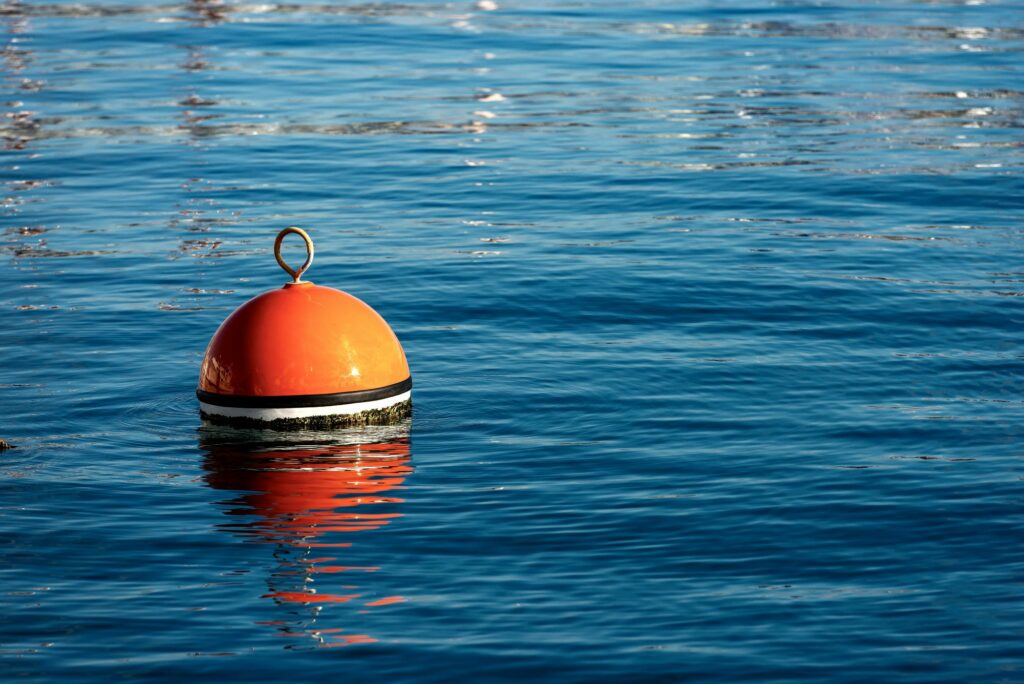
The floating buoys are there to help boaters find the mooring. (You can’t see the mooring anchor and chain because they are underwater.)
How Do I Get from the Shore to My Moored Boat?
There are four ways to get to your mooring:
1. Use your own dinghy or small vessel.
2. Get the marina deckhands to drop you off.
3. Fly your helicopter to the helipad on your megayacht.
4. Swim(!)

Is Mooring Your Boat Dangerous?
If you’ve ever seen boats washed up on shore after a storm, you know that mooring is not the safest way to store your boat:
- Your boat can come un-moored and drift away.
- Modern-day pirates can break into your boat and steal your electronics, outboard motors, etc.
- Crustaceans like barnacles and bivalves can colonize your boat, sometimes wreaking havoc on your vessel.
- Your boat is a sitting (or floating) duck for whatever Mother Nature decides to throw at it.
The vast majority of problems are due to improper mooring – be it failing to set up, inspect, or maintain the mooring. Damage can also occur if you fail to monitor the weather conditions. With this in mind, safely securing your vessel to your mooring is essential.
If you’re concerned about your boat, a slip at the marina is always much safer. The only way to truly ensure that your boat is protected is to dry dock it in a secure storage facility with a roof. This could be your garage, the marina, a storage facility, or a peer-to-peer storage option like Neighbor.

Where Can I Moor My Boat?
If you decide to rent a designated space from the marina, they will assign you an anchored mooring. But if you are setting up your own location, your choice of mooring locations is limited by several factors.
· The depth of the water
· The quality of the lake, river, or ocean floor
· Local currents and weather
· Other boat traffic
· Local boating regulations
Water Depth
The ideal depth for dropping your anchor depends on the size of your boat. This is where a good depth finder comes into play.
For the vast majority of history, boaters have made do without depth finders.
The most common pre-electronic technique for determining depth was a weighted lead line. Ideally, you’ll need a basic familiarity with local bathymetry and dead reckoning.
The Ideal Sea, River, or Lake Floor
Anchors dig into the sea floor in such a way that they hold when pulled laterally but release when pulled directly up. However, anchors will only dig into the sea floor in some conditions.
Ideally, you are looking for a nice, soft bottom where your anchor can really find purchase (aka, the holding power of your anchor). Muddy, mucky bottoms are ideal. Sandy bottoms are next best.
Rocky bottoms can be problematic. The anchor may initially bounce off or skid on the rocks. The bigger problem is that your anchor can get irrevocably wedged in between some big boulders. While this might make for a solid mooring, it condemns you to have to cut anchor when you leave.
Cutting anchor is not only expensive but could leave you a long way from a dock or marina without a means of mooring your boat — a potentially dangerous situation. Of all the equipment you’ll need on your boat, the anchor is one of the most important. For this reason, some pilots carry two anchors.
Grassy or kelp-covered bottoms are not good, either. While your anchor might appear to gain purchase, it might have just lodged itself in the grass. This obviously does not make for a secure mooring.

Local Currents and Weather
When scoping out coastal areas for a mooring, you have to take into account the fact that conditions are constantly changing on the water. Today’s calmer waters are tomorrow’s rolling whitecaps. The swivel shackle is designed to allow your moored vessel to move around without snarling the mooring lines.
· Tides and tidal currents can vary widely, from a neutral slack tide to a massive king tide.
· Winds can shift dramatically with frontal conditions. Winds also shift due to diurnal (day vs. night) cycles.
· Waves can change from flat to rolling in minutes.
· Currents can vary not only from the above factors but also from the bathymetry and coastline features around your mooring.
Anticipating currents and weather is a calculus that only an experienced navigator should make.
Boat Traffic
Locations where there is no boat traffic one day might be full of boats during a weekend sailing regatta.
Many a boater’s day has been ruined when they discover that another boat has poached their mooring, or that the mooring line has been severed by a boat prop.
Local Boating Regulations
You’ll also need to check the local regs, as you can’t just drop anchor anywhere you want.
What Equipment Do I Need to Moor My Boat?
The anchor is what makes it possible to moor your boat. From pyramid anchors to mushroom anchors to plow style anchors, there are a wide variety of anchors for different boats and conditions. Longer and heavier boats will obviously require larger anchors.
Typically, the anchor is linked to the mooring buoy by a chain. The mooring line that connects the mooring buoy to your vessel is known as the mooring pennant. It’s very important that this line has a chafe-resistant coating, as the regular movement of currents over time can add up and cause rope fray.
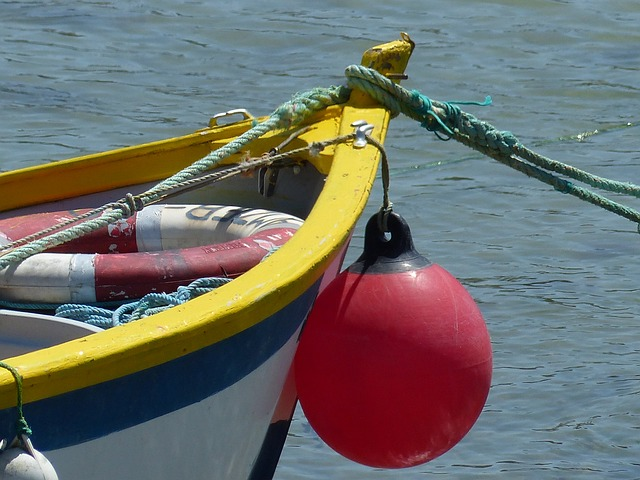
Of the other materials you’ll need, another essential item is the boat hook — you’ll need it to grab the mooring ring on your buoy! Boaters typically approach their mooring from downwind with a crew member on the bow to hook the buoy.
Am I Ready to Moor My Boat Now?
Would you use an online article to teach you how to drive a car? Of course not.
You’ll need an experienced boatsperson to literally “show you the ropes” on how to keep your boat moored:
· Anchoring
· Slowly circling to make sure the anchor is secure
· Tying the boat off with the mooring pennant
· The three types of boat mooring configurations: stern-to, bow-to and side-on
· Unsticking a stuck anchor
Mooring Lore
The anchors on heavier vessels like big cruise ships and cargo liners are so big that they dwarf a person. As anchor geeks love to point out, it is actually the weight of the heavy chain – not the anchor – that keeps these super-ships moored in place! This makes sense when you consider that each single chain link on the ¼ mile anchor line of an aircraft carrier weighs as much as a person (136 pounds).
When Captain Cook was moored off the coast of Hawai`i in 1779, he had to set a watch on deck to keep the boat secured because the Native Hawaiians – who had never seen metal before — would swim out and pull the nails right out of the ship’s hull!
To Moor, or Not to Moor
Hopefully, this article has helped you consider what mooring your vessel entails. Moving forward, you will need to make some decisions about where to store your boat.
Until you have an experienced boat person on deck to show you how to set anchor and establish a mooring, you should stick with commercially available options for storing your vehicle, like the marina, a storage facility, or peer-to-peer storage options like Neighbor.