

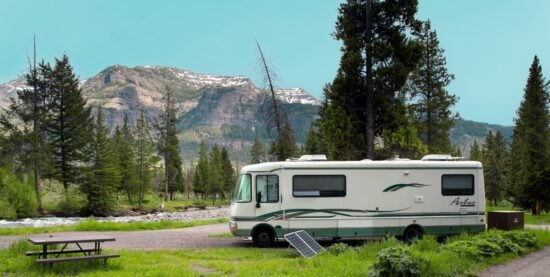
You’ve got a dream. You stepped into it at the latest RV show: a heavy-duty, triple axel, fifth-wheel RV. It’s big enough for your family with a cushy entertainment space and a loft for the kids to sleep in. But what really stole your heart was the extending porch and the garage space to haul your Razor side by side in the back.
Here’s the catch…
Now, you need to figure out what it’s going to take to haul that bad boy. Do you need a commercial driver’s license (CDL), a permit, or an endorsement on your non-commercial driver’s license?
And even if it’s not required, are there advantages to getting a CDL vs. non-CDL driver’s license? Do you have to go to a truck driving school to get your CDL? And if you do get your CDL to drive your RV, could you also use it for other employment opportunities?
Let’s answer:
- What is a CDL?
- When do you need it?
- What can you use it for?
- And how to get your CDL?
What is a CDL (Commercial Driver’s License)?

A Commercial Driver’s License (or CDL) is required for operating commercial motor vehicles. You need a CDL when you are…
- Transporting over 15 passengers
- Tractor trailers
- Hazardous materials
- Commercial size buses
- Towing double trailers
- And sometimes RVs over 26,000 lbs or longer than 45 ft.
Having a CDL license allows you to operate buses, tractor trailers and – more relevant for you – RVs that are over 26,000 lbs.
A CDL is required for those who wish to operate a large commercial vehicle for business-related purposes such as cargo truck drivers, heavy equipment haulers, truck driving instructors, and professional bus drivers.
Any commercial vehicle that weighs more than 26,000 pounds requires a CDL. But there are exceptions for recreational vehicles depending on which state you’re in.
To obtain a commercial driver’s license, drivers need to be at least 18 years old. However, if the vehicle transports hazardous materials or is used for towing, the driver must be a minimum of 21 years old.
For the states that do require a CDL, you’ll want to look into the Class A or Class B commercial licenses. With a Class A you can operate either an RV over 26,000 lbs or a travel trailer exceeding 10,000 lbs.
Obtaining a CDL license requires more specialized training, testing, and medical clearances compared to a non-CDL license.
What Is a Non-CDL?
A non-CDL license is a standard driver’s license that the DMV issues after you’ve taken a written and practical driver’s test. You can get a learner’s permit as young as 15 years old and a license when you’re 16 years old if you pass the tests.
While most states don’t require you have a commercial driver’s license to drive an RV, some require special endorsements on your driver’s license. But RV Laws can also change, so check with the DMV in your state to get up-to-date requirements.
The Key Differences between CDL and Non-CDL Licenses
If you’re leaning toward buying a large Class A RV that may require a CDL, then you need to understand the differences between commercial and non-commercial driver’s licenses. The key difference between CDL and non-CDL licenses boils down to this:
CDL is a more in-depth process for learning how to drive, maneuver, and care for large commercial vehicles safely. It’s an investment to get your CDL because it’s assumed you’re using it for commercial purposes.
Here are some other differences to keep in mind:
#1: The Type of Vehicle that You Can Drive With Each License
Having a CDL opens up a world of opportunity when it comes to the vehicles you can drive. Think tractor-trailers to luxury buses. These vehicles offer unique driving challenges and responsibilities, which is why you need to cultivate the knowledge and skills to safely operate these large-scale vehicles, starting with what kind of gas they use.
#2: The Skills and Knowledge Required
While employers like their drivers to complete official CDL training, you’re not required by law to do so.
However, it’s smart to get a basic level of knowledge and experience driving a longer, heavier vehicle for safety’s sake. These larger vehicles drive differently than standard vehicles. They use air brakes, have bigger blind spots, and are governed by different laws. So invest in your safety, and take the time to learn these nuances.
Now if you’re retired or active military and have two years experience driving large vehicles or buses, then you don’t have to take the CDL test. Your service training is sufficient.
Oh, and the CDL driving test is no joke…
#3: The Driving Test Involved
The CDL driving test is a 2 hour test that grades your ability to safely control, drive, and inspect your vehicle.
As part of your assessment, you’ll need to back up, do quick stops, and perform three point turns. But also be ready to drive steep inclines and traverse bridges. In a vehicle that’s over 40 feet long, that’s no small feat. So make sure you practice.
#4: The Renewal Process
The DMV informs you when it’s time to renew. Unlike your state’s driver’s license that you renew every year, your CDL only needs renewing every five to eight years depending on your state.
It also requires more than a driver’s license renewal. It takes a trip to the DMV where you’ll need to show proof of insurance, residency, work eligibility, and a current medical report.
And then you can pay the fees, of course.
#5: The Cost
If you choose to take a course then your CDL can cost between $1,000-$8,000 depending on where you choose to attend. Renewal fees vary by state but are generally less than $100.
If you choose not to go to school, then it’s $200 or less depending on your state. So yes, you could save some money by skipping school, but ask yourself, could you safely drive a class A RV without training? Is it worth taking that risk?
Only you know your abilities, so make a safe choice for you and your family.
What Are the Advantages of a CDL?
With a CDL, you can make money driving almost any commercial vehicle: nuses, semi-tractor trailers, 15-passenger vans—you get the idea. Your CDL can also qualify you for any number of transportation jobs with an added bonus.
If you have a CDL, you can also drive any RV in any state of the Union without fear of license restrictions. You’re a free bird, my friend!
There are some restrictions as to what you can transport with your CDL. For example, to transport hazardous materials, you have to have your class C CDL—but anything else is free game.
What Are the Advantages of a Non-CDL?
With a non-CDL, you can drive anything with four wheels and no air brakes. It’s your normal driver’s license, which you got when you were sixteen or older.
Now, as was mentioned, some states require a special endorsement on your license to drive certain RVs. But if you’re sticking to the Class B or Class C RV types, you’re probably safe.
To see if your state requires an endorsement on your license, go here.
Do I Need a CDL to Drive an RV?
No, you don’t need a CDL to drive most RVs. In fact, you can drive the vast majority of RVs with a good, ole non-CDL license.
The RVs that tend to exceed the 26,000 lbs breaking point are Class A RVs like luxury travel buses and toy haulers.
The only states you need a CDL for are:
- Hawaii and Washington DC if it’s over 26,000 lbs
- Indiana and Wisconsin if it’s longer than 45 feet
All the other states allow you to drive your RV without a CDL, but they may have other licensing requirements.
Summary
When you finally drive that heavy-duty fifth wheel off the lot, you’ll need a place to store your RV.
You want your rig to be ready for the big trip – and not riddled with maintenance issues that can delay the fun. That’s why you need to store your RV properly.
If you store it on your driveway or RV pad, you’ll risk exterior damage. But where can you find covered or enclosed RV storage in your area?
Neighbor can help.
With Neighbor, you can find RV storage options in all 50 states. You may even find storage spaces in your very own neighborhood.
Neighbor – a peer-to-peer RV storage marketplace – offers RV storage up to 50% cheaper than traditional storage options. Find listings (from pre-screened hosts) nearest you!
For up-to-date information, visit your state’s DMV website.