


It’s long. It’s wide. It’s heavy. It doesn’t start fast. It doesn’t stop fast. It’s a fully loaded recreational vehicle. And you have to learn how to drive it.
While it might look like an intimidating machine to control, driving an RV builds upon the same basic driving skills you gained when you were sixteen.
It’s just…bigger.
You’ll need to be aware of the…
- Cargo carrying capacity,
- The dimensions,
- The nuances of parking in tight places
- The limits of your RV.
But learning how to drive an RV (stress-free) is less about respecting the size of the RV and more about refining your basic driving skills.
Key Takeaways
- Practice is key! Use an empty lot to work on your RV driving skills.
- Strategize your route and stay informed about current weather and road conditions with the help of RV-friendly navigation tools.
Basics Tips for Driving an RV
Revisiting the basics is your first step to becoming comfortable in your RV.
Remember when you were first learning how to drive? You probably turned too slow, checked your mirrors too often, and tapped your brakes at the slightest provocation.
You had to go slow until your brain learned how to process this new environment. But the more experience you gained, the more natural driving felt to you.
Over time, you began to understand that you can accelerate out of a curve–without flipping over. You also realized that you could press the accelerator a little harder–without giving your passengers whiplash.
Eventually, you built enough confidence to tell your dad to relax and stop stomping on the floorboard, as you gradually slowed to stop.
Ah, yes, memories! And now you get to relive them all as you learn to drive an RV.
But don’t worry; you’ve already got the basics. Now, you just have to apply them in a different way. Here are the key things to keep in mind:
Practice Parking and Maneuvering Your RV
Yes, just like that dreaded parallel parking drill during your driving test, you want to practice getting your RV in and out of tight places. Campsites aren’t always laid out with ease of parking in mind, so you need to be prepared.
Pay Attention to Potential Blind Spots
Most RVs are longer, meaning more potential for blind spots. Be aware of where these new blind spots are and know how to check them.
You’ll also need to recognize that other drivers (not in RVs) don’t understand where your blindspots are, so they are happy to sit there, riding along next to you in blissful ignorance. But don’t let it upset you.
Learn How to Properly Use Your RV’s Mirrors
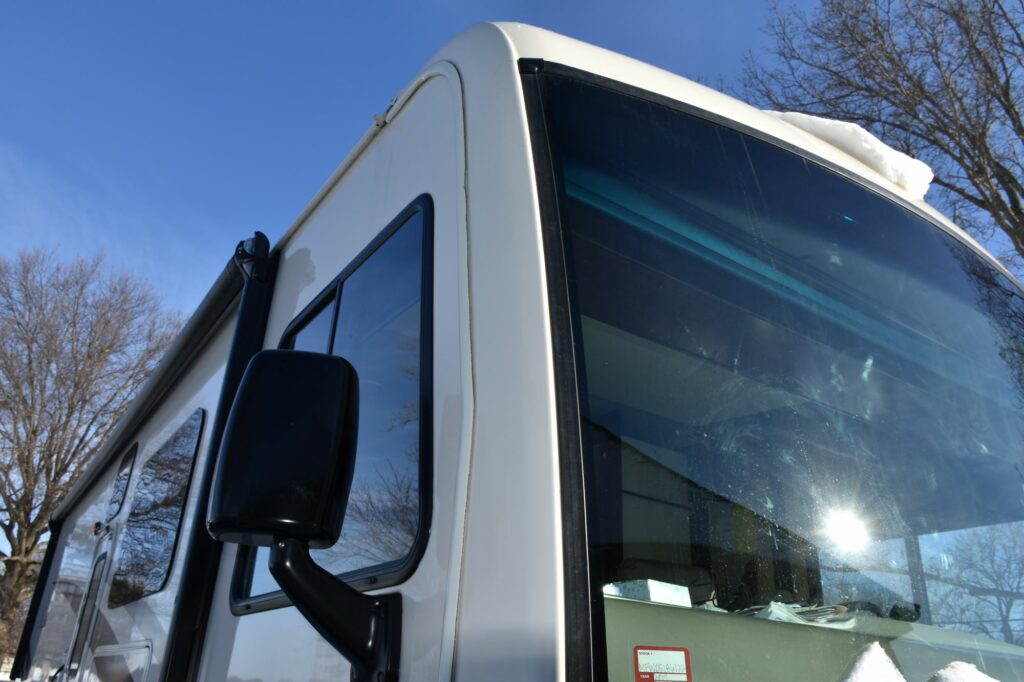
RVs usually have extended mirrors or convex mirrors to help you see into those extended blind spots. And if you don’t have them, I would highly recommend upgrading. They save your neck from having to twist around so much. With these mirrors, you can learn where to look to see where you’re going when parking or switching lanes.
Know Your RV’s Dimensions
Not all RVs are built to go anywhere. By understanding your RV’s height, width, and length, you can set an itinerary that doesn’t involve narrow bridges or a weight limit that you might exceed. Especially if you’re traveling through mountain country with a lot of tight switchbacks, you need to know what your RV can and can’t do in order to plot a safe route.
To make finding a route easier, you use an RV-safe GPS or check out these RV GPS apps, which prove to be such time-savers.
You also need to inform the campground of your RV’s dimensions. That way, they assign you to a spot big enough for your RV. This isn’t a problem most of the time, but some parks don’t have spaces over 35 feet. And there are some RV laws regarding where you can park certain RVs.
Learn How to Distribute the Weight When Packing Your RV
Weight distribution doesn’t have anything to do with how you drive an RV. But driving an RV is a lot easier when you load it correctly. Proper weight distribution…
- Minimizes trailer sway for a smooth ride
- Prevents internal damage to your RV
- Relieves stress on the superficial structure
- Saves you money at the gas pump
You also want to determine your Cargo Carrying Capacity (which you can learn how to do here), so you can prevent overloading your travel trailer. An overloaded travel trailer can strain the brakes on your tow vehicle–which isn’t safe for anyone.
Getting Comfortable in the Driver’s Seat
Finally, get comfortable in the driver’s seat. Adjust your seat, mirrors, and steering wheel to fit you. This prevents fatigue and helps you maintain control of the vehicle.
To get the best view from your RV mirrors, make sure the left and right flat mirrors show the horizon at the top and catch your RV’s left and right rear corners, respectively.
Practice Makes Perfect
Theory is important, but nothing beats practice. So here are some RV driving tips to practice. You don’t have to invest in an RV driving school – unless required by your state. Instead, take along a seasoned RV buddy to be your copilot and walk you through the basics of driving your RV.
Where to Practice
Find a safe environment, like an empty parking lot or an open field.
What to Bring
Have orange cones that you can set up to simulate vehicles or other obstacles. And always bring a buddy that can help spot you.
…and snacks because this could take a while.
How to Practice
Here’s what you want to practice.
- Parking
- U-turns
- Backing up
- Braking
- Maneuvering around obstacles
These drills help you test the limits of what your RV can do and what you’re comfortable doing with your RV. Set up cones to simulate parking spots/obstacles and get to work.
Parking Drills:
- Set up cones to simulate a parking space.
- Practice turning in like normal to get a feel for the wider arch you need to park your RV.
- Next, place a line of cones about 16 feet away and across from the parking spot you’ve created to simulate another row of cars.
- Practice pulling into your parking spot again and then again.
- Once you’ve mastered pulling forward, it’s time to practice backing into your parking spot.
Backing Up
You’ve practiced in a parking spot, but now you need to get a good feel for controlling your RV while you’re backing up.
- Start with a row of cones on either side, simulating a single lane.
- Practice backing up straight down the lane. It sounds simple, but with a trailer, it’s tricky.
- Now, add a curve at the end of the straight lane to simulate parking around obstacles.
- Then, practice straightening out again.
U-Turns
When you’re traveling in unfamiliar territory, you’re bound to have to make a few U-turns, so practice and get a feel for how tight of a U-turn you can make–without putting yourself or your RV in danger.
- Start by measuring out a distance of 24 feet (approximately the width of two lanes of traffic and a bike lane.)
- Mark the width with cones.
- Then, starting on the outside of the cones, see if you can make a U-turn in that space. If the answer is no, then you know you’ll need to find a parking lot to turn around in when you miss your turn.
- If you manage to make the turn, move the cones closer by four feet (effectively erasing the bike lane.) See if you can make it.
- Gradually decrease the space you have until you find your limit.
Pro tip: If you are one of those unfortunate souls who cannot make a U-turn in your RV, gas stations make great turnaround spots.
RV Driving Tips While Navigating the Road
Specific driving techniques are helpful when mastering maneuvers like wide turns, proper braking, and handling inclines and declines.
Take Wide Turns and Factor in Tail Swing
Mastering the art of wide turns (and being aware of your RV’s tail swing) can help you navigate through tight spaces and dodge potential accidents.
Tail swing is the residual motion of a travel trailer when you make a turn. It’s simple physics. The trailer wants to keep moving in the same direction it’s been traveling, so when you turn, the trailer tips toward the same direction.
The way to deal with that is to brake and slow down to kill your forward momentum before you make those turns.
Learn the Right Braking Techniques
Proper braking techniques are crucial for maintaining control of your RV. Early braking helps you slow down your RV safely, prevent brake wear, and possibly prevent fender benders that waste everyone’s time.
By braking early, you can stop in shorter distances, reducing the chances of accidents due to inexperience or distraction.
Navigate Inclines, Declines, and Mountain Passes with Caution
Handling inclines, declines, and mountain passes can be challenging for new RV drivers. However, by driving cautiously, you can maintain control.
As a rule, if you’re unsure if your camper can make it through a pass – due to the steep grade or the road conditions – pull over and turn on your hazards. Then, use your GPS tools to find a safe route that you feel confident taking.
When driving in the mountains, plan your route according to your skill level and your RV’s parameters (height, weight, length, etc).
If you’re heading to a popular destination, you can even ask questions about road conditions on RV forums. Most RVers are more than happy to help.
Monitor Weather and Road Conditions
For a safe and smooth RV journey, keep an eye on weather and road conditions. Stay safe by avoiding inclement weather and potential hazards. And don’t risk it.
For example, if you’re uncomfortable driving on ice, don’t. Pullover by coasting to a stop. Then, flip your hazards on until you feel comfortable (or until help arrives). There’s no shame in playing it safe.
Choose Your Parking and Campsite Selection Wisely
Depending on your RV, choosing a suitable campsite is crucial. For one, if you have a large RV, a campsite with pull-through parking or plenty of space to maneuver can make setting up camp much easier.
But there are still plenty of tight spots when you’ll need to show off your parking skills. When those times come, you either want a good spotter or a backup camera. These tools can safely guide you into your parking spot and help you avoid potential obstacles.
A spotter can provide guidance and communicate directions. They can even inform you of how close you are to an obstacle. Backup cameras, on the other hand, can provide a clear view of the rear of your RV, which also helps you park safely.
Summary: Are RVs Difficult to Drive?
RVs can be challenging to drive at first, as they handle differently than regular vehicles and require adjusting to their turning radius and braking distances. But the good news is you don’t have to take an RV driving class to become more comfortable behind the wheel.
Now that you’re a pro RV driver, have you considered where you’ll park your RV when you’re not galavanting around the country, living your best RV life?
If you have a small RV, you might be able to fit it in your garage.
(That is, if you’re one of those people who actually use your garage for cars instead of accumulating random things the kids bring home.)
But more than likely, you’re going to need a place to store your RV, given that homeowners’ associations and city councils typically have an ordinance against parking an RV in your yard.
That’s where Neighbor can help.
Neighbor is a peer-to-peer storage marketplace where you can find inexpensive, covered storage for your RV that’s close to home.