

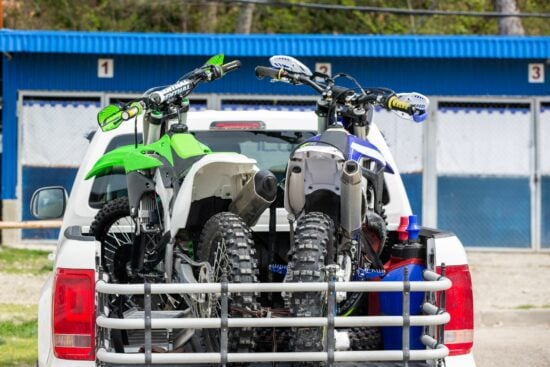
As a motorcycle owner, most of your rides will start and end at home. But there may come a time when you need to transport your motorcycle from Point A to Point B.
You may be a snowbird wanting to cart your motorcycle up to your winter home. Or maybe you’re traveling for the long weekend and want to take your bike for a cruise at your staycation destination. You may even be thinking about upgrading your current bike and buying a motorcycle from out of state.
If you don’t want to spend thousands of dollars on a motorcycle trailer, you can load the bike onto your truck and transport it that way–but that’s easier said than done. Done wrong, loading a motorcycle onto a truck bed can be tricky and dangerous–both to you and your bike.
Therefore, it’s important that you prepare properly and have the right equipment for the job.
Phase 1: Preparation
As we said before, loading your motorcycle into your truck bed is difficult and dangerous.
Motorcycles can weigh up to 500 pounds and can cause serious injuries if they fall on top of you during loading. Not to mention, if your motorcycle tips over while loading, it can also sustain damage.
Therefore, before you get started, having the right equipment for the job is essential.
Step #1: Selecting the Right Ramp
The first thing you’ll need is a strong ramp to wheel your motorcycle onto the back of the truck. While it might be tempting to try loading it using plywood or 2x4s, it will often end in disaster.
Instead, you should invest in a motorcycle loading ramp that checks the following boxes:
- It’s strong enough to handle the weight of your bike.
- It’s wide enough that your bike won’t fall off the side.
- It’s long enough so that you can easily push or ride your bike onto your truck.
Ideally, your ramp should be six to nine feet long and at least two feet wide.
Step #2: Buying Tie-Down Straps
As with loading a motorcycle onto a trailer, you will need tie-down straps, like the Jaco Tie Down Ratchet Straps, to fasten your motorcycle to the truck. You should have at least two to four ratchet straps and two to four soft loop straps. Both ratchet straps or cam-buckle straps will also work as tie-downs.
Step #3: Buying Wheel Chocks
Last, and most importantly, you will need high-quality motorcycle wheel chocks, like Black Boar Motorcycle Wheel Chock with Handlebar Straps, to keep your motorcycle safe and secure on the back of your truck. The wheel chock gets bolted to the bed of your truck, and the front wheel of your bike sits inside it—but more on that later!
Step #4: Gear Up for Safety
It’s also a good idea to keep safety precautions in mind when you’re loading your motorcycle. In addition to enlisting the help of at least one or two other people, here’s a quick rundown of safety gear to have on hand.
- Steel-toed boots so your toes aren’t crushed by your bike
- Grippy gloves
- Non-slip mats alongside your ramp
Step #5: Preparing Your Pickup Truck
Once you have all your gear and equipment ready, it’s time to prepare your pickup truck. The easiest way to load a motorcycle onto your truck is to make the distance from the ground to your truck as short and non-steep as possible.
To do this, park your truck at the bottom of a hill so that the loading, or breakover angle, is as low as possible.
If you don’t live near a hill, position the front tires of your truck on planks or chocks so that the bed of the truck is lower to the ground than the front.
Phase 2: Loading
Once your truck is parked in in the right spot and you have all the necessary equipment, you’re ready to begin loading your motorcycle onto your truck.
Step #1: Positioning the Motorcycle Ramp
The first thing you’ll want to do is position the loading ramp in the proper place. Ideally, the ramp should be perfectly centered with your truck bed. That way, you have as much wiggle room as possible as you’re pushing the cycle up the ramp.
Ensure that the bottom of the ramp is firmly on the ground and cannot move. To do this, place a non-slip mat under the base of the ramp, or have someone hold it in place. Otherwise, it could slide forward under the weight of the motorcycle, and you, your bike, and the ramp could all come crashing down.
For this reason, it’s good to choose a ready ramp with a non-slip base or that anchors into the ground.
Step #2: Wheel Chock Placement
The second part of the loading process is to position and fasten your wheel chock. The chock should be in the center of the truck bed and far enough toward the front of the bed so that the entire cycle will fit on the back with the tailgate closed. Once you have the chock properly positioned, fasten it according to the step-by-step guide included with your chock of choice.
Step #3: Loading Your Motorcycle
With your ramp and chock in place, you’re ready to load your motorcycle. You can push the bike up the ramp or ride it up.
While riding the bike up is faster and much easier if you’re loading the bike alone, it’s also risky. One wrong move could cause you and your bike to careen off the side of the ramp, which can spell disaster for both you (and your truck). Therefore, the safer option is to push the bike up the ramp.
To push your bike up the loading ramp, put the bike in neutral. Next, stand on one side of the bike with another person on the other side, and push the bike to the top together. Position your motorcycle so that the front wheel is against the front of the wheel chock, and perfectly centered.
Phase 3: Securing the Motorcycle
The hardest part is done once the motorcycle is loaded and in your pickup bed. All that’s left to do now is use ratchet or cam straps and ensure it doesn’t move while in transit.
Here’s how we recommend securing your motorcycle, regardless of what type of straps you use:
- Put the kickstand down until the first straps are tight. That way, your bike doesn’t tip.
- Fasten one end of a tie-down strap to a tie-down hook on your truck and the other end to either your steering wheel or the fork seals.

- Tighten the strap enough so that the bike won’t tip, and raise the kickstand.
- Attach a second ratchet strap to the opposite tie-down hook in your truck and fasten the other end to either the steering wheel or fork seal.
- Tighten both ratchet straps.

- Take a third tie-down strap and attach it to one of the tie-down hooks in your truck.
- Run the strap through the rear wheel of your motorcycle and attach it to the tie-down hook on the other side of the truck.
- Tighten the strap.
To see these steps in motion, check out this video:How to Load a Motorcycle into the Back of a Truck BY YOURSELF
Phase 4: Final Inspection
With all of your hooks and ratchet straps secure, do a final lap around to confirm everything is on order. As a precaution, shake the motorcycle from side to side to ensure it doesn’t move too much.
If everything looks good, you’re ready to hit the road!
Wrap Up
Owning a motorcycle is a lot of fun, but it’s also a huge responsibility. Following proper loading techniques is just one piece of the pie. You’ll also need to store your motorcycle in a safe place.
An indoor (and preferably climate-controlled storage space) is recommended.
If you don’t have room at home in your garage, consider using Neighbor to find safe, affordable storage for your motorcycle near you. When you book indoor motorcycle storage through Neighbor, you can rest assured that your cycle will be safe from harsh weather (and a number of other threats).
Frequently Asked Questions
Can You Load a Motorcycle in a Pickup Truck?
Yes, if you have the right equipment, you can load a motorcycle onto a pickup truck.
How Do You Strap Down a Motorcycle in a Pickup Truck?
To properly strap down a motorcycle on a pickup truck, you will need ratchet or cam straps and tie-down hooks on your truck.
What Is the Easiest Way to Transport a Motorcycle?
The easiest way to transport a motorcycle is with a utility trailer, but a pickup truck is a close second.
What Should You Consider When Choosing a Ramp?
When you’re choosing a ramp for your motorcycle, make sure it’s strong enough to support your bike. You should also make sure the ramp platform is several feet wide and at least six to eight feet long so that the loading angle is as flat as possible.