


If you just bought a new side-by-side, you’re probably itching to hit some trails. But how do you get your UTV to the best off-roading trails if you can’t drive it on public streets and highways?
Transporting your UTV on a trailer is the safest way to get to (and from) trails, the car wash, storage, and all the other essential places your UTV needs to go.
In this article, we’ll show you the best way to tie down a side-by-side to a trailer and brush you up on the essential equipment you’ll need to stay safe while traveling with your UTV.
The Necessary Tie Downs for Side-by-Side Transport
Before we get into the guide, let’s first discuss equipment. There are a few things you’ll need to ensure stability and safety when you tie down a UTV.
Ratchet Straps
Ratchet straps are the ideal tie-down for a side-by-side because they can apply a lot of tension and are made of durable polyester and nylon.
The strength ratings of your straps should be three times the weight of the vehicle you’re securing. Three to four-inch straps are ideal for this application.
You can find ratchet tie-down sets through retailers like RhinoUSA. SpeedStrap also offers tie-down kits with all the equipment you need (packaged in one bundle).
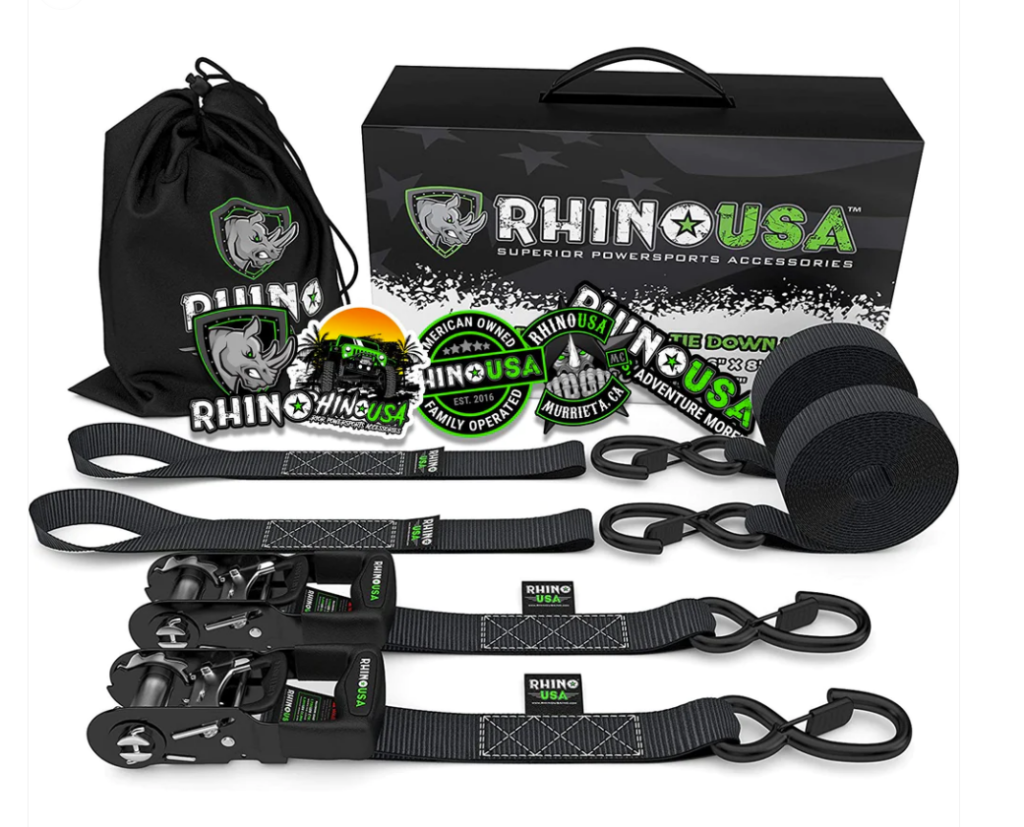
Image courtesy of Rhino USA (Product featured above: 1.6″ x 8′ HD Ratchet Tie-Down Set 2-Pack)
Axle Straps
These straps are the safety belt for your vehicle’s axles. They hold on tight and keep your UTV from moving around during transport. Be sure to look for axle straps with tough webbing, heavy-duty D-rings, and high break strength.
Retailers like Mac’s Custom Tie-Downs will have what you need.
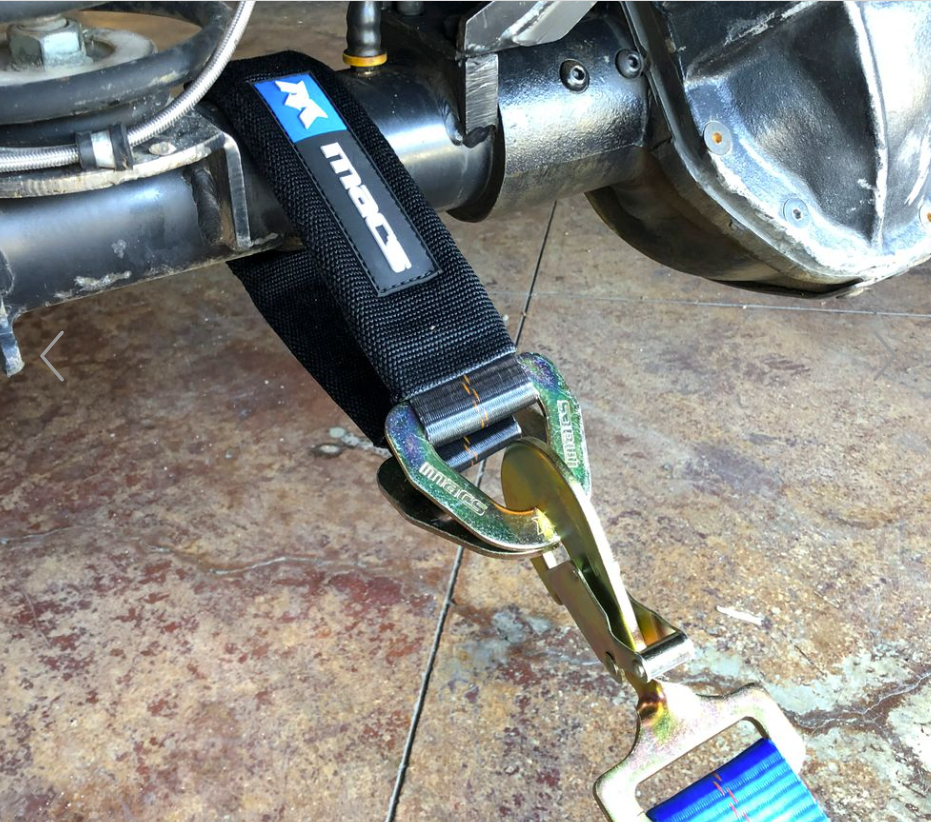
Image courtesy of Mac’s Custom Tie Downs (Product featured above: 24″ Axle Strap with Sleeve – Black)
Wheel Nets and Tire Bonnets
Wheel nets (also known as “tire bonnets”) are used to lock your UTV’s wheels in place during transport. These pieces of equipment are good if you’re traveling long distances, as they remain tied down to your trailer safely the whole way. Alternatively, you can use wheel chocks or tire blocks to secure your UTV. These are cheaper and quicker for short trips.
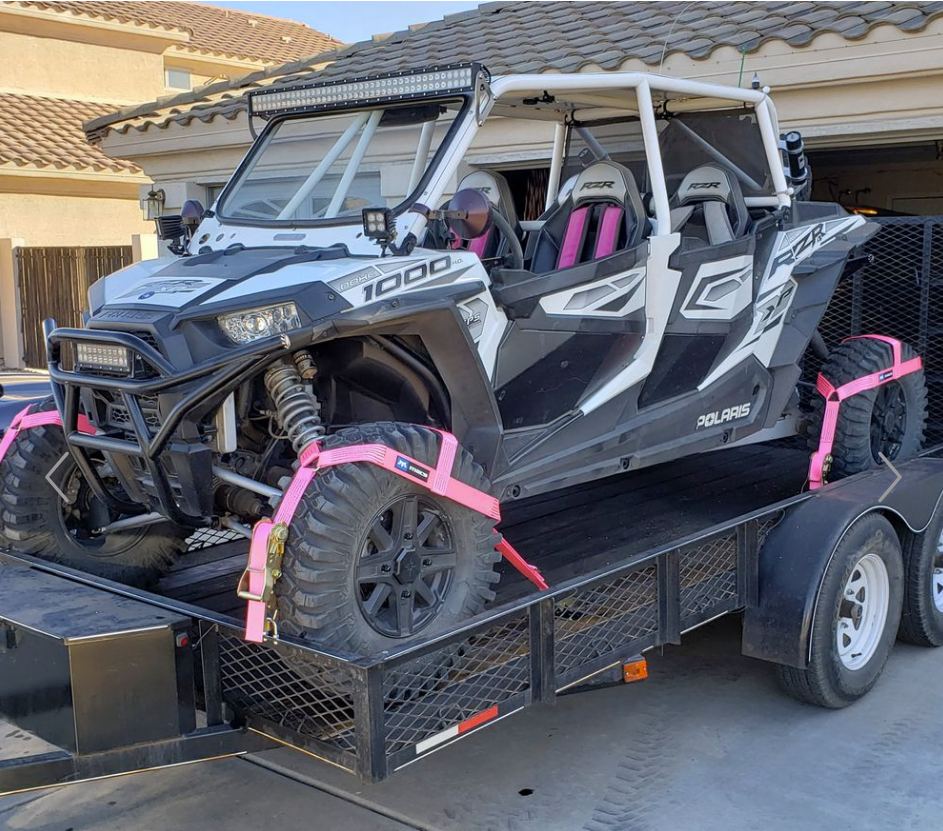
Image courtesy of Mac’s Custom Tie-Downs (Product featured above: Medium Adjustable UTV Tire Net Pack)
Safety Chain
The last piece of equipment you’ll need is a sturdy-length safety chain. Attach this with a hook and clasp to the front tow hook of your UTV and secure it to the trailer floor. This chain is the last line of defense if your other straps break loose, as it will buy you time to pull over before the UTV falls off the trailer.
You can find UTV tire chains through retailers like Tire Chains ‘R’ Us.

Image courtesy of Tire Chains ‘R’ Us (Product featured above: Ladder Pattern V-Bar ATV-UTV Tire Chains)
Step-by-Step Guide to Securing Your Side by Side
Having covered the equipment basics, let’s now delve into the core process. In this part, we will guide you through the step-by-step process of securing your side-by-side. From identifying anchor points to using four-strap ratchet tie-downs, we’ve got you covered. Consider this your practical guide to mastering the art of tying down a UTV.
If you’re more of a visual learner, here’s a video that helps explain the process for tying down a side-by-side on a trailer.
Step 1: Prep Your Trailer
The first step is to ensure your trailer is properly connected to your truck or towing vehicle. Make sure your trailer matches the hitch attached to your truck, as hitches that are too small will not be secure.
Then, crisscross your safety chains and attach them to the truck as well. Next, plug in your brake lights and test that they are working.
Lastly, remove any wheel chocks that keep your trailer in place and raise the support stand.
Step 2: Identify Anchor Points and Secure Your Ramps
Your anchor points are where you’ll hook up your tie-down straps or chains, ensuring your UTV stays put during transport.
Look for the lowest points of the UTV and the trailer’s furthest points. These will give you the best leverage and stability. If you’re tying down to a D-hook on the trailer floor, make sure they are secure and not going to pull out of the trailer when you apply tension.
Next, set up your trailer ramps. These ramps usually have hooks on the end that latch into the end of the trailer, locking them in place.
Once you’ve placed the ramps, you can drive your UTV up onto the trailer in low gear, stopping just before the front bumper touches the back of the trailer.
Step 3: Place Protective Measures
The four-strap tie-down method is ideal for transporting your UTV as it locks the vehicle in place. The front two straps should pull the vehicle forward, while the back two straps should pull the vehicle backward.
When using a ratchet strap, follow these steps to secure your UTV to the trailer:
- Hook one end of the strap to the UTV and the other end to the trailer.
- Pull the strap tight.
- Use the ratchet to secure the strap.
- Crank the ratchet tie-downs as tight as you can.
- Tie any excess strap securely to the UTV or trailer so it doesn’t fly loose.
With this method, you can easily tie down a UTV, ATV, dirt bike, or dirt bike, ensuring they aren’t going anywhere!
Step 4: Final Touches
Lastly, add your wheel nets, tire bonnets, and safety chain as needed. You can also place wheel chocks under the front wheels or the rear wheels (or both!)
Before you hit the road, make sure your UTV’s suspension is equally compressed on both sides. Tightening a ratchet strap ensures the suspension compresses, but if you pull down one side more than the other, you will wear out one shock before the others.
What NOT To Do When You Tie Down a UTV
It’s important to keep a few things in mind when you’re tying down your UTV. Overloading your UTV trailer (or getting the weight distribution wrong) could damage not only your trailer and side-by-side but your truck as well.
Here’s what not to do when you tie down a UTV:
Don’t: Overload Your UTV trailer
Find the weight capacity of your trailer by subtracting its empty weight from the Gross Vehicle Weight Rating (GVWR) listed. The result will be the maximum cargo capacity of the trailer. Exceeding this capacity can overload the towing vehicle and affect its braking and handling.
Don’t: Skip Out on Proper Fasteners
Using a single ratchet strap will spell doom for your UTV, and even though they can be expensive, it’s important to tie down a UTV with at least four straps. Using wheel chocks and a safety chain is also key for safe travel.
Don’t: Improperly distribute weight
If your UTV’s weight isn’t properly distributed, the trailer will sway uncontrollably in the right conditions. About 60% of the weight should be in front of the tandem axle and 40% behind it to avoid swaying.
Tips for Safe Traveling with Your UTV and Trailer
Safe towing involves more than just tying down your UTV properly. It’s also about how you drive while towing. Use these tips for a safe and smooth towing experience:
DO: Avoid Sudden Maneuvers
This goes for everyone pulling a trailer, no matter if it has a UTV on it or not, but slow and steady handling is the key to safety. Avoid sharp turns or abrupt stops.
DO: Maintain a Constant Speed
Sudden changes in speed can lead to instability and make it harder to control the trailer, causing you to potentially lose control.
DO: Regularly Check Towing Equipment
If you’re driving for long periods, make sure to inspect your trailer and tie-downs whenever you stop to ensure nothing has come loose while traveling.
Protect Your UTV On and Off the Road
Protecting your side-by-side during transport is just as crucial as safeguarding it before and after use. This primarily involves safe storage!
You will need an enclosed place to keep the vehicle away from rain, moisture, and UV rays, which can cause engine corrosion and tire dry rotting. So, if you don’t have enough space to store your UTV in your own garage, it’s a good idea to look for alternative storage solutions.
Fortunately, most UTVs are less than 3 meters long, so renting a 10’x10’ storage unit is the perfect solution for keeping it safe until your next adventure!
You can even find safe, local, and affordable storage options with marketplaces like Neighbor.com. Neighbor is a peer-to-peer storage marketplace that pairs vetted hosts (who have free space) with people who are looking to store their ATV, UTV, or other equipment in a safe place.