


Traveling around the country means hooking up to a lot of dirty power along the way. Whether it stems from epic thunderstorms or an old electric grid, dirty power means your RV could be hit with an appliance-damaging power surge. That’s why you need the best RV surge protector. (Because you’ve invested too much time and money for a power surge to damage it).
Key Takeaways
- Only appliances plugged into the surge protector are safe from power surges.
- When using RV surge protectors, plug into the electrical hookup before you plug in your camper.
- The cheapest option is power strips with a built-in surge protector. These plug into the outlet and protect whatever appliances are plugged into it.
- To select the correct RV surge protector, account for the amp requirements.
Top Picks for Advanced Surge Protection in RVs
These top picks include RV surge protectors that are leaders in smart technology and monitoring. Let’s take a look.
Power Watchdog by Hughes
The Power Watchdog by Hughes blends technological prowess and a user-centric design. Equipped with automatic Electrical Management System (EMS) monitoring and Bluetooth control, it sends wireless fault alerts directly to your smartphone. So you always know what’s happening, even when you’re not physically near your RV.
Compared to hardwired models, Power Watchdog has a major benefit that differentiates it from other models on the market.
When a hardwired protector is hit with a surge, you have to replace that whole model – which with hardwired models is expensive. But Power Watchdog supplies replaceable cores. So instead of buying a whole new unit at full price, you just buy the replacement core. That’s a real value add!
The Power Watchdog offers the following features:
- Actively protects your RV by cutting off the power supply when unstable power conditions are detected
- Prevents damage to your RV’s electrical system
- Automatically restores power when conditions stabilize, so you don’t have to worry about resetting the power yourself.
- Replaceable cores are sold separately, meaningyou don’t have to buy a whole new unit if you get hit with a surge.
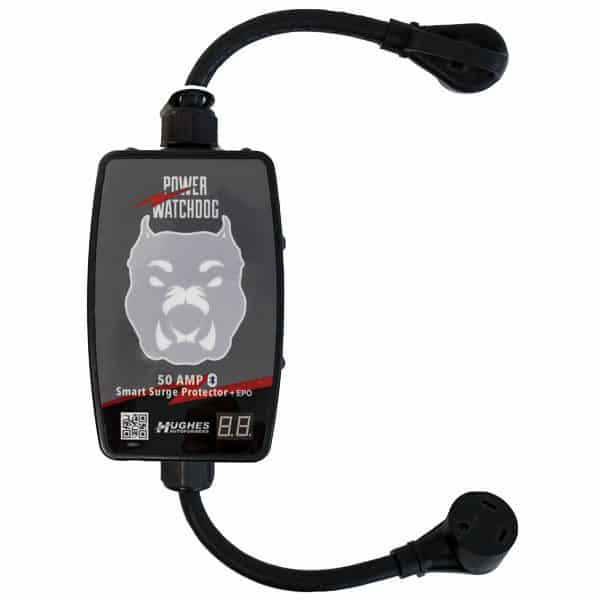
Specs
- A 3,000-6,100 joule rating
- 30 amp and 50 amp models available
Power Watchdog comes in six different models ranging from $349-$135.
This provides both protection and convenience for your RV. So, even if your RV is in storage, it’s still protected.
Link to buy available here
Progressive Industries EMS
Progressive Industries EMS is much more than a surge protector; it’s a comprehensive electrical management system. Acknowledged for its top-notch quality, it provides reliable protection for both 30-amp and 50-amp RVs against voltage spikes. Progressive’s electrical management systems are designed for RVs.
The surge protector plugs into the electrical hook-up, and then your RV plugs into the surge protector. Nice and simple.
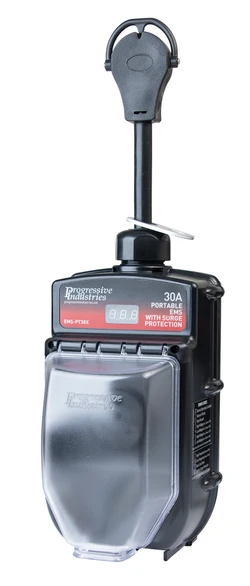
Some key features of a Progressive Industries unit include:
- Built-in surge protection
- Voltage regulation
- Open ground, open neutral, and reverse polarity detection
- Miswired pedestal detection
- Designed for outdoor use
Specs:
- 1650 Juele rating
- Available in 30 and 50-amp designs
- All weather shields included on some models
The Progressive Industries EMS costs between $200-$300. (Link to buy here)
If you’re looking for an integral surge protector that you don’t have to worry about plugging in all the time, then Progressive Industries also has a selection of hardwired units.
Hardwired surge protectors are of higher quality and hook directly into your breaker box or disconnect box (for your AC unit.) But they also have to be installed by an electrician.
Surge Guard by Southwire
Surge Guard offers impressive protection with 2,450 joules for the 30-amp version and 3,350 joules for the 50-amp version. It’s also equipped with integrated wiring diagnostics and weather-resistant treatment, enhancing its durability and reliability.
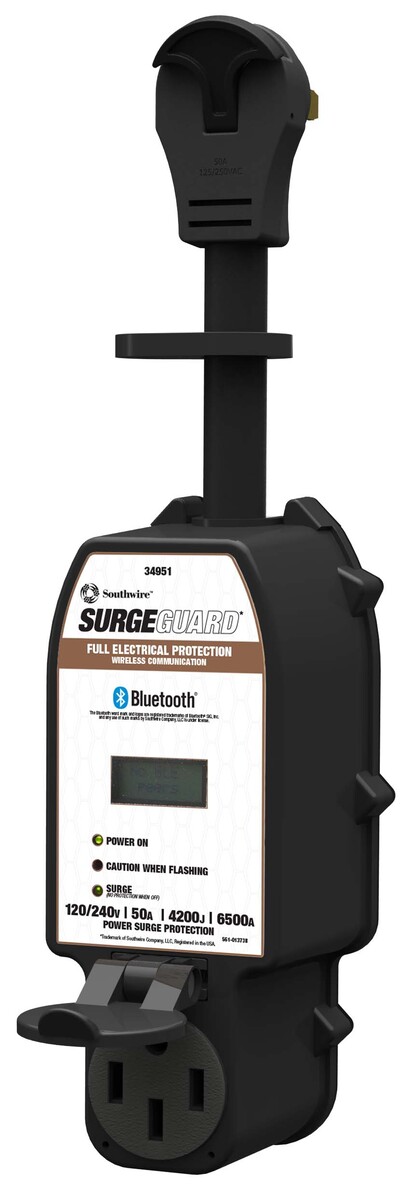
Common Features:
- Total electrical protection from faulty park power
- Provides protection against:
- Power surges
- Open ground
- Open neutral
Specs:
- Hard wired unit
- Requires installation
- Available in 30 and 50-amp varieties
- 2,450-3,350 joules of protection
(Link to buy available here).
However, keep in mind that the Surge Guard:
- Doesn’t function as an EMS system, meaning it doesn’t send alerts about power fluctuations to your phone.
- Requires manual resetting after surges. Yes, you have to go turn the power back on.
- Is non-serviceable, so it requires full replacement when it reaches its protective capacity.
Despite these limitations, its sheer quality and durability make it a strong contender. State-of-the-art features like these also explain its above-average price. If you have your mind set on a Surge Guard by Southwire, expect to pay around $763 on Amazon and around $1,218 at zoho.com.
Do I Really Need an Expensive Surge Protector for My RV?
No, you don’t need to spend a fortune on a hardwired surge protector.
You can protect your RV with a couple of power strips that have built-in surge protection. But there are some higher-tech models that could be worth the investment. They provide superior defense and ease of use, so it’s worth looking around to see what’s the best RV surge protector for you.
As a guide, don’t spend more on your surge protector than you would on the least expensive appliance that you want to protect. (E.g. your microwave costs around $200, so that’s a good starting budget.)
Investing in a surge protector saves you from the higher cost of replacing appliances or RV wiring if a sudden power surge were to cause damage.
Choosing the Right RV Surge Protector for Your Needs
You want to choose a protector that’s…
- Compatible with your camper
- Gives you peace of mind
- Fits your budget
By considering a few deciding factors, you can easily find the best RV surge protectors for your use.
Factor #1 To Consider: Amp Requirements
Determine your amp requirements to make sure the unit is compatible with your RV. For instance, do you have a 30 amp or a 50 amp electrical hook-up? The surge protector should match your plug.
Factor #2 To Consider: Hardwired vs. Portable
Choose between hardwired or portable. Do you prefer the high quality hardwired system that is less likely to wear out? Or do you prefer the convenient plug-and-go portable surge protectors that are easy to replace?
Note: Portable RV surge protectors are easy to install and replace. All you need to do is plug it into the campground’s pedestal or main power source. Then, connect the electrical cord from your RV to the surge protector. Note that these portable surge protectors require more frequent replacement compared to hardwired options.
While hardwired surge protectors offer great reliability, they need to be professionally installed by an electrician. Despite the extra effort of hiring an electrician, hardwired surge protectors offer:
- Higher quality
- Less chance of wearing out the connections
- Reduced risk of theft since it is hardwired inside your RV
Next, Finalize Your Budget:
What’s it worth to you? Do you have a full kitchen with high-end appliances?
Then, it’s worth it for you to invest a couple hundred dollars on an RV EMS (also known as an “Electrical Monitoring System”).
But if you only have one or two appliances you want to protect, it’s much easier – not to mention a whole lot cheaper – to buy a couple of power strips with built-in surge protection from Walmart and plug those two appliances into them.
Each of these factors plays a crucial role in ensuring that the surge protector you choose is not only effective but also compatible with your RV.
How Many Joules of Surge Protection Do I Need to Protect My RV?
It depends on if you have a 30 amp or 50 amp hookups. The 50 amp hookups allow more power to come through, meaning you’ll need more protection.
Here’s what you need to know about joule ratings: the higher the joules, the greater protection from power surges.
For an RV with 30-amp connections, you should aim for a surge protector with a minimum of 3000 joules of protection. For 50-amp RVs, go for a minimum joule rating of 6100.
Summary
RVs aren’t inexpensive. A reliable surge protector is just one way to prevent costly electrical damage. Yet another way to sidestep electrical-related damage is to store your camper properly when you’re not using it.
If you keep it hooked up to power when you store it, you’ll need to use your EMS to monitor the power coming in. If you find you keep experiencing surges or potential surges, then you know you’re connected to dirty power.
The best course of action is to find a storage place that has good, clean power. And that’s not always easy. But Neighbor is making it easier.
Neighbor is a self-storage marketplace that provides residential RV storage options (including covered and enclosed storage spaces) that are affordable and close to home.
You can search for RV storage near you here.