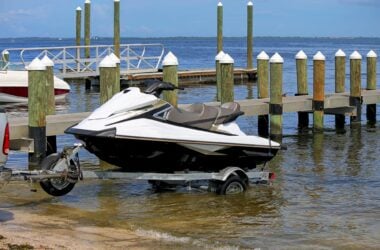


If you’re looking for a way to spice up your summer beach activities, a jet ski (also known as a “personal watercraft”) is a great way to do so. But, the price of a brand-new Sea-Doo can easily turn you off from the idea. Thankfully, buying a used jet ski is an option, and used jet ski prices are certainly easier to stomach.
In this guide, we’ll tell you everything you need to know about purchasing a second-hand jet ski, including what questions to ask the seller and how to find good deals.
The Importance of a Pre-Purchase Inspection
Before investing your hard-earned money into a private sale, thoroughly inspect the watercraft. This step is vital to ensure you are not wasting your money on a faulty product.
So, what should you look for during the inspection?
A good rule of thumb is to start with the mechanical elements of the jet ski and move toward cosmetic or “less integral” elements after that. That way, if you notice something telling during the mechanical tests, you don’t have to waste more time than necessary.
We suggest the following order for your pre-purchase inspection:
- Engine Hours and Service Log
- Compression Test
- Hull Examination
- Seats and Upholstery
- Intake Grate
- Bilge Pump
Step #1: Decode the Jet Ski’s Hours
The number of engine hours gives an indication of how much use the jet ski has undergone and can help estimate the jet ski engine’s potential lifespan. Jet skis are often categorized into ‘low-hour’ or ‘high-hour’ based on an average of 30 hours of use per year.
But remember, individual usage can vary greatly. For example, a jet ski owned by someone who lives in Florida will likely have accrued more engine hours because jet ski season is much longer in their southern climate.
Most jet ski engines aren’t designed to last a long time, so it’s uneconomical to purchase a personal watercraft with more than 300 hours. A good range to be in is around 100 hours or less.
Step #2: Review Service Records
Service records are essentially the jet ski’s report card. They reveal how well the PWC has been cared for and can identify any potential issues not apparent through a visual inspection.
Note that a jet ski without accessible service records is a red flag. Costly issues or unsafe conditions could be lingering beneath the surface–with you being none the wiser.
Remember, regardless of the hours on the clock, the most accurate reflection of a jet ski’s condition is its service history–not necessarily its “low-hour” or “high-hour” categorization. Low engine hours can be enticing, but used jet skis that haven’t been serviced professionally can be a dangerous investment.
Step #3: Perform the Jet Ski Compression Test
If you’re dedicated to saving money by buying a used jet ski, then you need to learn how to perform a compression test. A compression test will tell you whether the engine is in good shape, and if the cylinders are firing equally.
To start out, you need to have an engine compression gauge. You can pick up a compression gauge for between $50 and $100 online or in an auto-parts store.
Then, do a bit of research online on the jet ski model you’re going to look at. Each engine will have a different compression rate, so do some research to see if you can find the ideal range. Typically, for a 2-stroke jet ski, you want at least 150 psi from each engine cylinder. The range for a supercharged jet ski is a bit different because they have more cylinders (around 175-190 psi). For example, the Kawasaki Jet Ski Ultra 310LX-S is a 4-stroke, four cylinder engine.
To perform the actual test, follow these steps:
Make sure the engine is cold and the battery is fully charged
- Remove the spark plugs from the cylinder heads
- Use the appropriate thread adaptor and screw in your gauge
- Turn the ignition to crank the engine, it won’t start without the spark plugs, but it will apply pressure to the gauge
- Take note of the reading, and check the other cylinders
If all cylinders have similar pressure, then you’re in good shape. If one is much higher or lower than the others, that’s a sign that the engine might need to be serviced.
Step #4: Examine the Jet Ski Hull
While a new jet ski will have that glisten and gleam of freshly waxed paint, it comes at a price. But, that doesn’t mean a used jet ski has to be dull and lackluster. That’s why you should always check a jet ski’s hull before making a decision.
Start by looking for visible signs of damage like cracks, chips, or dents. Pay particular attention to the keel and stern area, as signs of wear or damage can reveal the jet ski’s history and potential future issues. Make sure the hull and deck are not separated or damaged at the seam, and inspect for any warping or deformities.
Next, examine the jet ski for indications of botched repair work. Here are some things to look for:
- Poor fiberglass patches
- Mismatched paintwork
- Check that the drain plugs are intact and functioning correctly
- Look for fading or dulling of the gelcoat
For small chips or dings, you can easily repair yourself. But, for large cracks, you’re looking at hundreds, maybe thousands of dollars in parts and labor, so steer clear.
Step #5: Assessing the Condition of Seats and Upholstery
While it might seem like a trivial element of the jet ski inspection, checking the seats is actually very important. Even minor tears or holes in the seat upholstery should be caught early to prevent water from seeping through and causing further damage.
If everything else is in tip-top shape, a few cracks in the seat cover might not be the biggest problem. You can easily DIY a replacement for around $100. You can even use that as leverage to talk the seller down.
Step #6: Inspect the Intake Grate

Intake Grate on a PWC, Image Courtesy of worx.com.au
Proper maintenance for jet skis involves cleaning out the intake grate before and after each use. Sticks, algae, seaweed, and other marine debris can easily clog up the intake grate and even harm the impeller. If you take a look at the intake grate on the jet ski, and it’s filled with debris, chances are the seller hasn’t taken care of other parts of the jet ski, either.
Step #7: Test the Bilge Pump
Not all personal watercraft come equipped with a bilge pump, but if the one you’re looking at does, you’d better test it. The best way to test a bilge pump is to add some water into the hull with a garden hose and then turn on the pump to extract it.
Even if the jet ski has a tiny crack or water leak, a powerful bilge pump will keep it afloat for all your rides.
Step #8: If Possible, Go for a Water Test
After you’ve completed your pre-purchase inspection, you can see if the seller will allow you to take the jet ski for a test ride. After all, you’d test drive a car before you purchase it, so why should buying a used jet ski be any different?
If the seller agrees to a test drive, there are a few things to look for while out on the water.
- Easy steering, not locking up or pulling in one direction
- Even acceleration
- Warning lights (make sure there are none)
- Consistent RPMs (typically around 7,000 or above)
Additional Questions to Ask the Seller
As you reach the final stages of your visit with the seller, you can ask them a few more questions to get a full picture of the used jet ski you’re considering.
- Do you lubricate the engine bay when you put the jet ski in storage?
- Have you ever taken it to a service shop, or did you do all the maintenance?
- Have you ridden it in fresh or saltwater?
- What dealer did you purchase it from?
Calculating the True Cost of Ownership
Once you believe you’ve gathered enough insight and think, “I’m ready to buy a used jet ski,” consider a few other costs:
- Jet ski insurance costs typically range between $200 and $500 annually, covering a variety of potential risks and liabilities. Insurance on supercharged jet skis is more than if you were to insure a 2-stroke PWC, simply because they are the “sport” models.
- Safety gear, such as life jackets, helmets, and goggles can run you around $100, especially if you’re buying gear for the whole family.
- Regular maintenance and dewinterization can cost anywhere from $200 to $500.
- Licensing and upkeep on your PWC and jet ski trailer can vary from state to state, so make sure you do your research before purchasing a used PWC.
Prolong the Life of Your Used Jet Ski
If you find a hidden gem and walk away with an older jet ski in great condition, you’re going to want to keep it that way.
The best way to preserve a jet ski’s integrity is to perform regular maintenance and store it properly during the off-season. You want to protect it from the elements since UV rays, rain, and moisture build-up can damage the engine, hull, or electrical system.
If you lack space in your garage to store your personal watercraft, you should consider renting a 10’x10’ storage unit that’s climate-controlled. You can easily save money on jet ski storage by using a provider like Neighbor.com, which has a self-storage marketplace with prices 50% lower than traditional storage options. All of their hosts are vetted and safe, so you can sleep easy knowing your jet ski is snug as a bug all winter long.