
Neighbor.com sampled 40 multifamily properties throughout New York City (Brooklyn, Queens, South Westchester County, the Bronx, and Harlem).
The hope was to unearth insights into NY resident parking pricing trends and equip NYC multifamily property owners with the data-driven parking pricing strategies they need to maximize NOI.
But be aware: the answer to this question “How much to charge for parking space on-site?” isn’t always simple.
The pricing strategy that’s recommended for a multifamily property in Brooklyn may differ from the strategy that’s recommended for a building in Harlem. In some cases, pricing experts may recommend two entirely different pricing strategies for properties next door to each other.
Findings of Neighbor.com’s New York City Parking Research
Within the 469 square miles of NY, resident parking prices can vary up to 300%, even if those properties are located on the same block. In rarer cases, these pricing discrepancies exist for strategic reasons.
A property may charge $100/month more in parking fees than the building down the road because:
- They offer a parking type with more coverage: Competitors may only offer uncovered surface lot parking. In that case, property owners can charge more for covered/indoor parking.
- They have a longer waitlist: If a multifamily property only allocates one space per unit/bedroom/leaseholder, competition for spaces will be high. Higher competition gives property owners the leeway to drive up prices.
- They offer assigned spaces: Competitors may only offer unassigned spaces to tenants.
Parking type, parking ratio, and assignment status are only a few factors to consider when setting (or optimizing) resident parking prices.
How Much Should I Charge for a Space in an Uncovered Parking Lot?
Examples of uncovered parking options: Street-level surface lots, rooftop spaces in parking garages, etc.
Of the 40 multifamily properties sampled, 35% currently offer uncovered parking to residents–but only 56% of that 35% charge residents additional fees to park in those uncovered lots. The other 50%, however, offer free, on-site parking as an amenity.
Of those properties that charge for uncovered parking, the average parking rate for New York, NY is around $305.22/month (Note: This ~$305.22 is a separate, unbundled fee charged on top of monthly rent fees, utilities, storage, etc.)
| Market Name | Raw Average | Charged Average | % of Properties That Offer Uncovered Parking | % of Properties That Charge for Uncovered Parking |
| New York | $171.69 | $305.22/mo | 35% | 56% |
*Definition of “Raw Average”: This average includes properties that offer residents free parking (whether uncovered or covered), as well as those properties that charge residents additional fees for a given type of parking space.
**Definition of “Charged Average”: This average excludes those properties that offer free parking. It only represents those properties that charge residents additional fees to park in their on-site parking facilities.
How Much Should I Charge for a Space in a Covered Parking Structure?
Types of covered parking options: Private carports, enclosed/open-air parking garage spaces, private residential garage spaces, etc.
Of the 240 multifamily properties sampled, 95% offer one or more types of covered parking. Of those 95% of properties that offer covered parking, 100% charge residents to park in these covered parking spots.
Of those properties that charge for covered parking (private carports, parking garage spaces, private garage spaces, etc.), the average parking rate for New York, NY is around $269/month (Note: This ~$269/month is a separate, unbundled fee charged on top of monthly rent fees, utilities, storage, etc.)
| Market Name | Raw Average | Charged Average | % of Properties That Offer Covered Parking | % of Properties That Charge for Covered Parking |
| New York | $268.62/mo | $268.62/mo | 95% | 100% |
*Definition of “Raw Average”: This average includes properties that offer residents free parking (whether uncovered or covered), as well as those properties that charge residents additional fees for a given type of parking space.
**Definition of “Charged Average”: This average excludes those properties that offer free parking. It only represents those properties that charge residents additional fees to park in their on-site parking facilities.
Factors to Consider When Setting Parking Prices
NY-based property managers/owners shouldn’t make the mistake of setting parking rates arbitrarily (instead of strategically). Popular advice emphasizes the importance of factoring competitor parking rates into pricing decisions–but this is only the first step.
You’ll also want to consider:
#1: Parking Structure Type
Covered parking generally commands higher rates than uncovered parking due to the additional benefits it offers–namely, weather protection and more robust security.
If multiple parking types are offered at your property (both uncovered and covered), you’ll want to structure your parking prices accordingly. Set covered parking spots at higher rates than uncovered parking spots.
#2: Parking Space Type
Multifamily parking spaces in New York may fall into one (or multiple) of these categories: standard, compact, tandem, stacked, or EV charging spaces.
- Compact Spaces: Priced lower due to their smaller size.
- Tandem Spaces: Renting a tandem space is considered an affordable alternative to renting two separate, standard-sized parking spaces.
- EV Charging Spaces: Pricing depends on whether the charging is shared or exclusive to the tenant.
- EV parking prices will vary depending on whether these are communal stations vs. reserved EV parking spaces.
- Of 240 sampled properties, 13% offer EV parking options at no cost to the renter. (When EV charging is free, a property most likely offers communal charging stations).
- 36% mentioned that residents only have to pay third-party charging fees.
- EV parking prices will vary depending on whether these are communal stations vs. reserved EV parking spaces.
#3: Assigned vs. Unassigned Parking
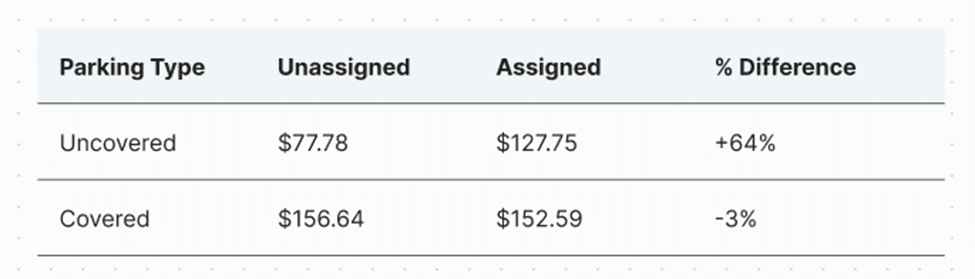
Guaranteed parking is an amenity residents will pay good money for. Surprisingly, however, assigned parking spaces aren’t always priced at higher rates than unassigned parking spaces (according to Neighbor’s 2025 Multifamily Parking Report).
240 properties were sampled in this study, and the findings may surprise you:
The key takeaways?
- When it’s uncovered parking, assigned parking spaces are (generally speaking) substantially more expensive than unassigned spaces
When it’s covered parking, the price differences between assigned vs. unassigned spaces are minimal.
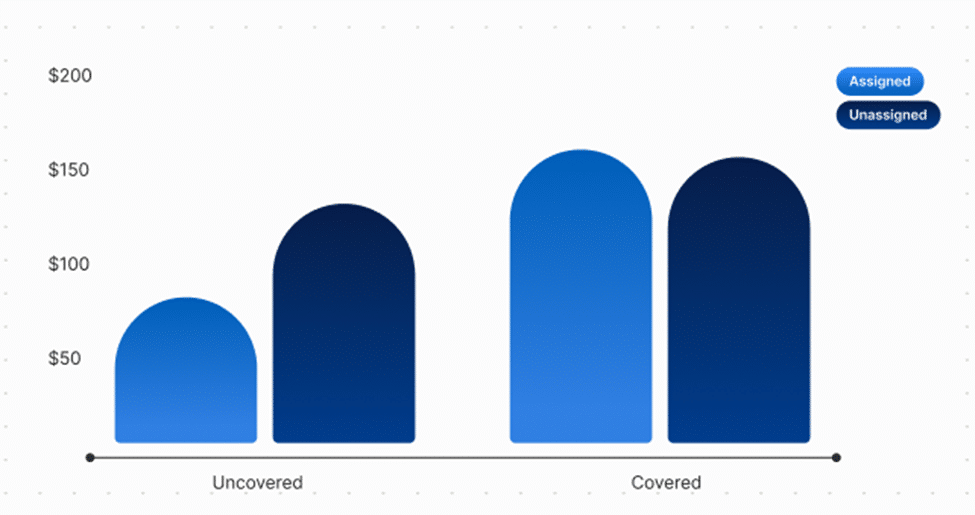
But that doesn’t mean property owners can’t (or shouldn’t) charge more for assigned parking spaces. Even if existing residents already pay the same monthly rate for both assigned and unassigned parking spaces, you can implement these price adjustments with new residents.
When you, as a property owner/manager, provide extra value, you can justify extra costs. Here are some of the most marketable perks of assigned parking:
- Guaranteed parking: Eliminates unpredictability
- Reduces unauthorized parking: When spaces are assigned to specific residents, it’s easier to spot unauthorized parkers.
- Commercial lots are less likely to offer assigned parking: How do you ensure renters (both residents and non-residents) choose your parking lot over another downtown lot? Assigned parking. Commercial surface lots are typically first-come, first-serve.
#4: Market Rate (Location)
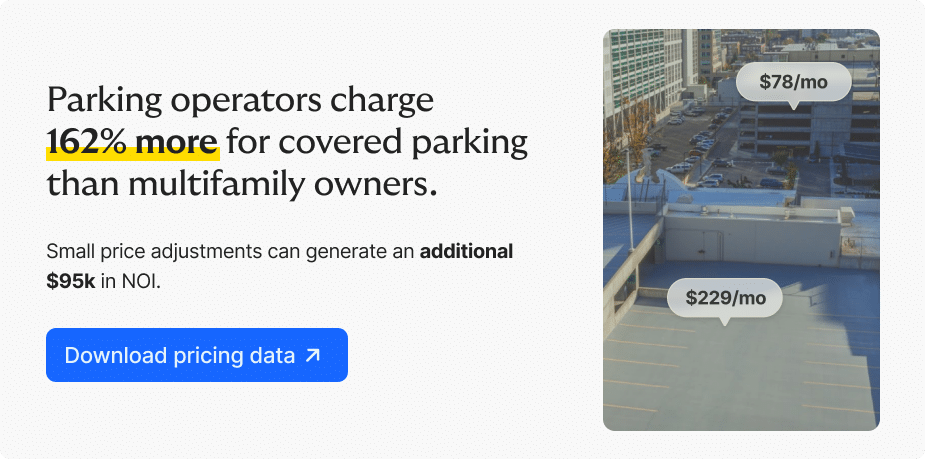
Neighbor.com’s research revealed that, in some cases, commercial parking operators in NY actually charge less for parking than multifamily properties (despite the similarities these spaces share regarding coverage, security, etc.).
Note: Out of the 10 markets sampled, New York was the most likely to contract out resident parking to a third party, which could involve additional management fees that need to be offset with higher parking rates.
Multifamily Parking Rates vs. Market Rates (Uncovered Parking)
In New York, NY, commercial parking facilities charge (on average) around 20% less for uncovered parking than multifamily properties in the area.
| Market Name | Avg. Multifamily Parking Price | Avg. Market Parking Price | Price Difference ($) | Price Difference (%) |
| New York | $305.22/mo | $245.06/mo | -$60.16/mo | -20% |
Multifamily Parking Rates vs. Market Rates (Covered Parking)
In New York, NY, commercial parking facilities charge (on average) around 48% more for covered parking than multifamily properties in the area.
| Market Name | Avg. Multifamily Parking Price | Avg. Market Parking Price | Price Difference ($) | Price Difference (%) |
| New York | $268.30/mo | $397.95/mo | +$129.65/mo | +48% |
#5: Parking Ratio
The average parking ratio in NY is lower than the number of vehicles per household (0.7 vs. 1.2), creating a higher demand for more on-site parking options. This is common in larger cities where buildable square footage is limited.
Sure, a shortage of parking spaces = more parking revenue, but on the flip side, limited parking spots can negatively impact renter satisfaction.
Properties with limited parking can consider alternative solutions, such as utilizing platforms like Neighbor for overflow parking. That way, owners can meet existing (or prospective) tenants’ parking needs and increase the likelihood that these tenants will sign (or renew) a lease.
#6: Ratio to Rent
On average, multifamily properties across the U.S. set their parking rates at 3-4% of average monthly rent costs.
To boost NOI (and potentially increase property valuation), Neighbor recommends setting resident parking rates at 8-10% of monthly rent costs.
#7: Recommendations from Parking Pricing Tools and Experts
To ensure competitive pricing, property owners should analyze hyperlocal data, including neighborhood trends, resident income levels, and parking demand. For guidance on how to best optimize your parking strategy, Neighbor.com offers free consultations and personalized portfolio analyses for property owners.
When Are Free Parking Spots the Best Pricing Strategy?
Some NY-based multifamily property owners opt to include parking in rent (or offer it for free) for the following reasons:
- To differentiate their property from competitors.
- To increase the # of amenities offered to tenants, increasing the attractiveness/marketability of a property.
- To encourage residents to utilize on-site parking instead of nearby commercial garages.
Making Adjustments to Your Resident Parking Prices
When implementing pricing changes, always proceed with caution to avoid resident dissatisfaction. As a best practice, take the following measures:
- Only introduce modest increases during lease renewals (no off-cycle increases)
- Test new parking prices with new residents before implementing changes property-wide.
- If rolling out changes property-wide, give residents plenty of advanced notice.
Remember: When you optimize your resident parking prices, you can boost NOI without having to raise rent.
For pricing data in the top 10 US markets (including NY), as well as cutting-edge parking optimization strategies, download the 2025 Multifamily Parking Intelligence report here.