
Experts estimate that 50% of multifamily properties across the US undercharge for resident parking (this includes multifamily properties based in the Salt Lake City area).
If you’re wondering how much to charge for parking space in larger cities like SLC, we have the hyperlocal data necessary for setting optimized parking prices (prices proportional to your residents’ purchasing power).
Your goal as a property owner is to maximize the value of your multifamily parking assets.
Our goal at Neighbor.com is to make data-backed parking pricing recommendations for property owners in multifamily properties across Salt Lake City, Utah’s capital city.
Our recommendations will draw from extensive research across the following SLC neighborhoods: Downtown SLC, South Salt Lake, Murray, West Valley, and Southwest SLC.
Key Insights from Salt Lake City’s Residential Parking Market
Property owners are often surprised to discover that within the same Salt Lake City neighborhood, parking fees can fluctuate dramatically – sometimes varying by up to 300% between neighboring properties. This significant disparity raises important questions about optimal pricing strategies.
When faced with such wide-ranging rates – for instance, one property charging $40 monthly while a nearby competitor asks $150 – how do you determine the sweet spot for your facility? The solution depends on the following variables:
- Your specific market
- The type of parking structure
- Space availability: Do you have more parking than other properties in the area? Or is there a waiting list in effect?
- Parking assignment policies: Assigned vs. unassigned parking.
The data showed that 65% of properties offered at least 1 form of parking. In some cases, all on-site parking options were rented out at no additional charge. In other cases, one parking type was free while another was charged at a monthly rate.
As a property owner, know there’s a way to maximize parking revenue without compromising resident satisfaction. Here’s how:
How Much Should I Charge for an Uncovered Parking Space in Salt Lake City, UT?
Types of uncovered parking options: An uncovered parking lot (also known as a “surface lot”), rooftop spaces in multi-level parking garages, etc.
Outdoor parking in the Salt Lake multifamily market revealed some interesting trends. Our research shows that 80% of [20] surveyed properties provide uncovered parking options. 18% of that 80% charge residents for uncovered parking.
For properties that do charge for uncovered parking, the average uncovered parking rate is around $39/month (this is charged separately from base rent and other fees).
Here’s how the numbers break down:
| Market Name | Raw Average | Charged Average | % of Properties That Offer Uncovered Parking | % of Properties That Charge for Uncovered Parking |
| Salt Lake City | $7.31/mo | $39.00/mo | 80% | 19% |
*Definition of “Raw Average”: This average includes properties that offer residents free parking (whether uncovered or covered), as well as those properties that charge residents additional fees for a given type of parking space.
**Definition of “Charged Average”: This average excludes those properties that offer free parking. It only represents those properties that charge residents additional fees to park in their on-site parking facilities.
How Much Should I Charge for a Covered Parking Space in Salt Lake City, UT?
Salt Lake City’s harsh winters make covered parking particularly valuable, which is reflected in our market analysis of carports, enclosed garages, and private parking spaces.
A substantial 95% of surveyed properties offer covered parking options, with 84% of those properties setting additional charges for these premium spaces.
Surprisingly, Salt Lake City properties charged for covered parking at rates around $41.35/mo–only marginally more than the average rate for uncovered parking ($39/mo).
Note: This additional fee exists independently of regular rental charges and other property-related expenses.
| Market Name | Raw Average | Charged Average | % of Properties That Offer Covered Parking | % of Properties That Charge for Covered Parking |
| Salt Lake City | $34.73/mo | $41.35/mo | 95% | 84% |
*Definition of “Raw Average”: This average includes properties that offer residents free parking (whether uncovered or covered), as well as those properties that charge residents additional fees for a given type of parking space.
**Definition of “Charged Average”: This average excludes those properties that offer free parking. It only represents those properties that charge residents additional fees to park in their on-site parking facilities.
Factors to Consider When Setting Parking Rates
Factor #1: Parking Structure Type
Across the U.S., covered parking is charged at a higher rate than uncovered parking. For instance, spaces in parking garages (whether fully-closed or open) are typically more expensive than parking spots in an uncovered surface lot.
Looking at Salt Lake City, specifically, covered parking rates are only ~6% higher than uncovered parking rates (on average). This marginal price difference between covered and uncovered parking spots is considered surprising behaivor, as residents of high-traffic areas and snowstorm-prone areas are willing to pay more for the protection of covered parking spaces.
Factor #2: Space Type
Standard, compact, tandem, and EV-equipped spaces each require unique pricing strategies:
Compact Spaces
The market typically values these at 15-20% below standard rates due to their lower square footage (and therefore their lower maneuverability).
Tandem Arrangements
While these spaces aren’t particularly convenient (as cars will have to be parked front to back, restricting access), these parking options are less expensive than two individual spaces at the same multifamily building.
EV Charging Spaces
With Utah’s growing electric vehicle market, charging-equipped spaces represent an emerging premium segment.
Looking at the entire population (all 240 buildings contacted across 10 top markets), about 42% of properties are offering one or more EV charging options for residents, including
- Communal EV charging stations
- Private/assigned EV charging spaces
But how much more do Salt Lake multifamily properties charge for EV spaces (compared to traditional parking spaces)?
In some cases, EV charging stations are completely free for residents to use. While private/assigned EV spaces are almost always charged at an escalated rate, communal charging stations are not charged at additional rate. At the very most, residents will have to pay a third-party free when using third-party charging stations–a fee that multifamiy property managers/owners have no say over.
Here’s a closer look at how these multifamily properties are pricing their EV parking options:

Factor #3: Assignment Status
While conventional wisdom suggests assigned spaces should command higher rates, this isn’t the reality across all contacted markets (Salt Lake City, Los Angeles, New York, Seattle, San Francisco, Miami, Washington D.C., Phoenix, Denver, and San Diego),
Here’s what the data showed:
- Uncovered spaces show significant price variations between assigned and unassigned parking options.
- Covered parking is subject to a minimal price differential based on assignment status (as you’ll see in the chart below).


One simple way to increase parking revenue is to introduce assigned parking into your menu of resident amenities. Assigned parking spots can be priced at higher rates for the following reasons:
- They’re more secure: Unauthorized parkers are easier to detect when spaces are assigned
- They’re more convenient: Residents can rest assured that they’ll never have to resort to street parking. Everyone who is assigned space will be entitled to guaranteed parking.
- They’re rare finds: Salt Lake residents want those rare jewels that are assigned spaces
Factor #4: Market
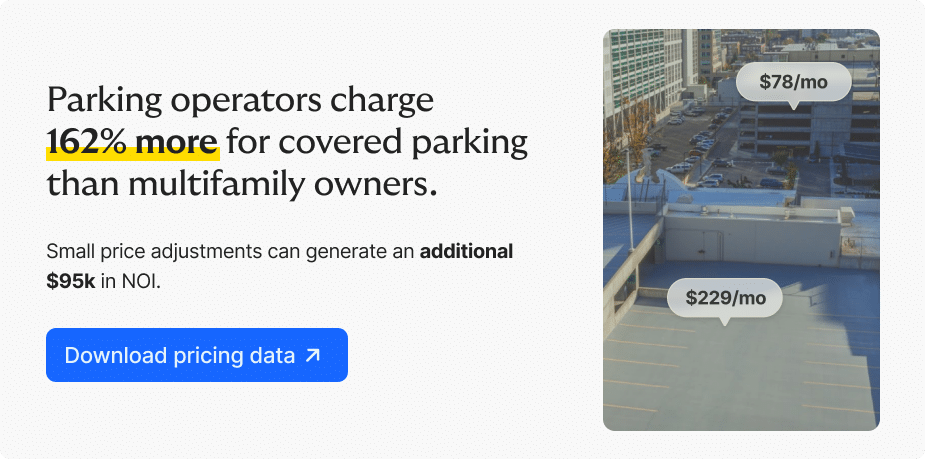
Commercial operators of SLC parking garages charge approximately 162% more for covered parking than multifamily property owners. This gap suggests potential revenue optimization opportunities for well-located residential properties.
There are very few reasons why multifamily property owners should be charging over 160% less for parking than a parking operator located in the same neighborhood.
With this parking pricing data at their disposal, multifamily owners and their property managers will be better equipped to set strategic parking rates.
Multifamily Parking Rates vs. Market Rates (Uncovered Parking)
In Salt Lake City, commercial parking facilities charge (on average) around 60% more for uncovered parking than multifamily properties in the area.
| Market Name | Avg. Multifamily Parking Price | Avg. Market Parking Price | Price Difference ($) | Price Difference (%) |
| Salt Lake City | $39.00/mo | $62.26/mo | +$23.26/mo | +60% |
Multifamily Rate vs. Market Rate (Covered Parking)
In Salt Lake City, commercial parking facilities charge (on average) around 196% more for covered parking than multifamily properties in the area.
| Market Name | Avg. Multifamily Parking Price | Avg. Market Parking Price | Price Difference ($) | Price Difference (%) |
| Salt Lake City | $41.35/mo | $133.62/mo | +$92.27/mo | +223% |
By setting covered parking at just 50-70% of the market rate, multifamily properties in SLC can earn an additional $69k in NOI (roughly) per year per property. Across a 25-property portfolio, this can translate to millions of dollars in additional revenue.
Factor #5: Rent Ratio
Analysis shows successful properties typically price parking at 4-6% of monthly rent rates, though prime locations can sustain higher percentages (anywhere between 8-10% of monthly rent costs).
In evaluating 10 different markets (Los Angeles, New York, Salt Lake City, Seattle, San Francisco, Miami, Washington D.C., Phoenix, Denver, and San Diego), we found that, on average, monthly parking fees equate to 3-4% of total rent costs.


Factor #6: Supply-Demand Dynamics
With Salt Lake City’s average parking ratio at 1.5 spaces per unit and vehicle ownership at 1.9 per household, demand typically exceeds supply, creating pricing leverage for property owners.
Property managers needing to boost ancillary revenue can incremently increase parking rates.
Professional Pricing Resources
While this report provides valuable benchmarks, optimal pricing requires property-specific analysis. Consider consulting parking management experts for customized recommendations.
Strategic Benefits of Free Parking
Some properties strategically choose to include parking in base rent to:
- Differentiate from competitors: Free parking isn’t an amenity offered at every multifamily property. If a prospective renter is deliberating between apartment complexes, free parking is one amenity that could potentially sway someone who’s on the fence.
- Enhance marketing appeal: Free parking is a marketable amenity, one that can be featured in materials like brochures and flyers.
- Reduce vacancies: Free parking reduces the risk of residents seeking out third-party facilities nearby.
Implementing Rate Changes Successfully
When adjusting parking rates, consider these best practices:
- Test new structures with prospective residents first:. Overall, it’s riskier to unveil new resident parking prices property-wide, as this can affect resident satisfaction
- Avoid off-cycle increases: If you increase parking prices mid-lease, you may face tenant pushback.
- Be transparent about these parking rate increases: Residents will want to know the “when” and “why” of this new pricing structure. In an email or other written communication, explain why these pricing changes are taking effect (whether it be cost of living fluctuations or new amenities like EV charging) and when. The last thing you want to do is ambush your residents.
For deeper insights into Salt Lake City nationwide parking pricing data (and common best practices), you can download the 2025 Multifamily Parking Intelligence here.