

Often, multifamily property owners lack the hyperlocal parking pricing data they need. As a result, they may not know how much to charge for parking space if their primary goals are to a) yield the most parking revenue possible and b) avoid resident dissatisfaction.
Recent research by Neighbor.com revealed some fascinating (and equally valuable) insights about San Diego’s multifamily parking landscape. Twenty apartment complexes across various San Diego neighborhoods–downtown San Diego, Coronado, Northwest San Diego, Chula Vista, Imperial Beach, and Northeast San Diego–were surveyed.
The findings from this Southern California market might put your current parking pricing strategy into question.
San Diego’s Multifamily Parking Landscape: Research Findings
In San Diego, 75% of multifamily owners offer more than one parking type. Prices will vary between these parking types (parking garage vs. surface lot vs. carports). Not only will you see pricing variation between parking types but between apartment complexes, too.
Parking rates at neighboring San Diego properties can differ by up to 300%–an eye-opening disparity that raises crucial questions for property owners. These pricing variations can manifest in adjacent neighborhoods (Chula Vista and Imperial Beach) and even adjacent properties that are located on the same city block.
Consider this scenario: Your neighboring property charges $175 monthly for parking, while another complex two blocks away asks just $65. Where should you position your rates? The answer requires careful consideration of multiple factors unique to San Diego’s market dynamics.
Ultimately, the amount of parking revenue your property can feasibly generate will depend on the following factors (Note: This isn’t an exhaustive list):
- Local market rates: The rates set by local parking operators. Owners of parking facilities in high-traffic areas will charge more for the same parking spaces.
- Parking structure type: Parking garage, parking lot, carports, private garages, etc.
- Space type: Compact, tandem, EV spaces, etc.
- Space availability: Is there more parking than residents, or is there a standing waitlist for the on-site parking lot or parking garage?
- Whether the space is assigned vs unassigned
How Much to Charge for an Uncovered Parking Space in San Diego?
Types of uncovered parking options: Uncovered surface lots, rooftop spaces in multi-level parking garages, etc.
In San Diego, around 75% of multifamily properties offer at least one form of free parking. The uncovered parking option is usually the free parking option.
Data shows that around 75% of San Diego multifamily properties offer uncovered parking to residents. Of that 75% of properties, only 13% actually charge for it, validating the theory that when uncovered parking is available, it’s likely to be free of charge.
| Market Name | Raw Average | Charged Average | % of Properties That Offer Uncovered Parking | % of Properties That Charge for Uncovered Parking |
| San Diego | $20/mo | $160/mo | 75% | 13% |
*Definition of “Raw Average”: This average includes properties that offer residents free parking (whether uncovered or covered), as well as those properties that charge residents additional fees for a given type of parking space.
**Definition of “Charged Average”: This average excludes those properties that offer free parking. It only represents those properties that charge residents additional fees to park in their on-site parking facilities.
How Much to Charge for Covered Parking Space in San Diego?
Types of covered parking options: Private carports, enclosed/open-air parking garage spaces, private residential garage spaces, etc.
In San Diego’s multifamily market, 80% of surveyed properties offer covered parking spots. Of these, 77% charge tenants additional fees to rent one of these spaces.
While most would expect covered parking to be priced according to its premium value, in San Diego, uncovered parking is, on average, charged at higher rates than covered parking. This is considered unexpected behavior, as long-term tenants tend to place value on covered parking spots for their moisture protection and greater security.
| Market Name | Raw Average | Charged Average | % of Properties That Offer Uncovered Parking | % of Properties That Charge for Uncovered Parking |
| San Diego | $54.96/mo | $71.13/mo | 80% | 77% |
*Definition of “Raw Average”: This average includes properties that offer residents free parking (whether uncovered or covered), as well as those properties that charge residents additional fees for a given type of parking space.
**Definition of “Charged Average”: This average excludes those properties that offer free parking. It only represents those properties that charge residents additional fees to park in their on-site parking facilities.
Factors to Account for When Setting Parking Rates
Factor #1: Parking Facility Type
Covered parking typically commands a 35% premium, primarily for its ability to protect your vehicle against UV damage and severe weather damage. Looking at San Diego, however, uncovered parking is actually priced higher than covered parking spots, on average.
This unusual trend represents an opportunity for multifamily owners to optimize parking prices. As a reference point, observe how local parking operators are pricing covered vs. uncovered parking spaces differently. Commercial parking owners operate from more sophisticated pricing algorithms, which advise that covered spaces be set at higher rates. Therefore, it’s expected that parking spots in garages and under carports will cost more.
Factor #2: Space Classifications
Beyond the parking facility type, monthly rates also vary according to the type of parking space.
Space Type: Compact Parking Spots
Common in larger, high-traffic areas, these spaces are typically priced at 80-85% of the standard rates.
Space Type: Tandem Parking Spots
Popular in newer developments, property managers often utilize package pricing strategies when setting tandem parking rates.
Space Type: Electric Vehicle Spaces
With California’s aggressive EV adoption, charging-equipped spaces represent a growing premium segment. Higher demand = higher cost, which is why we see premium rates for EV spaces when property owners do charge residents for EV charging.
In many cases, San Diego property owners will offer EV charging as a free amenity (as a way of incentivizing use or as a way of winning over prospective residents). Tenants can use communal EV charging stations at their disposal for no additional monthly fees. However, private EV spaces are more likely to be charged as a monthly fee.
Of those properties that reported on-site EV charging options for residents, here’s how pricing strategies varied across 10 top US markets (Los Angeles, New York, Salt Lake City, Seattle, San Francisco, Miami, Washington D.C., Phoenix, Denver, and San Diego),

Factor #3: Designated vs. Open Parking (Assigned vs. Unassigned)
San Diego’s market shows interesting pricing patterns between assigned and unassigned parking spaces. While it’s expected that assigned spaces would charged more than unassigned spaces in the same parking lot,


Introducing assigned parking spaces is one to generate additional parking revenue–all while meeting resident’s parking needs more effectively. Even if your residents haven’t voiced it already, surveys will likely show that assigned parking is a desired amenity among your tenants, especially in larger cities (like San Diego, CA) where assigned commercial parking is on the rarer side.
But is assigned parking right for your San Diego property? Here’s what you need to know:
- Unassigned spaces often work well in buildings with variable occupancy patterns.
- Assigned spaces command higher premiums in areas where there’s a higher concentration of multifamily buildings and/or commercial parking lots. When competition is high, amenities like designated parking can be a differentiating factor.
Factor #4: Market (Location)
Commercial parking operators in San Diego charge approximately 223% more for covered parking, suggesting potential revenue optimization opportunities. Despite their similiarites in space type, location, square footage, etc. the pricing disparities were vast.
But what’s the explanation behind this phenomenon?
The short answer is: there may be no good reason why multifamily property owners are charging over 200% less for covered parking than operators who own parking garages that are located in the same neighborhood.
So, what should be done to correct this unjustified parking price discrepancy?
Our parking pricing experts recommend increasing prices to 50-70% of the market rate (otherwise known as the average rate set by local parking operators).
At just half of what parking operators are charging, San Diego property owners stand to earn an additional $104,000 in NOI per property, per year. Just imagine how the earnings would accumulate over 10-property portfolio.
Here’s some clearer insight into the average market rates for both covered and uncovered parking spots in San Diego, CA:
Multifamily Parking Rates vs. Market Rates (Uncovered Parking)
In San Diego, commercial parking facilities charge (on average) around 6% more for uncovered parking than multifamily properties in the area. As you can see, the multifamily parking rate and the average market rate are closely aligned, at least in the case of uncovered parking.
| Market Name | Avg. Multifamily Parking Price | Avg. Market Parking Price | Price Difference ($) | Price Difference (%) |
| San Diego | $160/mo | $169.64/mo | +$9.64/mo | +6% |
Multifamily Rate vs. Market Rate (Covered Parking)
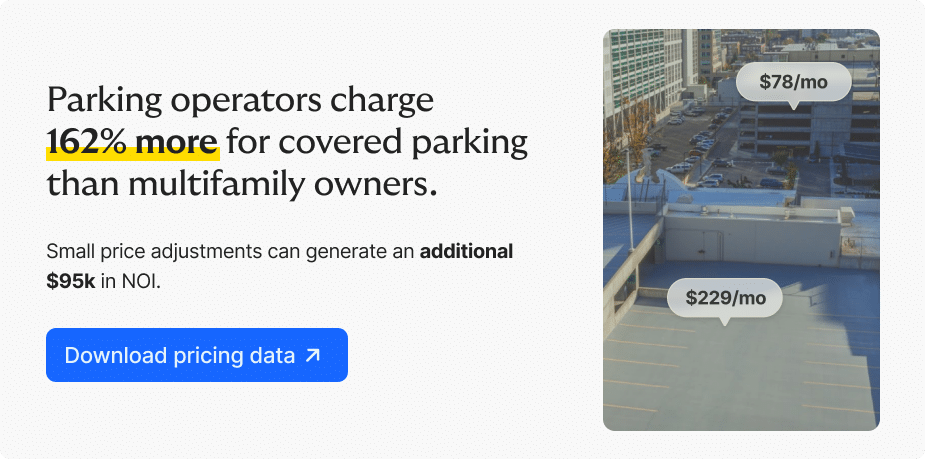
In San Diego, commercial parking facilities charge (on average) around 196% more for covered parking than multifamily properties in the area.
| Market Name | Avg. Multifamily Parking Price | Avg. Market Parking Price | Price Difference ($) | Price Difference (%) |
| San Diego | $71.13/mo | $229.84/mo | +$158.71/mo | +223% |
As you can see, there’s a much greater discrepancy between the market rate and the multifamily rate is much vaster with covered parking spots than uncovered spaces.
Factor #5: Availability (Parking Ratio)
San Diego’s average parking ratio (1.6 spaces per unit) is lower than the average number of vehicles per household (roughly 1.8 cars per household). The result? Greater demand pressure and longer waiting lists.
If property managers want to keep residents satisfied, they’ll need to think of long-term solutions to long-term parking shortages.
Factor #6: Rent-to-Parking Ratios
Local data suggests optimal parking fees typically range between 5-7% of monthly rent, with premium locations sustaining higher percentages.
As a general recommendation across all 10 markets sampled, our pricing experts suggest that parking prices equate to around 8-10% of average monthly rent costs.
Looking nationwide (Los Angeles, New York, Salt Lake City, Seattle, San Francisco, Miami, Washington D.C., Phoenix, Denver, and San Diego), total parking costs are equivalent to 3-4% of rent costs (as seen in the chart below):


Factor #7: Parking Pricing Tools
While market averages provide useful benchmarks, optimal pricing requires property-specific analysis considering local micro-market conditions.
For hyperlocal data and customized pricing recommendations, contact Neighbor’s team for a free demo and a personalized portfolio analysis.
Benefits of Free Parking for Residents
Some San Diego properties strategically bundle parking with rent (or offer on-site parking at no additional charge) for one or more of the following reasons:
- It’s a great way to develop a competitive advantage over those multifamily properties in the San Diego area that don’t offer free parking.
- It reduces parking vacancies. Reduced parking vacancies = more ancillary revenue.
- You’ll appeal to car-dependent residents. While San Diego is a relatively walkable city, most households in San Diego own close to two vehicles.
How to Adjust Resident Parking Prices Strategically
When modifying parking fees, consider these market-tested approaches:
- Begin with new residents: Prematurely applying adjusted parking prices to existing residents can result in dissatisfaction and higher turnover.
- Communicate value clearly: If residents feel ambushed by these price hikes, they may leave negative reviews or choose not to renew their leases, both of which can cut directly into your bottom line.
- Coordinate with lease cycles: Should you choose to optimize your resident parking prices according to the market rate, be sure to apply these price adjustments upon lease renewals only. Mid-lease price adjustments may also lead to resident dissatisfaction.
- Provide clear justification: Residents will want to know what prompted these price increases. Clearly explain that cost of living increases need to be reflected in resident parking costs. Citing the market rate and making it clear that your rates are a fraction of local parking operators’ rates should be enough to stifle resident complaints.
For insights into San Diego’s market parking rate and nationwide multifamily parking trends, download Neighbor.com’s 2025 Multifamily Parking Intelligence Report here.