
In one of America’s most parking-constrained cities, how should property owners in San Francisco approach multifamily parking pricing?
For years, the question “How much to charge for parking space?” has gone unanswered by property managers across SF.
In response to this data deficiency, Neighbor.com conducted an extensive analysis of 20 multifamily properties throughout the greater San Francisco area–from the Oakland/Berkley submarket to the downtown San Francisco market.
Our research unveils crucial insights for property owners in the Bay Area who want to optimize their resident parking prices (according to local competition and the market rate, among other key factors)
San Francisco Parking Market: Key Research Insights
In the city’s complex parking ecosystem, monthly rates between neighboring properties can vary by up to 300% – a remarkable disparity that reflects San Francisco’s intense parking demand (and limited supply).
When one property charges $350 monthly while another nearby asks $85, where should you position your rates? This considerable range demands strategic thinking about how you, as a property owner, will respond to San Francisco’s demanding market.
Beyond market rate, here are the other factors you should keep in mind when setting your resident parking prices:
- Type of parking structure (covered, uncovered, enclosed, etc.)
- Type of parking space (standard, compact, tandem, EV, etc.)
- Note: 60% of properties in San Francisco offer multiple types of parking to residents (outdoor, covered, and/or indoor). Most multifamily properties will set different rates for each parking type–unless on-site parking is offered regardless of space type. In this sample, only 25% of SF properties offered at least one type of free parking.
- Parking ratio (# of parking spaces allocated to each resident/unit, # of residents on the waitlist – if one exists)
- Ratio to rent (Parking rates make up what % of monthly rent costs)
- Assignment status (designated vs. open parking)
How Much Should You Charge for an Uncovered Space in San Francisco?
Types of uncovered parking options: Uncovered surface lots, rooftop spaces in multi-level parking garages, etc.
In space-constrained San Francisco, only 30% of surveyed properties maintain uncovered parking facilities. Of these, only 33% implement additional parking fees for these uncovered parking spaces.
Properties that do charge for uncovered spaces set average rates of $362.50/mo–the highest average monthly rate of our entire sample. Ultimately, this disproportionately high average is a reflection of both San Francisco’s parking scarcity and high land values. (Note: This ~$362/month rate is a separate, unbundled fee charged on top of monthly rent fees, utilities, storage, etc.)
| Market Name | Raw Average | Charged Average | % of Properties That Offer Uncovered Parking | % of Properties That Charge for Uncovered Parking |
| San Francisco | $120.83/mo | $362.50/mo | 30% | 33% |
*Definition of “Raw Average”: This average includes properties that offer residents free parking (whether uncovered or covered), as well as those properties that charge residents additional fees for a given type of parking space.
**Definition of “Charged Average”: This average excludes those properties that offer free parking. It only represents those properties that charge residents additional fees to park in their on-site parking facilities.
How Much Should You Charge for Covered Parking Spots in San Francisco?
Types of covered parking options: Private carports, enclosed/open-air parking garage spaces, private residential garage spaces, etc.
In the Bay area, 95% of surveyed properties offer covered parking options. Among these, 97% charge their residents additional fees for these spaces.
Properties with parking garage structures or canopied parking lots charge an average of $153.61/mo, which is less than half of the average rate of uncovered parking for SF. This is considered unusual behavior, as covered parking spaces have a higher perceived value compared to uncovered parking options.
Of those properties that charge for covered parking (private carports, parking garage spaces, private garage spaces, etc.), the average parking rate for San Francisco is around $154/mo (Note: This ~$154/month is a separate, unbundled fee charged on top of monthly rent fees, utilities, storage, etc.)
| Market Name | Raw Average | Charged Average | % of Properties That Offer Covered Parking | % of Properties That Charge for Covered Parking |
| San Francisco | $148.31/mo | $153.61/mo | 95% | 97% |
*Definition of “Raw Average”: This average includes properties that offer residents free parking (whether uncovered or covered), as well as those properties that charge residents additional fees for a given type of parking space.
**Definition of “Charged Average”: This average excludes those properties that offer free parking. It only represents those properties that charge residents additional fees to park in their on-site parking facilities.
Critical Pricing Considerations for Multifamily Parking
#1: The Type of Parking Facility
San Francisco’s microclimate affects covered versus uncovered pricing differently than other markets. Covered parking typically commands a 22% premium. However, in San Francisco, uncovered parking spots are, on average, more expensive than covered parking spaces. Our data shows that multifamily properties in the San Francisco area usually charge around 58% LESS for spaces in a covered parking garage.
#2: Space Type Variations
The following types of parking spots are priced differently in San Francisco’s market:
- Compact Spaces: These compact parking spots are staples in larger cities like San Francisco (as they are high-traffic areas). Compact spaces are better equipped to meet the parking needs of a larger # of renters, as they occupy less square footage. Therefore, property owners can fit a greater # of spaces in the same-sized parking garage.
- Tandem Spaces: Common in older buildings, these spaces are prorated to be a fraction of the cost of two individual parking spaces.
- EV Spaces: Critical in California’s leading EV market, these EV-compatible spaces are usually charged at premium prices. However, because they’re a desired amenity, residents are willing to pay these escalated monthly fees.
#3: Assigned vs. Unassigned Status
Price variations between assigned vs. open parking lots may not come as a surprise. What may come as a surprise, however, is how little an impact assignment status has on the price of parking spots in the San Francisco area (particularly covered parking spots).


The difference in price between assigned covered spaces and unassigned covered spaces is a meager 3%. Even more shockingly, assigned covered spaces were actually less expensive, on average, than unassigned covered spaces.
While the data may show these surprising trends, that doesn’t mean San Francisco property owners can’t justify higher prices for their assigned spaces. Increasing the rates of assigned resident parking spaces is one of the simplest ways to drive greater parking revenue.
When announcing new assigned parking rates, highlight the benefits outlined below. That way, residents better understand that premium parking comes at premium rates.
- It’s predictable: Tenants arrive home knowing that there is a designated space waiting for them.
- It’s more secure: Property managers will be able to detect unauthorized parkers with ease. When/if an unauthorized vehicle is parked in a resident’s assigned space, they will likely contact management to report the incident immediately.
- This sets your lot/garage apart from other commercial parking options: Assigned parking is hard to come by in a big city. If your property can offer an amenity not typically offered in commercial parking garages, you can prevent the possibility of your residents seeking out a third-party parking lot or parking garage.
#4: Market (Location)
Parking in San Francisco is notoriously pricey, especially if a parking garage is located near a major attraction, office complex, or other hub (like the San Francisco International Airport). SFO airport parking, in particular, commands an exceptionally high monthly rate.
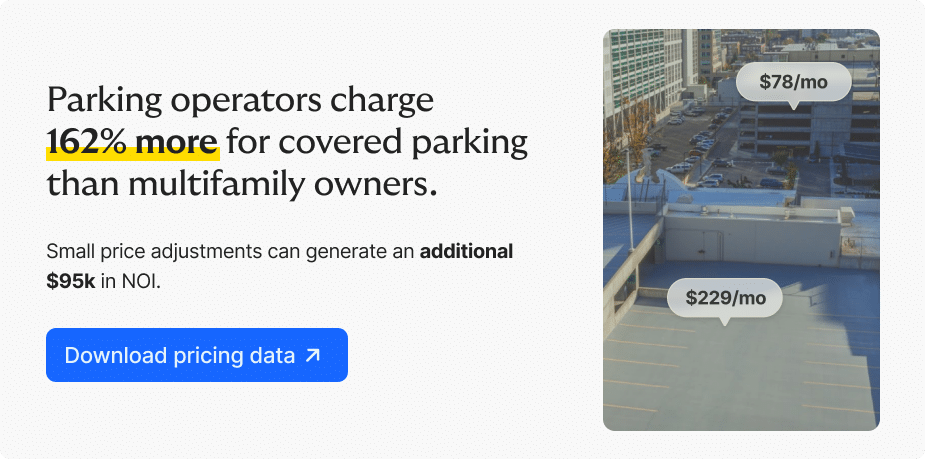
But prices aren’t consistent across different parking types. Did you know that commercial parking operators may charge as much as 200% more for covered parking than multifamily property owners? (Spoiler alert: San Francisco is no exception).
But why is this?
You may chalk up this pricing discrepancy to a variation in the parking facility type, space type, and/or parking availability–but what if we told you that oftentimes, these parking spaces offer the same level of coverage, boast the same amenities, and are located in the same neighborhoods.
As our parking pricing experts, there are very few reasons why multifamily property owners should be charging significantly less for parking than a parking operator located in the same neighborhood.
But are these parking pricing discrepancies vaster with assigned or unassigned spaces?
Here’s an inside look:
Multifamily Parking Rates vs. Market Rates (Uncovered Parking)
In San Francisco, commercial parking facilities charge (on average) around 51% less for uncovered parking than multifamily properties in the area.
| Market Name | Avg. Multifamily Parking Price | Avg. Market Parking Price | Price Difference ($) | Price Difference (%) |
| San Francisco | $362.50/mo | $176.15/mo | -$186.35/mo | -51% |
Multifamily Rate vs. Market Rate (Covered Parking)
In San Francisco, commercial parking facilities charge (on average) around 117% more for covered parking than multifamily properties in the area.
| Market Name | Avg. Multifamily Parking Price | Avg. Market Parking Price | Price Difference ($) | Price Difference (%) |
| San Francisco | $153.61/mo | $333.81/mo | +$180.20 | +117% |
If multifamily property owners in San Francisco were to optimize their covered parking prices to just 50-70% of the market rate (roughly $233.67/mo), they could generate an additional $155,637 in NOI per property per year.
Factor #5: Supply-Demand Metrics
With San Francisco’s average parking ratio sitting at 1.2 spaces per unit and the average # of vehicles per household hovering around 1.6, demand management becomes crucial for property managers in the area.
If you don’t have enough spaces to satisfy the parking needs of all vehicle-owning residents, you can pay to add more parking and expand existing parking garages or parking lots, OR you can recommend new residents to Neighbor, a peer-to-peer parking platform.
Factor #6: Rent Ratio Data
Pricing analysts suggest that optimal parking fees typically range between 8-10% of monthly rent in this premium market. However, the nationwide average (Los Angeles, New York, Salt Lake City, Seattle, San Francisco, Miami, Washington D.C., Phoenix, Denver, and San Diego) shows that resident parking fees usually equate to 3-4% of total monthly rent costs.


Benefits of a Free Parking Strategy
Those properties that choose to include parking in base rent–or offer it as a free amenity–usually do so for one (or more) of the following reasons:
- Free parking can differentiate an apartment complex in a competitive submarket
- Free parking can be used to streamline marketing efforts: While many complexes will offer amenities like on-site gyms and on-site laundry facilities, not every complex offers free resident parking.
- Free parking can be the key to consistent occupancy: If you offer at least 1 form of parking to your residents, you can reduce overall vacancies and maintain the appearance of a safe and highly trafficked parking area.
Rate Adjustment Implementation
When revising parking fees, consider these market-specific strategies:
- Phase-in changes gradually: Implement these new resident parking prices with prospective tenants first. If successful, apply these rates to existing leases.
- Highlight security features and other parking amenities: If you’re going to increase parking fees, you’ll need to provide some justification. Either introduce a new parking amenity (e.g., EV charging) OR advertise your existing amenities more broadly. It’s very possible that active residents don’t know about all the amenities your on-site parking facilities have to offer.
- Compare to commercial alternatives: The most effective messaging for your on-site parking facilities might be to compare your property’s rates to the rates of local parking operators. Knowing that parking operators can charge over 200% more for similar spaces will incentivize your residents to continue parking on-site.
For local parking pricing data and intel on the latest pricing trends, download the 2025 Multifamily Parking Intelligence Report through Neighbor.com (for free).