

To understand Seattle’s dynamic resident parking pricing strategies, Neighbor.com analyzed 20 multifamily properties in the following neighborhoods: Downtown Seattle, North Seattle, Shoreline, Capitol Hill, Central District, Redmond, and University District.
The goal of this research was to equip property owners in Seattle with the essential insights they need to monetize their resident parking facilities to their fullest potential.
This data will urge Seattle investors to rethink their traditional parking strategies. Once these property owners have a better idea of how much to charge for parking space in Seattle, WA, they can generate anywhere from an additional $11,092 to an additional $189,944 in NOI (per year, per property).
Seattle Parking Pricing: Research Analysis
In Seattle (and across these top 10 US markets: Los Angeles, New York, Salt Lake City, Seattle, San Francisco, Miami, Washington D.C., Phoenix, Denver, and San Diego), parking rates of neighboring properties could vary by as much 300%, even if the parking spaces themselves were identical in size (square footage), type (standard, compact, tandem, EV), or facility type (parking garage, carport, surface lot).
While it’s advised that you research what property managers in the area are charging for parking spaces, the sheer variation can send you down a pricing rabbit hole.
Rather than depending solely on the parking prices of your competitors (aka neighboring multifamily buildings), it’s wiser to use the market rate as a reference point when setting your resident parking pricing strategy. Ultimately, apartment parking prices are volatile, unpredictable, and often not rooted in any tangible strategy–so don’t let these rates lead you astray.
Note: Around 55% of Seattle apartment complexes offer more than one type of parking to residents. Prices will vary according to parking type.
For more information on what multifamily properties in the Seattle area are charging for uncovered vs. covered parking, keep reading. (Be aware that only 10% of properties in the Seattle, WA area offer at least 1 form of free parking).
How Much Should I Charge for a Space in an Uncovered Parking Lot?
Types of uncovered parking options: Uncovered surface lots, rooftop spaces in multi-level parking garages, etc.
Of the 20 Seattle apartment complexes contacted, 30% currently offer uncovered parking to residents. Of those properties, 67% charge for uncovered resident parking. The remaining 33% offer uncovered parking as a free amenity.
Of those properties that charge for uncovered parking, the average parking rate for Seattle is around $103.50/month (Note: This ~$103/month is a separate, unbundled fee charged on top of monthly rent fees, utilities, storage, etc.)
| Market Name | Raw Average | Charged Average | % of Properties That Offer Uncovered Parking | % of Properties That Charge for Uncovered Parking |
| Seattle, WA | $69/mo | $103.50/mo | 30% | 67% |
*Definition of “Raw Average”: This average includes properties that offer residents free parking (whether uncovered or covered), as well as those properties that charge residents additional fees for a given type of parking space.
**Definition of “Charged Average”: This average excludes those properties that offer free parking. It only represents those properties that charge residents additional fees to park in their on-site parking facilities.
How Much Should I Charge for a Space in a Covered Parking Structure in Seattle, WA?
Types of covered parking options: Private carports, enclosed/open-air parking garage spaces, private residential garage spaces, etc.
Of the 20 multifamily properties contacted, 95% offer one or more types of covered parking. Of those 95% of properties that offer covered parking, 100% charge residents additional fees for this parking time. Because Seattle is prone to heavy rainfall, it’s expected that covered parking would be, on average, ~30% more expensive, as this is a desired amenity for its enhanced protection against rain and other severe weather.
Of those properties that charge for covered parking (private carports, parking garage spaces, private garage spaces, etc.), the average parking rate for Seattle is around $138.94/month (Note: This ~$78 /month is a separate, unbundled fee charged on top of monthly rent fees, utilities, storage, etc.)
| Market Name | Raw Average | Charged Average | % of Properties That Offer Covered Parking | % of Properties That Charge for Covered Parking |
| Seattle | $138.94/mo | $138.94/mo | 95% | 100% |
*Definition of “Raw Average”: This average includes properties that offer residents free parking (whether uncovered or covered), as well as those properties that charge residents additional fees for a given type of parking space.
**Definition of “Charged Average”: This average excludes those properties that offer free parking. It only represents those properties that charge residents additional fees to park in their on-site parking facilities.
Factors to Consider When Adjusting Resident Parking Rates
Factor #1: Type of Parking Structure
Seattle’s climate plays a major role in the pricing discrepancies between covered and uncovered multifamily parking. As mentioned, covered parking typically commands a 30% premium at Seattle multifamily properties, primarily for its year-round weather protection.
Whether it’s a property with a fully enclosed or open parking garage, residents will expect to pay more for covered parking spots like these, especially when they live in larger cities and high-traffic areas like Seattle, where covered parking is limited, and demand is high.
Factor #2: Type of Parking Space
A common misconception is that all spaces in the same multifamily parking garage are priced at the same rate. In a single parking garage, you can find a variety of different parking spaces to meet a variety of different parking needs, including the types below:
Compact Parking Spots
Popular in newer developments, these spaces typically yield 85-90% of standard rates.
Tandem Positions
Common in larger cities like Seattle, these tandem positions are priced as a single parking spot (even though they are spacious enough to fit two separate vehicles). For example, renting two individual parking spots may cost you $400/space. However, a single tandem space may err closer to $700/mo.
EV Spaces
There are two popular types of EV spaces–communal charging stations and private EV spaces. The latter is usually charged at a higher monthly rate than a standard parking space.
Of the 240 properties contacted across Seattle, Los Angeles, New York, Salt Lake City, San Francisco, Miami, Washington D.C., Phoenix, Denver, and San Diego, 48% currently offer communal EV charging stations, and 43% offer assigned EV spaces. The remaining properties offered EV charging but did not specify the type.

Regarding EV pricing, only a small subset of these multifamily properties offered residents EV charging at no additional cost (including no third-party fees). 38% charged residents a monthly fee to rent a private EV space.

Factor #3: Assigned vs. Unassigned Parking Spaces
The value of an assigned parking space is obvious to most. Guaranteed parking is a convenience most are willing to pay a premium price for. No one wants to fight for a parking space or scour for street parking at the end of a long day.
Despite this perceived value, the data showed that the price differences between assigned and open parking were relatively minimal, especially when the spaces were covered (as seen in the charts below).


If you already offer both designated and open parking spaces, ensure your pricing strategy prices assigned vs. unassigned spaces proportionately to their value.
If you don’t offer assigned spaces, these can be introduced into your on-site parking lot and/or parking garage. From there, you can give your residents the option to upgrade for an additional charge. When announcing this new assigned parking program, be sure to market the unique benefits of assigned parking so that your residents are willing to pay the escalated rate.
Factor #4: Market (Location)
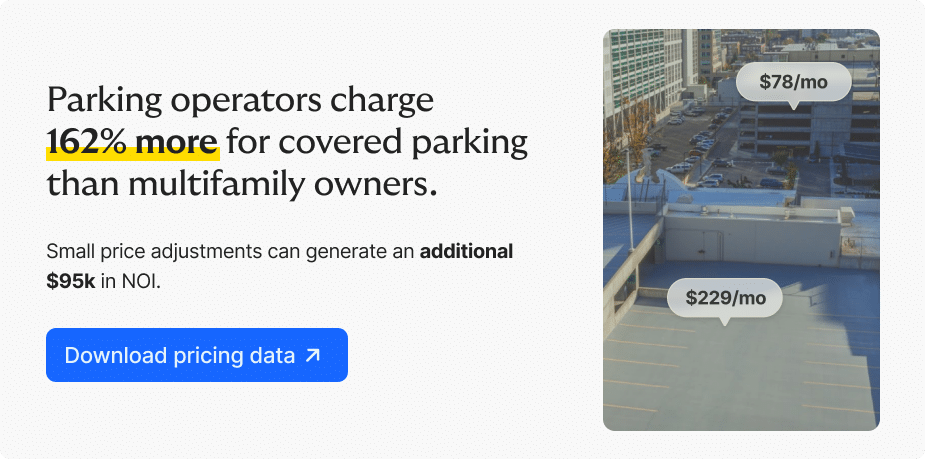
Across all 10 markets, the data shows that local parking operators charge dramatically more for similar parking spaces (162% more, on average, to be exact)–and Seattle, WA, is no exception.

*Note: The chart above only speaks to covered parking spaces–not uncovered spaces.
Most parking pricing experts agree that there are very few reasons why multifamily property owners should be charging 70% less for parking than a parking operator located in the same neighborhood.
We should only see these vast price discrepancies when these spaces vary by:
- Parking spot type: Compact, standard, tandem, EV parking space
- Parking facility type (covered vs. uncovered): Indoor (enclosed parking garage), outdoor (surface lot), covered (carport).
- Parking ratio (parking availability): If the parking ratio exceeds the average # of vehicles per household, there’s likely to be a waiting list. With lower supply, demand goes up–and so do the parking rates.
- Whether the spaces are assigned vs. unassigned
- An apartment’s average monthly rent rate
But when two virtually identical parking spots in two virtually identical parking garages are priced at rates that vary by 162%, what’s the explanation?
In most cases, these pricing disparities can be attributed to a lack of parking pricing data. Without the necessary data, property managers and property owners often set prices arbitrarily rather than strategically.
Here’s a closer look into the differences between the multifamily rate and the market rate in the greater Seattle area.
Multifamily Parking Rates vs. Market Rates (Uncovered Parking)
In Seattle, commercial parking facilities charge (on average) around 59% more for uncovered parking than multifamily properties in the area.
| Market Name | Avg. Multifamily Parking Price | Avg. Market Parking Price | Price Difference ($) | Price Difference (%) |
| Seattle, WA | $103.50/mo | $164.69/mo | +$61.19 | +59% |
Multifamily Rate vs. Market Rate (Covered Parking)
In Seattle, commercial parking facilities charge (on average) around 73% more for covered parking than multifamily properties in the area.
| Market Name | Avg. Multifamily Parking Price | Avg. Market Parking Price | Price Difference ($) | Price Difference (%) |
| Seattle, WA | $138.94/mo | $239.96/mo | +$101.02 | +73% |
By setting resident parking prices at 50-70% of the market rate, multifamily properties can maintain competitive pricing, all while earning an additional $47k in NOI (roughly) per year per property.
Factor #5: Parking Ratio
Seattle’s average parking ratio (1.2 spaces per unit) versus vehicle ownership (1.8 per household), intensifying demand pressure.
Because the average number of vehicles per household often exceeds the # of spaces allotted for each resident, Seattle-based multifamily properties will likely have parking waitlists in place. To meet residents’ parking needs, property owners will either need to add more parking or refer prospective residents to platforms like Neighbor, one of the leading peer-to-peer parking platforms.
Ratio to Rent
Market data indicates optimal parking fees typically range between 6-8% of monthly rent. However, Neighbor’s data shows that most parking rates will fall, on average, between 3-4% of total rent costs (as seen in the charts below):


If a property owner aims to boost NOI, hiking parking prices to 8-10% of total rent costs could drive additional ancillary revenue if executed thoughtfully. Ultimately, a property owner must consider their renters’ purchasing power. Failing to do so could result in higher turnover.
When to Offer Complimentary On-Site Parking to Residents
Some Seattle multifamily properties opt to offer free parking for the following reasons:
- It reduces parking vacancies: Initially, free parking may raise fears of significant declines in parking revenue. However, with the right strategy, it can have the opposite effect. Not only will it reduce parking vacancies
- Compete with newer developments: Free parking isn’t an amenity that all your competitors will offer. When new multifamily construction is at all-time highs, you’ll need to compete with those newer properties offering the latest, high-tech amenities. Remember, tenants aren’t necessarily searching for the flashiest amenities. Sometimes, it’s best to master the basics.
- Great for marketing messaging: In parking-constrained cities like Seattle, where the average market rate for parking is approximately $239/mo, free parking is an amenity that is sure to grab prospective renters’ attention.
Implementing New Parking Prices
When adjusting parking fees, always exercise the utmost caution. Optimizing your resident parking prices isn’t as simple as hiking prices and hoping your residents will respond positively. Property owners need to think (and act) strategically.
- Consider new construction in your area: If new construction in your area is high, increasing your resident parking prices could spike your vacancy rates–especially if the building next door offers lower-cost, on-site parking.
- Avoid off-cycle adjustments: For best results, only implement parking price adjustments upon lease renewals.
- Test your new pricing strategy on new residents: It will be easier to justify new resident parking prices with new/prospective residents than with existing ones.
- Opt for incremental price increases over dramatic price increases: Should you choose to roll out your new pricing strategy property-wide, dramatic price jumps can scare off existing tenants.
For complete Seattle parking insights and national market comparisons, download Neighbor’s 2025 Multifamily Parking Intelligence Report.