


Buying an RV is a big decision, not just financially, but in lifestyle, too. It’s easy to fall in love with a shiny motorhome on the dealer lot, only to realize later that it’s too big, too small, or too hard to maintain.
The smarter approach? Rent an RV first. By taking a few strategic trips in different RVs, you can learn what truly works for your travel style, your skill level, and your budget—without locking yourself into a long-term loan you might regret.
The Real Commitment of RV Ownership
An RV isn’t like buying a new car. Prices range from $20,000 for a basic trailer to over $150,000 for a luxury motorhome, and financing adds thousands more in interest over time. With today’s rates hovering between 6.5% and 10%, a $60,000 loan can easily cost you $70,000-$80,000 by the time you pay it off.
But the financial commitment goes beyond the purchase price:
- Depreciation hits hard: New RVs can lose 20-30% of their value in the first year alone. If you buy the wrong RV and need to sell it quickly, you could lose tens of thousands of dollars.
- Ongoing costs add up: Insurance, registration, maintenance, repairs, and storage can easily run $3,000-$5,000+ annually, even if you rarely use it.
- Storage is a hidden challenge: Many owners discover too late that their neighborhood or HOA doesn’t allow RV parking. Commercial storage facilities can cost $100-$300 per month, depending on your area.
- The learning curve is steep: From backing up a 30-foot trailer to managing holding tanks and electrical systems, RV ownership comes with skills you’ll need to develop—sometimes through expensive mistakes.
Before taking the plunge, consider getting hands-on experience with the RV lifestyle to ensure it’s truly right for you.
Why Renting Is the Smartest “Test Drive”
A quick 20-minute loop around a dealership won’t tell you what living in an RV really feels like. You need to spend real time on the road, in campgrounds, dealing with the daily realities of RV travel.
That’s where RV rental platforms like RVshare come into play. They connect you directly with local RV owners, giving you access to the exact kinds of RVs you’re considering—whether it’s a compact camper van, a towable travel trailer, or a spacious Class A motorhome.
How to get started: Platforms like RVshare make this process straightforward. You can search by location, RV type, and dates, compare prices and reviews, and book with insurance coverage included. Many owners are happy to walk you through the RV’s features and share their honest experiences, insights you’ll never get from a dealer’s sales pitch.
The beauty of this approach is that you’re testing real RVs that people actually own and use, not just showroom models. You’ll see how the RV holds up after real miles, what breaks or wears out, and what owners love (or regret) about their purchase.
Here’s what a few days on the road will teach you:
- Driving and handling: Is it stressful or manageable? Can you navigate city streets, back into campsites, or handle highway crosswinds?
- Living space reality: Does the floor plan actually work for cooking, relaxing, and sleeping? Or does it feel cramped after day two?
- Your actual space needs: You might think you need a 35-footer, only to discover a 25-footer is plenty (and much easier to drive).
- Must-have vs. nice-to-have features: That outdoor kitchen sounds great until you realize you never use it. Or maybe you discover you absolutely need a residential refrigerator.
- Your tolerance for maintenance: How comfortable are you with dumping tanks, checking tire pressure, and troubleshooting systems?
A rental gives you low-stakes education. Make mistakes, learn what you don’t know, and walk away with real knowledge—not dealer promises.
The Strategic Approach: Which RVs to Test
Don’t just rent one RV and call it research. The goal is to compare different types so you understand the trade-offs. Start with the type of RV you think you want. If you’re leaning toward a Class C motorhome, rent one first. Spend 3-5 days using it the way you imagine using your own RV. Take notes on everything.
Next trip, rent something different. If your first rental was a motorhome, try a towable trailer next. If you started with a large Class A, test a smaller Class C or a camper van. Why? Because the differences between RV types are massive, and you won’t know what works until you experience the contrast.
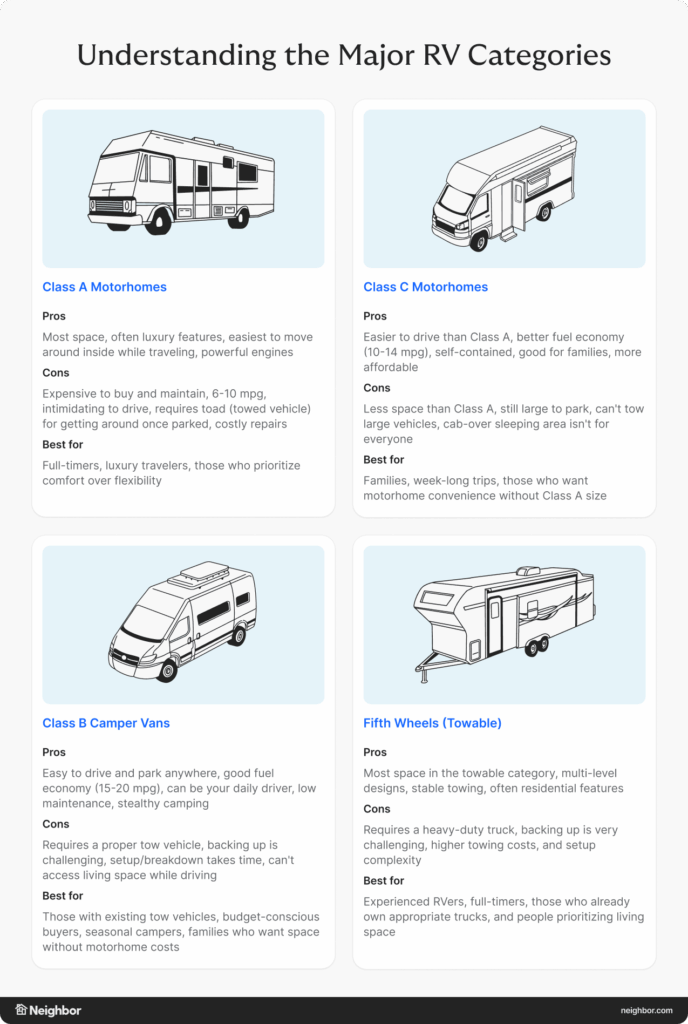
Understanding the Major RV Categories
Class A Motorhomes (Bus-style RVs):
- Pros: Most space, often luxury features, easiest to move around inside while traveling, powerful engines
- Cons: Expensive to buy and maintain, 6-10 mpg, intimidating to drive, requires toad (towed vehicle) for getting around once parked, costly repairs
- Best for: Full-timers, luxury travelers, those who prioritize comfort over flexibility
Class C Motorhomes (Cab-over design):
- Pros: Easier to drive than Class A, better fuel economy (10-14 mpg), self-contained, good for families, more affordable
- Cons: Less space than Class A, still large to park, can’t tow large vehicles, cab-over sleeping area isn’t for everyone
- Best for: Families, week-long trips, those who want motorhome convenience without Class A size
Class B Camper Vans:
- Pros: Easy to drive and park anywhere, good fuel economy (15-20 mpg), can be your daily driver, low maintenance, stealthy camping
- Cons: Very limited space, minimal storage, small bathroom/kitchen, expensive per square foot
- Best for: Solo travelers, couples, weekend warriors, urban adventurers, those who value flexibility over space
Travel Trailers (Towable):
- Pros: Affordable, huge variety of sizes/layouts, can detach and use tow vehicle for exploring, easier to store
- Cons: Requires a proper tow vehicle, backing up is challenging, setup/breakdown takes time, can’t access living space while driving
- Best for: Those with existing tow vehicles, budget-conscious buyers, seasonal campers, families who want space without motorhome costs
Fifth Wheels (Towable, requires truck bed hitch):
- Pros: Most space in the towable category, multi-level designs, stable towing, often residential features
- Cons: Requires a heavy-duty truck, backing up is very challenging, higher towing costs, and setup complexity
- Best for: Experienced RVers, full-timers, those who already own appropriate trucks, and people prioritizing living space
Each RV type teaches you something different about your preferences and capabilities.
What to Test and Learn on Your Rental Trips
Treat each rental like a comprehensive test. Here’s your evaluation checklist:
Driving and Maneuverability
During the drive:
- How’s the visibility? Can you see blind spots? Are the mirrors adequate?
- How does it handle wind? Does it feel stable or nerve-wracking on highways?
- What’s the turning radius? Can you navigate parking lots and tight turns?
- How are the brakes? Does it stop confidently or require significant stopping distance?
- What’s the noise level? Is it quiet enough for conversation, or do you need to shout?
At the campground:
- Can you back into a campsite without help? How many attempts does it take?
- How stressful is parking? Would you avoid certain campgrounds because of size?
- Can you level the RV yourself? How long does setup take?
- Are you comfortable setting up hookups and dumping the tanks?
Living Space and Layout
After 24 hours:
- Is the bed comfortable enough for multiple nights? Can two people sleep without bothering each other?
- Is there enough seating? Do you have a place to relax during bad weather?
- Does the bathroom feel adequate, or claustrophobic?
- Can you move around without bumping into things or each other?
After 48 hours:
- Where does all your stuff go? Is there enough storage for clothes, food, and gear?
- Does the kitchen layout make sense? Can you actually cook meals without frustration?
- Are outlets and USB ports where you need them?
- How’s the climate control? Too hot? Too cold? Uneven temperature?
After 3-5 days:
- What layout features do you use constantly? (Outdoor kitchen, extra seating, workspace?)
- What features went unused? (Bunk beds? Entertainment systems? Outdoor shower?)
- If you were living here for weeks, what would drive you crazy?
Systems and Maintenance
Daily operations:
- Time yourself: How long does it take to set up and break down camp?
- How often do you need to refill fresh water? How fast do holding tanks fill?
- Does the battery power last through a night of boondocking?
- Is the generator loud? Does it run the AC adequately?
- How difficult is dumping tanks? Would you feel confident doing this regularly?
Unexpected challenges:
- Did anything break or malfunction? How did you handle it?
- Did you need roadside assistance or owner support?
- What maintenance tasks surprised you?
Cost Reality
Track your expenses:
- Fuel costs (write down actual miles per gallon)
- Campground fees (you might be shocked how quickly they add up)
- Propane refills, dump station fees, campground extras
- Food and supplies (does eating in the RV actually save money?)
This gives you a realistic picture of ongoing ownership costs beyond the loan payment.
A Real-Life Example: How Real Renters “Test Drove” the RV Lifestyle
Getting the RV experience without owning
“Renting an RV was a really easy process. The communication was quick, and everything went smoothly. We didn’t have any problems, so I don’t have anything negative to say. Definitely a great way to experience RVing without the large price tag of buying an RV.” – Roy
This renter captured what so many first-timers discover—that a short rental lets you enjoy the freedom of RV travel without worrying about storage, payments, or upkeep.
“Easy app to use, made communication with the owner easy. Everything was explained really well. Pick-up and drop-off were simple and without difficulty. More affordable than buying an RV to sit in my yard most of the year.” – Jami
For casual campers, renting often just makes sense. You can take trips when you want to, then return the RV when you’re done: no maintenance, no space taken up at home, no regrets.
“We tried RVShare for two reasons: to evaluate the process of pulling and setting up a full-size camper…and to think through options of buying vs. renting in the future. Our experience with the RVShare process was excellent, especially with the people we rented from. As we anticipate camping only a few times a year, and since we don’t have a place to store a camper, we’re very likely to keep renting with RVShare for future trips.” – Glenn
This kind of insight is exactly what “trying before you buy” is all about. These renters learned firsthand how a full-size camper fits their lifestyle and realized that renting is the smarter choice for their travel frequency and storage situation.
What Rental Experience Can’t Teach You (And That’s Okay)
Renting isn’t a perfect simulation of ownership. Here’s what you won’t learn:
Long-term maintenance: You won’t experience annual winterization, roof seal maintenance, or systems that degrade over the years.
Customization and improvements: Rentals are stock models. You won’t know what it’s like to upgrade solar panels, add organization systems, or personalize your space.
Ownership pride and attachment: There’s something different about caring for your own rig versus a rental.
Year-round reality: Most people rent during ideal seasons. You won’t experience extreme cold or heat unless you specifically plan for it.
Community and lifestyle: The full-timer community, rallies, and long-term friendships develop through ownership, not rentals.
But that’s fine. Rentals aren’t meant to replicate every aspect of ownership, they’re meant to test the fundamentals so you don’t make an expensive mistake.
Questions to Ask RV Owners During Your Rental
One underrated benefit of peer-to-peer rentals? You’re renting from actual owners who know the rig inside and out.
Before your trip, ask:
- What do you love most about this RV?
- What would you change if you could?
- What maintenance issues have you encountered?
- Any quirks or tips for this specific model?
- How often do you actually use it?
- If you were buying again, would you choose the same type?
These conversations provide genuine insider knowledge you’ll never get from a dealer. Owners will tell you the truth about what it’s really like without pressuring you to purchase something.
Making Your Decision After Test Rentals
After renting 2-3 different RV types and talking to other people, you’ll have a better idea on what you want. Here’s a quick guide to evaluate what you learned:
Create a comparison chart:
- List each RV type you tested
- Rate them (1-10) on: driving ease, living comfort, features, setup time, fuel costs, stress level
- Note dealbreakers and must-haves for each
Ask yourself:
- Which rental felt most natural and enjoyable?
- Which type would I actually use 15+ times per year?
- What’s my realistic budget including loan, insurance, storage, and fuel?
- Am I willing to develop the skills needed for my top choice?
- Does my vehicle situation support this? (Towing capacity, garage space, parking options?)
Consider your travel style:
- Weekend warrior (2-3 day trips): Smaller is better
- Week-long vacations (4-8 trips/year): Mid-size works well
- Extended travel (multiple weeks): Larger rigs justify themselves
- Full-time living: Comfort trumps convenience
Be honest about frequency: If test rentals revealed you’ll use an RV 3-4 trips per year, maybe keep renting instead of buying. If you’re planning 8+ trips, ownership makes more sense.
Final Thoughts: Experience First, Commit Later
Buying an RV should be exciting, not stressful. The difference between a great decision and an expensive regret often comes down to one thing: real experience before commitment.
Renting first isn’t about delaying your dreams—it’s about making sure those dreams match reality. It’s about discovering what “perfect fit” actually means for you, not what a dealer or YouTube video suggests.
Take a few trips. Test different types. Make mistakes in a rental, not a purchase. Learn what you love and what drives you crazy. Then, when you’re ready, you’ll buy with absolute confidence.
The road will still be there. The campgrounds aren’t going anywhere. But the knowledge you gain from testing first? That’ll save you money, stress, and regret for years to come.
Your perfect RV is out there. Make sure you know what it looks like before you sign on the dotted line.