

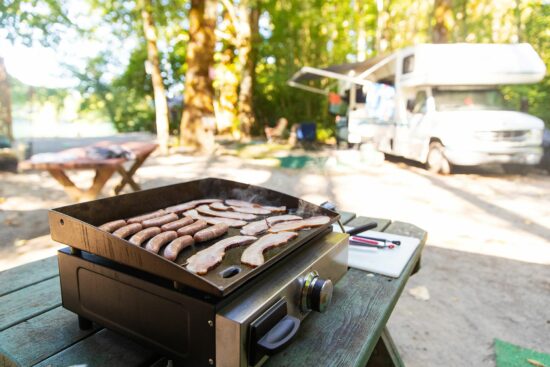
Growing up, we had a family tradition where anytime we went camping, we would roast our food (not just our smores) over the fire. Cooking outdoors made for some unforgettable memories with family–not to mention, conjured up some of the tastiest food I’ve ever had (Nothing beats a good blackened char).
While cooking over the fire can spark memories of camping trips past, it’s not always the best or fastest option.
Therefore, if you frequently camp in an RV, it’s handy to travel with a portable RV grill. There are many different types and sizes of RV grills, including electric, propane, and pellet-powered options.
The one that’s right for you will depend on the amount of storage space you have to work with, your budget, and the type of campsites you typically visit. As our top picks, here are the best portable camping grills we think you can’t (and shouldn’t) live without.

The Best Propane Grills for Effortless RV Cooking
Looking for some of the top portable gas grill models to choose from? Check these ones out!
- Flame King RV Grill – $104
- Coleman Roundtrip – $314
- Webber Q100 Grill – $229
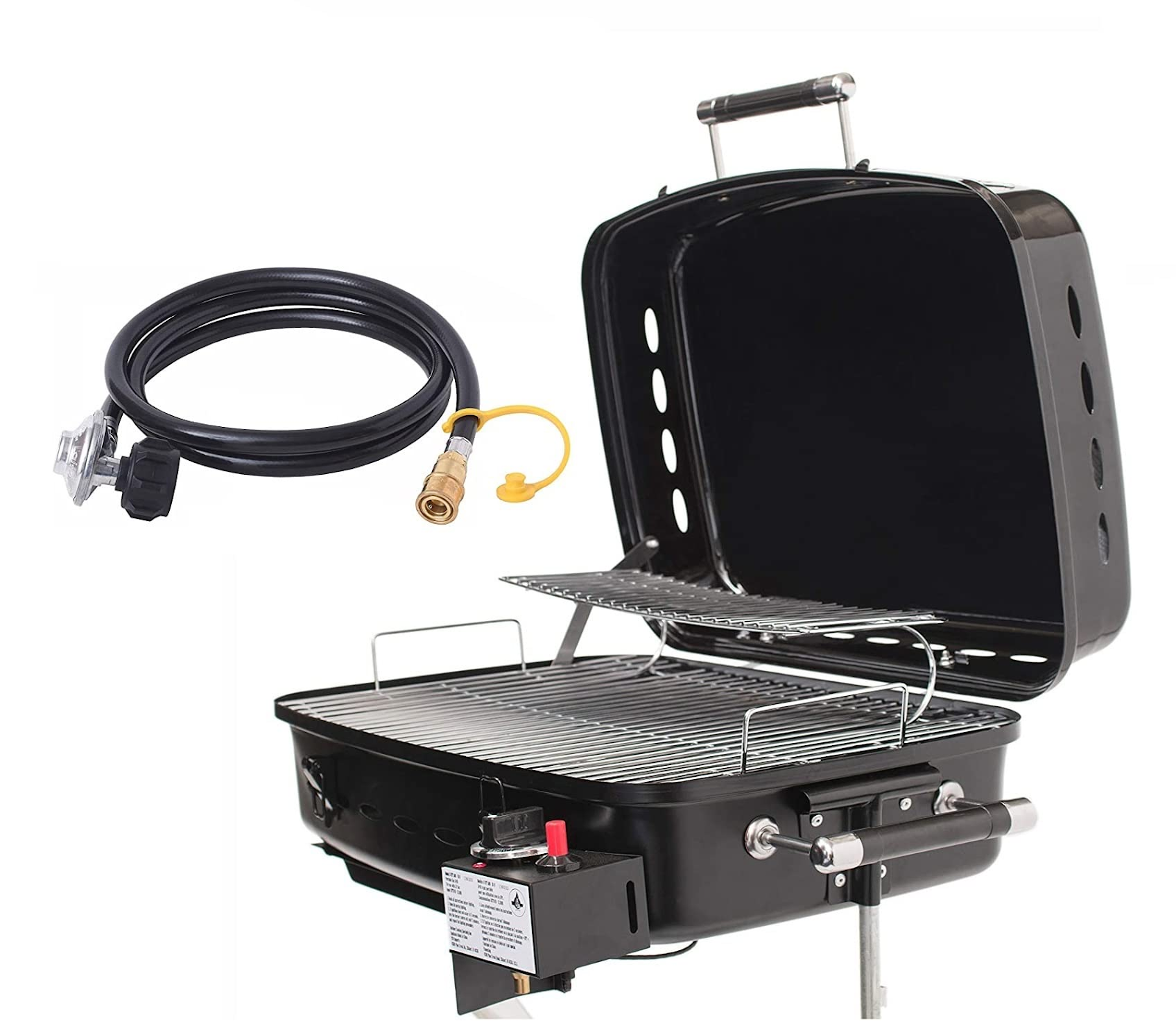
Propane grills like these are some of the most popular small grill options for part or full-time RVers. But why?
In addition to their compact size, many propane grills are flat and collapsible and stow away easily when not in use.
Unlike an electric grill, you can also use propane grills anywhere and everywhere because they do not require electricity to operate. Other pros of propane grills, like the Coleman Roundtrip, include the following:
- High-quality propane grills are easy to ignite
- They heat up quickly
- They distribute heat evenly for thorough cooking
Some propane grills come with extra features, like a locking lid (so animals can’t open it), precise flame control, and an easy-to-use temperature knob.
But are gas grills a better option? (While there is technically a difference between propane and natural gas, a user SHOULDN’T notice a performance difference between the two grill types).
While quicker and more user-friendly than pellet grills, propane grills can be pricier, given the cost of propane tank replacements, which can cost up to $10 for a one-pound tank. While this isn’t a huge expense, you can burn through a single tank for each meal, depending on how long you use your grill.
The Best Compact Charcoal Grills for RVing
Looking for a portable charcoal grill? Here are some of the charcoal grill models we personally recommend:
- Cuisinart CCG-100 – $129
- PK Grills PKGO – $350
- Webber Go Anywhere Grill – $71

Charcoal grills are another popular option for RVers. These grills are fairly easy to use and achieve a unique, smoky flavor.
Charcoal is also much cheaper to burn than propane or wood pellets.
Another advantage of charcoal grills is that charcoal is readily available nearly everywhere. If you’re camping at a remote campground (without a town nearby), pellets and propane may be harder to come by.
The only downside of a compact charcoal grill is that they’re slightly larger than other types of RV grills. The holding chamber, which sits at the bottom of the grill and contains the charcoal itself, nearly doubles the size of the grill.
The Best Electric Grills for RV Owners
Here are some of the best electric RV grills on the market:
- George Foreman Electric Grill – $130
- Ninja Woodfire Electric Grill – $400
- Blackstone E-Series Griddle – $300

Don’t want to deal with the hassle of burning charcoal or the potential dangers of working with propane? No problem. Opt for one of these top-rated electric grills.
These types of grills are the easiest and safest to use, but they also have the most restrictions, including the following:
- You must be near electricity to operate them, which means they’ll only work if you’re camping at a campground or have a generator in your RV.
- Electric grills take longer to heat up, making them a bad option if you’re in a hurry.
- Because you aren’t burning charcoal or pellets, electric grills don’t add any smoky flavor to your campfire dinners.
On the plus side, electric grills have the fewest working parts of any type of compact grill. Because they don’t require an additional chamber for charcoal or pellets, they’re smaller and more portable.
The Best Portable Pellet Grills
Here are some of the best pellet grills on the market:
- Traeger Ranger Pellet Grill – $450
- Green Mountain Davy Crockett Grill/Smoker – $350
- Pit Boss Pellet Grill – $500

Want to take your grilling to the next level? Pellets add the most flavor to your food during the grilling process. Choose from a variety of pellets to customize your flavor profiles.
The downside of pellet grills is that some models require electricity to operate. As with electric grills, pellet grills also take longer to heat up than gas or charcoal options.
Keep in mind: pellet grills also have a steeper learning curve, If you’re a master campfire cook, a pellet grill is for you. However, pellet grills don’t fit the bill if you value speed, ease of use, and compactness over flavor richness.
Deciding on the Ideal RV Grill for Your Outdoor Adventures
Now that you know some of the best portable RV grills, let’s look at how to choose the one that’s right for you.
Your Budget
Finally, your budget will play a big role in which grill you choose. Some higher-end RV grills, such as pellet smokers and elaborate electric ones, can cost upwards of $400 to $500. Others, such as basic gas and charcoal grills, will cost less than $100.
Therefore, it’s important to choose what fits your needs and what fits your budget.
Size and Portability
Size and portability are important in an RV grill for two reasons. First, when you’re not using your grill, it will need to be stowed away somewhere in your rig. Second, you’ll have to yank the grill out anytime you want to use it, which will only be more difficult if your grill is big and bulky.
For convenience, choose an RV grill that’s small, portable, and compact. Because space-saving is so important to a full-time RVer, some RVs come with grills already mounted to the side of the RV. When you’re done using these built-in grills, they stow away in a hidden storage compartment.
Cooking Capacity
While it’s important to choose a grill that’s small and portable, you also want one with enough cooking capacity to meet your needs. If your grill isn’t big enough to cook for your entire family, what’s the point in having one?
Most RV grills have single grill grates, but some have a lower and upper grill deck.
If you’re cooking for a family of four or more people and need extra cooking and grilling space, choose a slightly larger portable grill with an upper deck.
Cooking Surface
Along with different types of fuel sources, there are also different cooking surfaces to choose from. While metal wire grates are the most common option, you can also choose grates made of porcelain, stainless steel, or cast iron.
Note that cast iron and stainless steel grates last the longest, but porcelain grates are the easiest to clean.
However, if you prefer a solid surface for cooking eggs and other non-solids, you can also choose a griddle-style grill, like the Blackstone E-Series Griddle, which functions as a large griddle plate. Note that griddle-style grills are usually electric.
Add-Ons and Features
In addition to plenty of cooking space, it’s also important to consider what types of add-ons and features you want in a grill. Some portable gas grills and electric options will have the bare basics – a hot surface with adjustable temperature.
The best RV grills, however, such as pellet grills and griddles, will have additional options. For instance, the Green Mountain Davy Crockett grill/smoker has the option of adding a pizza oven.
If you value add-ons and features, the Ninja Woodfire Electric Grill and the Traeger Ranger Pellet Grill are two other great options.
Fuel Choices
As you’ve seen in this article, RV grills operate using different forms of fuel and power, including propane, electricity, charcoal, or pellets. Let’s break down the pros and cons of each option.
Electricity
| Pros | Cons |
| Cost nothing to operate since electricity is usually included with the camping fee | Take a while to heat up |
| The safest option in terms of fire safety since there isn’t an open flame | Inoperable if you don’t have access to an electrical outlet or generator |
| The easiest type of grill to use, because it’s plug-and-play | Can’t always get as hot as gas, charcoal, or pellets |
Gas
| Pros | Cons |
| You can use gas grills anywhere. | Propane is fairly expensive. |
| Heats up very quickly. | Propane gives off a foul odor that most people find displeasing. |
Charcoal
| Pros | Cons |
| You can use charcoal grills anywhere. | You typically need a lot of charcoal for each grilling session. |
| Charcoal provides a delicious, smoky flavor to food. | Heat control and even distribution is harder with charcoal. |
Pellets
| Pros | Cons |
| Add a delicious, smoky flavor to food. | Most expensive type of grill |
| Allow you to grill and cook food like a pro. | Pellet grills have a learning curve and can be difficult to use |
| Many pellet grills double as smokers. | Most pellet grills require electricity to operate, which could restrict its usage. |
Final Thoughts
When nights of campfire cookouts come to a close, and you no longer need your recreational vehicle during the off-season, you’ll need somewhere safe to store your RV until next season. (You’ll also need somewhere to store all your camping equipment, including your RV grill).
If you don’t have enough space at your home for RV storage or your local HOA prohibits it, consider using Neighbor to find safe and affordable RV storage near you. Neighbor is a peer-to-peer storage marketplace that can help you find the perfect storage spot near you so that your RV is safe and ready to go for your next journey.