

Has the volatility of the 2024 multifamily market backed you into a corner? Raise your rents or risk foreclosure–at least, it seems like those are your only two options.
But what if we told you there are ways to stimulate additional monthly revenue in your portfolio, without raising your rent prices?
Enter amenity fees. Property managers and apartment owners (like yourself) can leverage apartment amenity fees and drastically increase monthly rent–in a way that won’t repel new or existing tenants. While residents will certainly take notice of an annual 3% to 5% rent increase, renters will see an additional $10-$50 a month as a small price to pay for premium amenities like roof-top pools and on-site yoga studios.
In a worst-case scenario, when you charge amenity fees, this additional revenue will simply delay the need for rent hikes. But in a best-case scenario, they’ll eliminate the need for rent hikes altogether.
What Are Considered Amenities?
Not every feature is an amenity. Defined, amenities are highly desired features and services that make rentals more appealing to tenants. In a competitive market, amenities are what differentiate one apartment complex from another.
Here are a few popular examples:
- On-site laundry
- On-site parking
- Gyms
- Pools
- Concierge services pools
Apartment amenities generally fall into two categories: Basic amenities and premium amenities
Basic Amenities. These are practical essentials, such as on-site parking, laundry facilities, and security features. Tenants often expect these in multi-family properties, especially in urban areas. Nowadays, some form of on-site parking and laundry is baked into a rental lease.
Premium Amenities: These are perks, like fitness centers, swimming pools, valet trash services, or package delivery lockers, that make a property stand out. These amenities aren’t always expected, but they’re valuable enough to justify charging an extra fee.
Choosing Amenities to Charge For
Remember: not all amenities warrant a fee. For example, if a competitor on the same city block provides residents with two complimentary parking spaces in their on-site parking garage, charging $100+ per parking space could be the difference between securing a renter and losing out to a competitor. After all, no one likes paying amenity fees.
Similarly, if you didn’t previously charge residents for a particular amenity, you’ll want to think twice about altering your policy and charging a new monthly amenity fee for this location/service. If the local rental clientele has grown to expect it at no additional cost, you’ll quickly burn bridges with both existing and prospective renters.
However, here are some desired amenities that you can charge amenity fees. Here are a few examples:
Valet Trash
Hauling trash bags to your apartment’s centralized trash chute is an inconvenience of the past. For a flat fee – often around $20 to $30 monthly, tenants can skip the daily chore of hauling their garbage to a dumpster or curb.
For the tenant, the primary benefit of this program is time savings. For the property owner, the outcome is cleaner common areas that make the building more appealing to both current and prospective renters.
Gym Access
A fitness center is a high-demand amenity – especially for commuters. The last thing you want to do after a 45-minute commute is turn around and head to the gym. In addition to time, on-site fitness centers save tenants money.
Residents who previously paid costly gym membership fees can pay $25-$35 per month to use the same types of gym equipment. For properties with larger fitness areas or additional wellness features (like yoga studios, a swimming pool, or personal training sessions), higher fees may also be justified.
Parking
Parking is one of the most sought-after amenities, especially in neighborhoods with limited street parking. Charging a monthly fee—usually $50 to $100—for designated on-site parking spaces is common. You can also allow tenants to upgrade to premium parking options like covered or reserved spots for a higher rate ($100-$200/month on average).
When setting your parking rates, you’ll want to consider the following factors:
#1: Whether your parking spaces are covered or uncovered
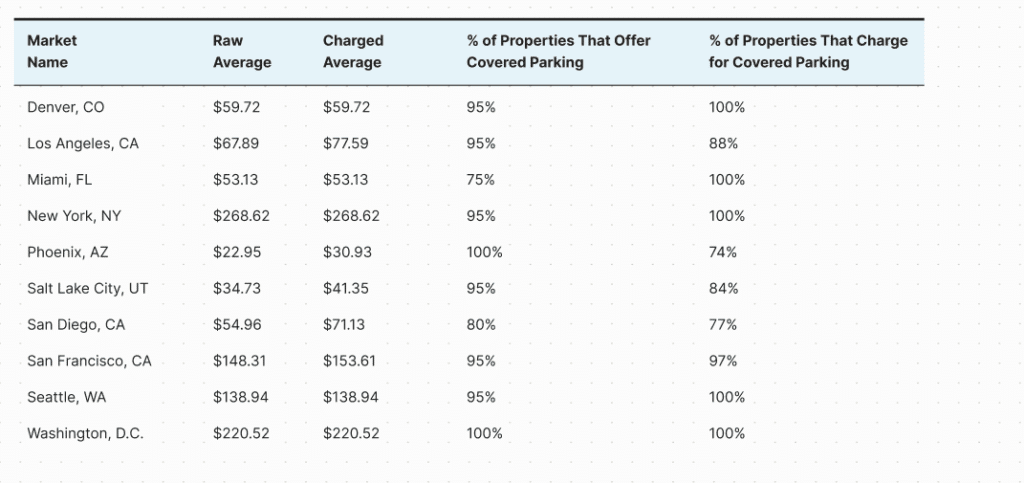
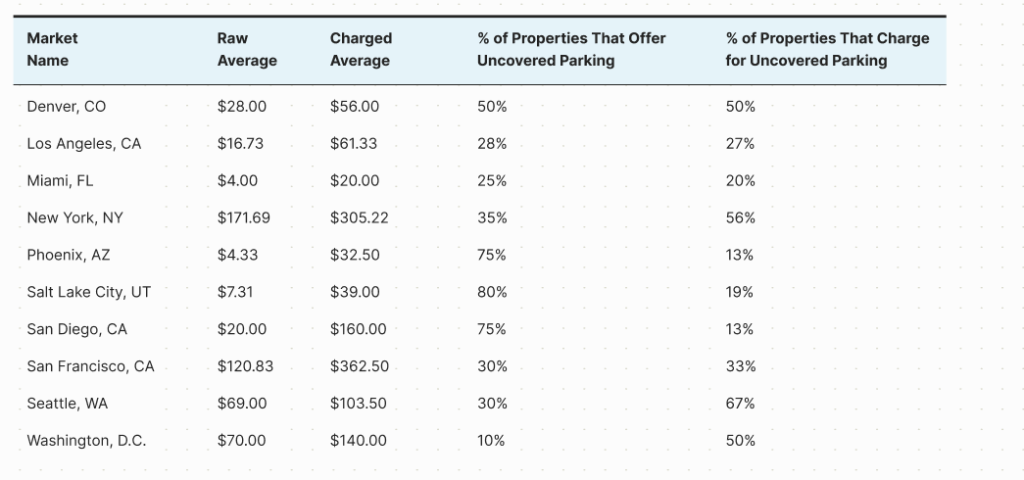
Generally speaking, covered parking is charged at a higher rate than uncovered parking, regardless of the market/region of the U.S., as additional coverage is a sought-after amenity among tenants.
Additionally, when free resident parking is offered (at any capacity), uncovered parking is more likely to be free of charge than covered parking. See the charts below for more insights:
Average Prices for Covered Resident Parking (Across 10 U.S. Markets)
Average Prices for Uncovered Resident Parking (Across 10 U.S. Markets)
#2: Whether your parking spaces are assigned or unassigned
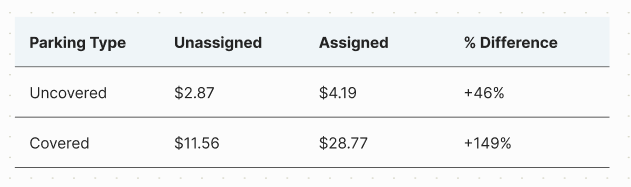
When setting your parking rates, be sure to account for whether your spaces are assigned vs. unassigned. In a 2024 study conducted by Neighbor.com, the data showed that assigned parking is typically charged at higher rates, regardless of whether it’s covered or uncovered parking (based on the raw averages – see below).
Pricing Strategies
Ultimately, the best pricing strategy is to investigate what similar properties in your area are charging. These prices will help you gauge tenant expectations.
If nearby complexes offer gym access for $25 a month, this gives you a solid starting point and helps you maintain competitive prices.
Once you know what you’re charging for, you can determine the optimal pricing approach. Here are a few options:
- Flat Fees: Flat fees are easy to understand. Tenants pay a set rate each month for an amenity, like $30/month for valet trash.
- Tiered Pricing: Tiered pricing lets you add more options. For example, offer general parking for $50, covered parking for $75, and a reserved spot for $100.
- Bundling: Bundling groups several amenities under one fee, like $50 for gym access and valet trash. This can be a good option for small properties or where tenants prefer a set package.
Look at what nearby properties are charging to stay competitive, but keep pricing direct and in line with the value you offer.
Calculating the ROI of Your Amenities
Property management must look closely at the costs associated with amenities (and their accompanying benefits). Here’s what you need to know before you can introduce new amenity fees:
Not all amenities drive revenue. In fact, some might actually drain resources and end up being more of a hassle than they’re worth.
Before you start introducing amenities and charging amenity fees, consider the setup and maintenance costs involved. A gym, for example, means buying new equipment, hiring staff for routine upkeep, and possibly investing in a more comprehensive insurance plan. But something like reserved parking involves minimal setup and can still bring a steady income.
Note that some additional services will be worth it to tenants, while others won’t. For instance, valet trash and package delivery services may be desirable amenities in a large complex, but they aren’t as essential in smaller buildings.
Surveying tenants (and studying local trends) will reveal which amenities tenants actually want—and are willing to pay extra for. Ultimately, you want to look for the amenities that will incentivize tenants to stay for the long term.
When it comes to the nitty gritty of calculating the ROI of your amenities, use this example:
Say you’re considering valet trash, and it costs $15 per unit to provide; a $20 monthly fee will cover your costs and give you a profit margin. Note that amenities with quicker payback, like parking or valet trash, are often safer bets, while high-cost amenities like pools may need a larger tenant base to justify the expense.
Communicating Amenity Fees
Here’s another tip that many property managers neglect – communication. To avoid any surprises, keep amenity fees clear and upfront. List all fees in the lease and marketing materials.
- In the Lease: List amenities with fees attached. Make it clear what each fee covers.
- Highlight Benefits: Show how fees support extras tenants use and enjoy. For example, explain that valet trash saves time and hassle.
- Offer Choices: Where possible, give tenants options. Let them opt into gym access or premium parking only if they want it.
Offering Amenities to Non-Residents
To maximize your earnings on on-site amenities, consider renting your extra space with Neighbor. With this leading peer-to-peer parking platform, property owners can expand their amenities to non-residents–effectively increasing their customer base.
Here’s how it works. You list the space you have available (vacant units, empty parking spaces, or unused self-storage spaces). You approve renters, and then you get paid monthly. The best part? Neighbor will pay you, even if your tenant doesn’t.