

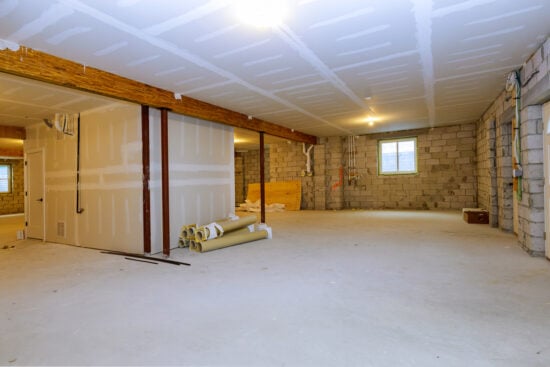
Your basement is ripe with unlocked potential. This space could serve as a hobby room, a home gym, a music studio, a guest room, or simply additional living space. All you need are some handy tools and a little imagination.
A finished basement can add square footage to your home or increase the value of your property. While it is an extensive project, it’s one you can likely complete by yourself.
This guide will help you gather the right supplies and provide simple steps to transform your basement.
Tools and Materials for Finishing a Basement
Before diving into the project, take inventory of which tools you have, and which you may need. Here’s a list of some tools you may want handy for this project:
- Safety gear (goggles, dust mask, gloves, earplugs, etc.)
- Ladder
- Hammer
- Level
- Tape measure
- Caulk gun
- Masonry drill
- Circular saw
- Nail gun
- Utility knife
- Speed square
As for materials, here are some of the things you’ll need to finish your basement.
- Boards
- Extruded polystyrene foam insulation
- Plywood
- Framing nails
- Wall screws
- Cement nails
- Duct tape
- Adhesive for insulation
- Ceiling tiles or other ceiling material
- Flooring materials
The size of your basement will inform how much material you need, so it’s handy to know the exact square footage. You’ll also want to determine the size of any interior walls you plan to construct and how much insulation you need for your ceiling and subfloor.
Phase 1: Preparation (What to Do Before You Begin)
Your safety and the legality of your project should be your #1 priority. Here are some essential steps you should take before diving into your basement finishing project.
Step #1: Establish a Plan
A lot goes into finishing a basement. Before you get started, develop a comprehensive plan, so you and your family know exactly what to expect throughout the project. Here are some items to consider while developing a plan:
- The structural integrity of your existing basement
- Your budget and timeline for the project
- Local building codes and zoning restrictions
- The electrical and plumbing system
Step #2: Acquire the Necessary Permits
You may need to apply for a permit before starting construction. Check local building codes and zoning requirements to see if your project requires a permit. These codes govern aspects such as structural integrity, electrical wiring, plumbing, and insulation.
Failure to adhere to building codes can result in fines and legal complications. It could also mean your home insurance won’t cover any damage that occurred in your newly renovated basement.
Step #3: Address Moisture Issues
The musty smell that plagues so many basements comes from excess moisture. Covering up moisture-related issues won’t make them go away. In fact, issues may worsen and potentially destroy the building materials.
Before starting your project, determine where your basement humidity originates–be it interior condensation or moisture seeping through the walls. This is the first step in eliminating the problem.
To identify the source, place a square sheet of plastic on your concrete wall. Moisture that forms on the front within a few days comes from condensation, whereas moisture on the backside comes from outdoors.
Interior moisture can be addressed by properly ventilating sources of moisture like dryers, showers, and humidifiers. However, moisture that seeps in from the outdoors may need one or more of the following treatments.
- Grading to direct stormwater away from your home
- Installation of an exterior drainage system that will direct water away from your home to a specific location, like a sump pump or dry pond
- Installation of an interior drainage system to redirect water
- Repairing basement wall cracks
Step #4: Create a Clear Workspace
Most basement owners use the space for storage, and while it may be tempting to think you can work around your belongings, it’s not a realistic plan. Clear your workspace by first sorting items into keep, donate, and trash piles.
Relocate items you plan to keep to any spare room, closet, or attic. If you don’t have any additional storage space, consider renting a self-storage unit until the project is complete. Rather than traditional storage, you can also consider more cost-effective options, such as a peer-to-peer storage marketplace like Neighbor (with spaces up to 50% cheaper than other options).
Ask Yourself: Do You Need a Professional Contractor to Finish a Basement?
While DIY basement renovations are fairly common, there may be some aspects of the project that you should leave to the professionals. Unless you have extensive experience in these areas, consider hiring a professional to complete the procedure properly:
- Electrical systems
- Plumbing
- Basement foundation repair
- An inspection to ensure your basement contains no harmful building materials and is structurally sound
Phase 2: How to Finish Your Basement Step by Step
Once you’ve handled any legal matters, taken care of moisture issues, and cleared out your belongings, you’re ready to get started. Here’s a step-by-step guide to finishing your basement.
Step #1: Insulate the walls
To regulate the temperature and moisture level of your basement, add insulation. The easiest way to do this is to use polystyrene foam board insulation. Here’s the process broken down:
- Start by measuring your basement walls to determine the amount of insulation needed.
- Next, use a utility knife to cut the polystyrene foam board insulation to fit the dimensions of your walls.
- Apply construction adhesive to the back of the insulation boards and press them firmly against the basement walls leaving no gaps.
- Wait according to the adhesive’s instructions (usually 30 seconds to a minute).
- Inspect the edges and seams of the insulation boards for any gaps or openings. Seal these gaps using foam insulation sealant or caulking
Step #2: Frame the walls
Framing the walls is the first step to making your basement look more like the interior of your home. The frames you create will provide a surface to attach drywall or other wall materials.
Follow these steps to create and install wall framing.
- Start by planning the layout of your basement. Consider factors such as room size, as well as door/window placement.
- Gather the necessary materials. This typically includes 2×4 or 2×6 lumber for the wall studs, pressure-treated lumber for bottom plates if applicable, and fasteners such as nails or screws.
- Cut the lumber to the appropriate lengths according to your wall layout plan.
- If your basement has a concrete floor, install pressure-treated lumber bottom plates along the perimeter of the walls. Use concrete screws or anchors to secure the bottom plates.
- Begin by constructing the wall frames on the basement floor. Lay out the lumber and space the studs at regular intervals (usually 16 inches apart). Use a framing square to ensure the corners are square.
- With the wall frames assembled, carefully lift them into position. Secure the base plate on the concrete floor using a masonry drill, masonry nails, and a hammer. Using a stepladder, attach the top plate to the blocking and joists using a framing nailer.
- If your basement includes doors or windows, frame these openings accordingly.
Step #3: Create Partition Walls
The walls that will separate one room from the next are called partition walls. Mark the placement of partition walls by snapping chalk lines on the floor for both sides of the base plate.
Assemble wall frames in the same fashion as exterior walls, leaving an additional 2.5 inches of space around planned door frames, and secure them in place as marked.
Step #4: Frame Around Obstructions
Albeit functional, any beams, posts, drains, water pipes, or electrical junctions in your basement could disrupt its aesthetic appeal. You may want to build around these components by creating attractive frames for these areas.
For fixtures that you’ll need access to, i.e., shut-off valves and electrical junctions, you can cut out space in the drywall and cover the area with a grate.
Step #5: Install Plumbing and Electrical Wires
Before finishing a basement wall or ceiling, you’ll need to install plumbing and electrical wires. If you’re not qualified to do these tasks yourself, now’s the time to call in the professionals.
Having electrical wires and plumbing completed before you finish the walls prevents the likelihood of needing to make repairs later.
Step #6: Finish the Walls
To create smooth interior walls, you’ll need to install drywall. This process requires patience (and extensive measuring and cutting), so take your time. Follow these steps:
- Measure the dimensions of your wall and use a utility knife or drywall saw to cut the drywall panels.
- Position the drywall panels against the wall studs, starting from one corner and working your way across. Secure drywall sheets to the studs using drywall screws.
- Cut openings for electrical outlets or other fixtures.
- Fill seams and screw/nail indentations with joint compound.
- Apply drywall tape to seams. Use a drywall knife to smooth out any air bubbles or wrinkles in the tape.
- Allow the first coat of joint compound to dry completely, then apply additional coats as needed. Sand each coat lightly between applications.
- Sand the wall once more so it’s smooth before you paint the wall.
Step #7: Install the Ceiling
Now that your walls are finished, it’s time to address the ceiling. You can opt to leave your ceilings unfinished, but you may experience noise or insulation issues.
If you do want to finish your ceilings, you have lots of choices, including a drop ceiling, drywall ceiling, tin ceiling, and wood paneling ceiling. We’ll focus on the first two since those are the most common. Here’s what you need to know about these ceilings:
Option #1: Drop Ceiling Installation
A drop ceiling is essentially a second ceiling suspended from the main structure. It typically consists of a metal or plastic grid system. Ceiling panels are then inserted into the grid to create the finished ceiling surface.
Drop-wall ceilings’ removable panels make them ideal for homeowners who need access to electrical or plumbing systems located above the ceiling.
Drop ceilings are typically created using a kit. This means the kit you choose will ultimately supply the detailed instructions you need.
Option #2: Drywall Ceiling Installation
Installing drywall on the ceiling is similar to installing drywall on the walls. The trickiest part of this process is managing the weight of the drywall panels while standing on an elevated surface.
Working with a buddy is much easier, but if you’re alone, you can use a drywall jack to help you.
Here are a couple more tips to ensure ceiling drywall installation goes smoothly:
- Before starting, ensure that the ceiling joists are properly spaced and securely attached.
- Carefully plan the layout of the drywall panels to minimize waste and ensure proper alignment with electrical outlets and light fixtures.
- Consider using lightweight drywall panels for ceiling installations, especially if you’re working alone.
- Apply primer before painting.
Step #8: Finish the Floor
While it’s not a hard set rule to finish the floor last, it can help you avoid damage from other building materials. Unless your basement has been finished in the past, you’re probably looking at a concrete floor.
Installing a subfloor before the flooring is the best way to increase warmth and keep out moisture that could affect your finished floor. Follow these steps to create an even subfloor and finished flooring in your basement.
- Examine the floor for hills and dips. Fill dips deeper than 3/16ths of an inch with a self-leveling compound. Allow the compound to dry per the manufacturer’s instructions.
- Attach polystyrene insulation to the cement using adhesive
- Install sheets of plywood over the installation and secure with masonry screws.
- Install your chosen flooring material by following the manufacturer’s instructions.
Step #9: Decorate the Space and Make It Your Own
And voila, you have transformed your basement into a brand new room in your home. How you choose to use this space is completely up to you. Here are a couple of ideas:
- Home office
- Home Theater
- Gym
- Family game room
- Storage space to rent out for a profit
Now, you just have to add furniture, decorations, lights, and personal touches to make the space your own. Note that if you plan to use your space as a home theater or gym, you may want to soundproof it by installing acoustic panels or soundproofing foam on the walls.
In Summary
With rent prices on the rise, it’s no surprise homeowners are looking to maximize space in their existing homes. In addition to finishing your basement, you could consider remodeling your attic, converting your garage into a living space, or cutting into yard space to construct a new room. These alternatives will expand your living space without the hassle of moving.