
What is self storage? It’s a private space you rent to keep your stuff safe when you’re moving or to stash the overflow from your home or office.
Neighbor helps people compare all their storage options, from the big-name facility in the suburbs to the unused garage a few streets over, and we hear the same questions from renters. This guide covers exactly how self storage works, what it really costs, and how to land on the right size.
What Is Self Storage?
Self storage is a secure space to keep your belongings, beyond your home or business, and you almost always rent it by the month.
You pack up your storage spot, lock it, and hold the key. The owner of the building rents you that space and otherwise stays out of your way. They’re essentially a landlord: they collect rent and keep up the property. With a few exceptions, what you store and how you get it there are up to you.
This is what separates self storage from a storage pod or full-service move. When you book a pod, the company delivers it, you pack it, and they can pick it up, keep it safe, and deliver it wherever you want. Full-service movers do all the packing and transporting. With self-storage, you’re responsible for it all.
About 1 in 3 Americans have rented a self-storage unit at some point, so if it feels like the right move, you’re in good company.
How Self Storage Works
Renting a unit doesn’t take much time or paperwork. In some cases, you can do the whole thing on an app.
Here’s what you’ll need to figure out:
- Start with what you’re storing: A quick list tells you the size you’ll need and whether anything requires climate control, a feature that costs extra. More on this below.
- Compare nearby options: The cheapest unit isn’t the best choice if it’s a pain to reach or seems easy to break into. Weigh up the security features, the access hours, and whether you want a drive-up or indoor unit.
- Consider insurance: Find out about the insurance requirement where you’re renting, and check how much off-premises coverage you already get from your homeowner’s or renter’s policy.
- Reserve the space and sign the agreement: If you’re reserving online but you need to sign in person, most facilities will hold your unit for a few days. You’ll show a photo ID and sign a contract. You’ll also need to show proof of insurance or buy a plan from the facility.
- Add your own lock and move in: Most facilities expect you to bring a lock, so double-check the lock specifications when you book. You’ll get a gate code when you move in.
Self-storage contracts usually run month to month, and either side can end it with about 30 days’ notice.
You pay for the full month with no proration, so even if you move out on June 3rd, you’ll still be paying for June. Skim through our pre-rental checklist for the rest of the fine print.
What Do You Need to Rent a Storage Unit?
Renting a storage unit typically calls for a photo ID, a payment method, and either a personal insurance policy or the facility’s plan. Most places also want a signed rental agreement before they give you a gate code.
So, before you book, you’ll need:
- A government-issued photo ID: Facilities use this to confirm your identity.
- A payment method: A card or bank account on file keeps the account current for monthly payments.
- Proof of insurance: Most facilities require coverage, either through your renter’s or homeowner’s insurance or a plan they sell.
- A lock: Most units come without one, so bring or buy one that fits your unit’s latch.
- A signed rental agreement: This spells out billing, access hours, and the notice to give before you move out.
- A minimum age of 18: Facilities generally require renters to be adults, since the agreement is a binding contract.
If you’re renting an unused garage or driveway listed on Neighbor, you’ll make a reservation request online. The host has 24 hours to approve it, and you can ask them any questions before, during, or after.
Self-Storage Unit Sizes and What Fits
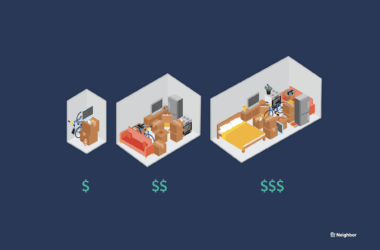
Units come in a handful of standard sizes, measured by width and depth in feet. Ceilings are usually around 8 feet high, which gives you more vertical room than you’d think.
Our size guide walks through it room by room, but here’s the quick version:
| Unit size | Roughly the size of | What it can hold |
| 5×5 | A walk-in closet | Boxes, seasonal items, a few small pieces |
| 5×10 | A small bedroom | A studio or dorm room’s worth of belongings |
| 10×10 | Half of a one-car garage | A one- or two-bedroom apartment |
| 10×15 | A bedroom | A two-bedroom home with appliances |
| 10×20 | A one-car garage | Up to five rooms’ worth of belongings or a vehicle |
💡 Tip: If you’re stuck between two sizes, plan how you’ll pack. Shelving units, stackable bins, and disassembled furniture can help you size down.
How Much Does Self Storage Cost?
A standard 10×10 unit costs around $120 a month, and this is the most popular pick. For climate-controlled storage, you’ll be paying closer to $137.
Those are national averages, and your real number depends on:
- Size: A bigger unit costs more, so right-sizing before you book is an easy way to save.
- Location: A 10×10 can cost $219 a month in L.A. and $80 a month in Houston. Prices are higher in dense areas, so driving a few extra minutes outside the city can cut your costs.
- Climate control: It adds protection from heat, cold, and humidity for a price.
- Access: Drive-up units are convenient for heavy loads, but they usually don’t have climate control, while indoor units may be less convenient but better protected.
- How you book: The online price often beats the walk-in price.
- Insurance: A basic policy from a facility will cost $8–$38 a month on top of rent.
These moving pieces get complex, which is one reason Neighbor exists. A single search lets you compare traditional units from national facilities with spare storage spaces that regular people are renting out near you, often for 50% less.
Does Homeowner’s or Renter’s Insurance Cover a Storage Unit?
Homeowner’s and renter’s insurance gives you some coverage for what you’re storing, but there’s a cap: you get less coverage than you do at home.
For homeowner’s policies, that cap is usually 10% of your personal property limit. So a $60,000 personal property limit might only extend $6,000 of coverage to a storage unit, no matter what’s inside. Renter’s policies work the same way, but the cap varies more by insurer.
Damage from a fire, theft, or vandalism, plus some weather events, is usually covered by your homeowner’s or renter’s plan. Damage from mold, pests, or flooding typically isn’t.
💡 Tip: For a breakdown of the cap and what’s covered, here’s our full guide. But it’s always a good idea to double-check the details with your insurer.
Climate-Controlled vs. Standard Storage
Climate-controlled units hold a steady temperature, usually 55–85°F, and regulate humidity to prevent mold and moisture damage.
Wood furniture can warp and crack when humidity fluctuates. Other household items, like electronics, photos, and artwork, can get damaged or moldy, too.
If this sounds like what you’re storing, climate control makes sense. Depending on your unit’s size and location, it might cost an extra 20%–50% a month.
If you’re just storing seasonal or holiday gear, you may not need it. Patio furniture, tools, and camping or sports equipment can all survive a hot summer or cold winter just fine.
What You Can’t Store in a Unit
A storage unit holds almost anything you’d keep at home, with some exceptions:
- Hazardous and flammable materials, like gasoline, propane, and paint, can’t go in. One leak or spark can destroy the whole building.
- Perishable food can spoil, rot, and invite rodent and bug infestations.
- Living things like plants don’t belong in a unit either.
- Anything with a strong smell should stay out, since odors drift through shared walls and vents.
Find Self Storage Without the Guesswork
Now you know what self storage is, you’ll want the best spot near you, and that’s what Neighbor makes easy.
One search shows you traditional storage units and neighborhood spaces like garages and driveways side by side. Browse reviews, photos, and descriptions of each space, so you can pick what’s closest, cheapest, and sized right for your stuff.
You can get up to $25,000 in renter property protection on any listing, and we’ve got a 4.9-star rating across 689,000+ reviews.
When you’re ready, compare listings online, or call us if you’d rather talk it through.
Frequently Asked Questions
What does self storage mean?
Self storage means you rent your own lockable space, usually by the month, and handle every bit of the packing and hauling yourself.
Is self storage the same as a storage unit?
No, but they’re close, and they’re often used interchangeably. “Self storage” describes what you’re doing, and a “storage unit” is what you’re renting.
How much does a self-storage unit cost?
A standard 10×10 self-storage unit costs around $120 a month, or about $137 for climate control. These are national averages, though, and location makes a huge difference. Units in college towns, big cities, and near military bases cost more.
How long can you rent a self-storage unit?
You can rent a self-storage unit for as long as you pay for it and your contract stays valid. Most rentals are month-to-month, so you usually need to give about 30 days’ notice. You’ll pay for the full month, regardless of when you move out, so it helps to time your move around your billing cycle.
Can you live in a self-storage unit?
No, you can’t live in a self-storage unit. It violates the rental terms of every big facility, and it also breaks the law, because units aren’t built or zoned as homes.